In 1946, frustrated by the racism she experienced as she sought to become a teacher, artist Ruth Asawa enrolled at Black Mountain College, a cauldron of creativity that attracted some of the most prestigious teachers and precocious students in the 1930s and ’40s. Asawa was born to Japanese immigrant parents and after Japan attacked Pearl Harbor, she was incarcerated along with her family at a prison camp in Arkansas. Even after the war, anti-Japanese sentiment precluded placement as a teacher, so she began her career as an artist, studying with the theorist and painter Josef Albers, architect and futurist R. Buckminster Fuller, and choreographer Merce Cunningham.
A few traces of her time with Cunningham, pioneer of a meticulously abstracted form of dance, remain in the first room of the exhilarating “Ruth Asawa: A Retrospective” at the Museum of Modern Art. Three brightly colored works on paper are subtitled “dancers,” and they explore the same form: a rounded figure eight, with its “arms” raised in a loop above what seems to be its torso. As curator Cara Manes explains in her cogent catalogue essay, these are related to the first work Asawa showed to a wide audience, “Figures on Green,” in which the curious figure eight form is more clearly rendered as a dancing figure, in one case leaping off the floor with legs bent in a classic ballet position.
These dancing glyphs, which evolved into a signature “form within a form” motif, may have inspired Asawa’s lifelong interest in the play between positive and negative space, inner and outer forms, the ability — as she later described it — for sculpture to capture air within its space. Cunningham’s choreography, and the rigorous technique on which it was based, broke with the usual verities of ballet: the rigid symmetry, the centrality of a leading dancer or couple, the sense that bodies had a front and back and were best seen from one, privileged vantage point. But his deeper influence on Asawa was probably at the level of technique, and the idea of service: Cunningham based his choreography on a rigorous, specialized training, and while he used chance procedures to order his dances and sometimes their movements, dancers served his vision.
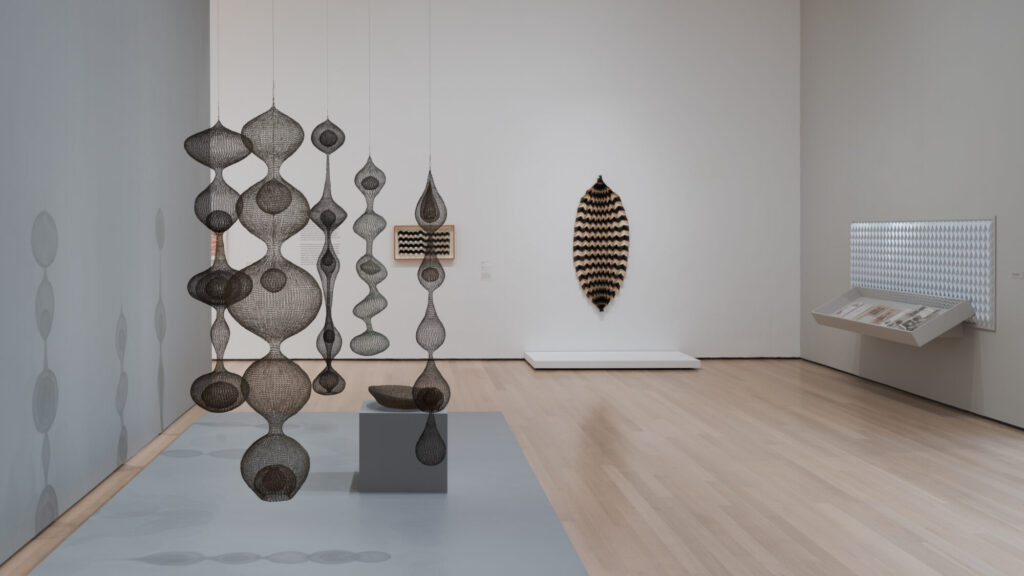
With dance in the back of one’s mind, Asawa’s brilliance is even more sharply etched at key moments of the exhibition. Among them are two breathtaking groupings of the hanging wire forms for which she is most famous: one with shadows cast from a skylight above; another more theatrical, with artificial lighting highlighting the play of transparency and shadows in her interwoven forms. When seen in groups, the works become anthropomorphic, beings in space, simultaneously connected and alien to one another, like the dancers seen in photographs of work made by Cunningham.
The retrospective frames Asawa’s career with an elliptical quotation, which expresses an ethical sense deeper than the mere politics that frame so many other contemporary exhibitions today, including the circumscribed view of the Cuban-born artist Wifredo Lam on view in another gallery. “How one sees, one does,” written the same year Asawa was denied a teaching position because of her heritage. “How one does, one is.”
This is as multifaceted as her work. It could operate at the level of making: What you can see, you can make, and what you make defines you as an artist. But it also operates at a spiritual and philosophical level: How we see the world — our blinkers and blindness, presuppositions and prejudice — determines how we will act, and those actions (no matter what we may intend or hope to do) determine our character and soul.
Throughout Asawa’s life, she saw the world in terms of opportunity, the ability to explore, make, teach, connect. Years later, she remembered learning from other imprisoned Japanese Americans, including artists who once had jobs at the Disney factory, and was thankful for the accidental encounter. She was denied a teaching position and yet remembered it as a turning point that steered her toward art and away from ordinary employment. Later, as a successful artist with a large family in San Francisco, she did teach, creating a vibrant school program to connect working artists with students in the city’s public education system.
That was one form of service. Another form of service, perhaps more fundamental to the work she left behind, was service to the line. A 2023 exhibition at the Whitney Museum of American Art, “Ruth Asawa: Through Line,” explored her work on paper, which in some ways is more perfect than her sculpture but absolutely continuous with it. At Black Mountain College, she played with the line, including meander figures, an ornamental pattern that follows a strict numerical sequence that can be repeated ad infinitum. In her sculpture, the sequence of the line, now expressed as wire, yielded forms in which the outside surfaces turned inward, and then looped back again, often several times, but potentially without limits.
But there’s a difference between being fascinated by how lines work and serving the line. The latter suggests that the line has some kind of spirit — its own agency — that it goes where it wants to go. Asawa, describing her process when working with wires, said: “You don’t think ahead of time ‘this is what I want,’” which is to say, she deferred to the material and the form it naturally wanted to take. “It’s like a drawing in space.” For Asawa, line was sufficient. When she drew flowers or human forms, she focused almost exclusively on contour and edges, not shadows or shading (that work was done by the sculptures, which made shadows rather than imitated them).
MoMA’s retrospective (first seen in different form at the San Francisco Museum of Modern Art earlier this year) is generous with both drawings and sculpture, as well as the documentation of Asawa’s career as a teacher and activist. But it touches only briefly on a revelatory episode from 1968, in which she was attacked for a figurative sculpture she contributed to a public park in San Francisco. “Andrea” was a bronze rendering of two mermaids, based on a body cast she made of a neighbor who had recently given birth. Using inspiration from her wire forms to suggest the scales of the mermaids’ tails, she created distinctly maternal figures, including one nursing a baby. This was inserted into Ghirardelli Square, a mix of older buildings and modernist landscape designed by Lawrence Halprin, who was vituperative and condescending in his dismissal of Asawa’s work as trivial, feel-good figuration. Halprin wanted the sculpture removed and replaced with something purely abstract.
Asawa was measured but firm in her response, describing the realism of the sculpture as a necessary response to a public space, where she meant to appeal to children and passersby who would want diversion and engagement, not visual austerity. Halprin shamed himself in the episode, and he lost both battle and war. Today the statue is seen as an important moment in the emergence of women artists working in public spaces, and a decidedly female take on the body, sexuality and family.
This showdown, too, was a moment that expressed Asawa’s sense of service and her willingness to favor an audience’s needs over her own idiosyncratic service to the line. The conflict might have had a larger effect, perhaps a transformative influence, on subsequent debates about public space and art, which have rarely been productive or happy. Asawa saw the episode not as a conflict between artistic styles — between Halprin’s modernism and her supposedly trivial figurative sculptures — but rather as an opportunity for speaking to a new audience in a language meant to serve them. The stakes weren’t ideological, they were civic and cultural.
But this all happened in 1968 when other things were making news, and it happened on the West Coast, a long way from New York and MoMA, which waited about 75 years to mount a serious retrospective worthy of Asawa’s work. When the San Francisco Chronicle introduced her as one of the protagonists in the drama, it was thus: “Ruth Asawa, wife of architect Albert Lanier, is the mother of six children …” Which says a lot about what Asawa and other women artists had to struggle with at the time.
Now, she is unquestionably one of the greatest artists of the last century, and one of the most beloved, and the distinction between abstract and figurative work no longer animates any rancor. She embodies almost any operative definition of “artist” and any prescription for what artists should do — make, teach, serve, challenge, provoke, destabilize — that is operative and fashionable today.
And yet, none of those definitions covers the entirety of her work or her life. Artists who may have hit a brick wall, who need inspiration, who need reassurance that what they do matters, should visit this show. And anyone else, too, who is stuck and — like a line — needs a way forward.
Ruth Asawa: A Retrospective at the Museum of Modern Art, New York, through Feb. 7. www.moma.org.
The post MoMA honors one of this country’s greatest artists: Ruth Asawa appeared first on Washington Post.