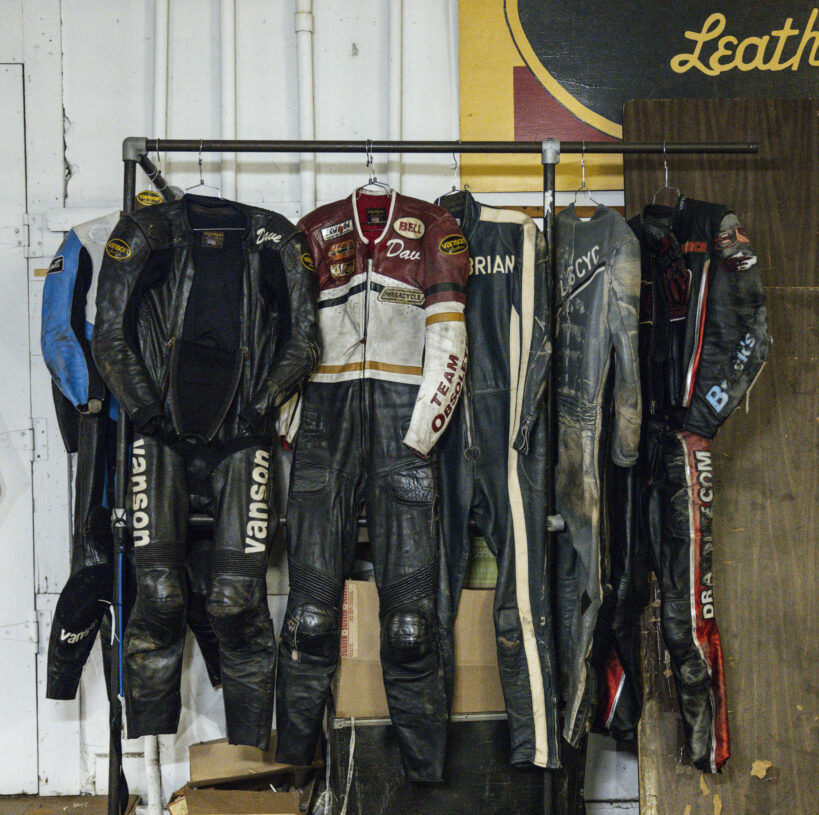
In a cavernous 19th-century textile mill building in Fall River, Massachusetts, expert artisans stitch together thick leather motorcycle jackets worn by celebrities and racing stars. Across town in a bright factory, highly skilled needleworkers oversee the application of a gold threaded crest onto a 600-count Egyptian cotton sham for a social club in India.
Down the road, in another gleaming modern factory, a 30-year textile veteran monitors one of his company’s four high-tech German looms as it weaves a 40-foot alpaca, silk and merino rug bound for a Manhattan townhouse. Occasionally, he pauses the loom to hand-insert contrasting weft yarns — a key design feature created by the firm’s French artist-in-residence, Sylvie Johnson.
Fall River, once called “Spindle City” after the number of spools that fed its thousands of textile looms, is undergoing a manufacturing renaissance that leverages its industrial heritage. But as community leaders and entrepreneurs collaborate to rebuild their manufacturing base, they face challenges that illuminate both the promise and the peril in the effort to re-shore America’s lost industries.
Over the 20th and 21st century, American manufacturing has been in a long, steady decline after the United States lowered barriers to offshoring in Mexico, Canada, and Central American in the 1990s, and later China. While Fall River’s population peaked in 1920 at about 120,000 people, the city’s fate mirrored that of the rest of the U.S.’s factory towns. By 2017, the city lost three major textile employers — Duro Industries, Globe Manufacturing, and most importantly, Quaker Fabrics, once the city’s biggest employer with some 2,400 people on its payroll and one of the world’s largest producers of jacquard upholstery fabric. The company moved operations to Asia in 2006.
Fall River became a cautionary tale: a onetime textile hub gutted by globalization, its mills shuttered and its workers displaced. By 2023, about 20 percent of Fall River’s 93,000 residents were living below the poverty level, twice the number than in 1990. But behind the mills’ imposing brick and limestone facades, a revival is underway. Companies here aren’t trying to compete with Asia on cost; they’re justifying their higher price-point by achieving the kind of quality you only get with a skilled workforce. The gamble is if the world still wants — and will pay for — the best from the United States.
The quality craftsmanship and high-tech production represent a strategic positioning against global competition, yet, until last year, one critical element was missing: how to recruit the next generation to keep looms, logistics and marketing humming. Employers here say their biggest challenge isn’t foreign competition but convincing young people that manufacturing is a career at all, let alone one worth showing up to every day. The future of Fall River, and perhaps of U.S. manufacturing itself, will hinge on whether craft can bridge that generational divide.
At Matouk, a third-generation luxury linen company, the design of linens and towels is deliberately craft-focused, enhanced by 21st-century cutting, stitching and dyeing machinery. “We’re really a great blend of artisans manufacturing products in a very traditional way because there’s really no other way to manufacture those products and make sure they meet our quality standards,” said Milton Goncalves, 54, Matouk’s chief operating officer.
They’re also bringing in technological advancements like Matouk’s two continuous quilting machines and multi-ply fabric cutters that slice through seven inches of fabric with remarkable precision. Goncalves walks over to one corner of the factory to point out their new TwineX4, a digital thread-dyer the size of a commercial refrigerator. The machine dyes thread to exacting color specifications without using water. Goncalves estimates that Matouk has saved 20,000 liters of water this year using the machine, the result of a years-long collaboration with Twine Solutions, Matouk and Wilson College of Textiles at North Carolina State University, partially funded by a state-level grant.
But despite the technological advancements, one of the biggest challenges facing Fall River’s comeback is finding workers to fill the factories.
Fall River native Patti Rego was an unlikely champion of the city’s manufacturing revival. Both of her parents worked in the mills — her father until retirement, her mother until the jobs disappeared. They clocked in from seven to three. “It was just a different way of life here,” Rego says. For her family, and for so many first-generation Portuguese immigrants, the mills had been both a livelihood and a limit. But factory work wasn’t a career to aspire to. A “good job,” her mother told her, was working in a bank.
Rego believed it. She left Fall River for New York, got a degree from FIT, then pursued a publishing career. But the mills never left her. As a teenager, she’d spent a summer pressing garments and digitizing patterns in her aunt’s factory, watching how Talbots dresses with lace and bibs came together piece by piece. “I got to see how things were made, and I learned an appreciation for the craft,” she recalls. That sense of pride in the work — the camaraderie on the floor, the artistry that hid behind the “sweatshop” label — stuck with her.
Two decades later, Rego, 47, reconnected with her hometown. While she marveled at the artisanal approach to manufacturing, she also began to see the cultural chasm between employers and the city’s youth, most of whom had never set foot in a mill or knew how many types of factory roles exist — including design and digitizing jobs. “There’s a million things you could do,” she said.
During the pandemic, Rego, who previously worked at Fall River’s tourism agency and now works in communications at a local community foundation, connected with Judi Vigna, 58, founder of Specialized Career Guidance, who suggested they collaborate on building a pipeline from the local high school to manufacturers. The idea was simple: Introduce students who didn’t have post-high school plans to the opportunities all around them.
Funded by state and federal grants, their pilot program onboarded six manufacturers who made motorcycle gear, bed sheets, linens and other textiles in 2024. From day one, 45 students selected for the pilot began touring factories in their city and seeing the range of jobs available. Jessica Stephens, principal of Durfee High School, said it has been powerful to show students “something that they didn’t know could be for them.”
After a month of skill development workshops, 26 participants applied for the nine 80-hour internships available. And this past summer, five recent Durfee High School grads who went through the internship program landed full-time jobs at the same factories, including in marketing and manufacturing.
The results extend beyond just job placement. “The program gave me the opportunity to be a part of something that I otherwise wouldn’t be able to while still in school,” said Hyde Farias, a student who joined Accurate Services, a family-owned apparel design and manufacturing company.
“By gaining exposure [to manufacturing], young people believe that they belong there, that they’re wanted there, that their skills and what they bring to the world is valuable,” Stephens explains. The educators see manufacturing as a hedge against technological displacement.
The city’s manufacturing innovation isn’t about robots or AI. It’s about young people discovering that manufacturing offers “viable positions in careers that have living wages, and they can stay right here in Fall River instead of leaving the area,” said Andrew Woodard, the Durfee pilot program director. Fall River’s story reflects a national conversation about manufacturing’s role in the U.S.’s economic future.
The post Is Gen Z the key to a manufacturing revival? Fall River thinks so. appeared first on Washington Post.