The United States routinely tops the list of foreign travelers’ dream destinations. They can’t seem to get enough of Manhattan’s skyscrapers, the mountains of Vermont, the hedonistic nightlife of Las Vegas, Hawaii’s pristine beaches and the dreamscapes of Disney parks.
But that’s changing.
Steep new fees, travel restrictions, visa hurdles, uncertainty at the border, and President Trump’s aggressive language toward Canada and other countries are all taking a toll.
Postpandemic travel growth has stalled and 4.5 million fewer international visits are expected this year compared with 2024, according to industry estimates.
Arrivals from nearly all regions of the world have dropped, according to the research firm Tourism Economics. Visitor arrivals from Germany fell nearly 12 percent through November, compared with last year. The number of visitors from France plunged by nearly 7 percent. Arrivals from South Korea were down almost 6 percent.
But the sharpest retreat came from Canada, the second-biggest source of foreign tourists in 2024, after Mexico. Arrivals fell nearly 26 percent through November compared with last year, when Mr. Trump first suggested making Canada the “51st state.”
“It’s a little bit of a lost year,” said Jan Freitag, the national director of hospitality market analytics at CoStar, a property research organization, who estimated that 11 million fewer hotel rooms had sold this year compared with last. “Every quarter we’ve revised our forecast down.”
International visitors reliably spend billions of dollars in the United States every year, with that cash, in turn, rippling out to restaurants, stores and other small businesses. Last year, tourism generated $2.9 trillion in economic output, supporting 15 million jobs, according to the U.S. Travel Association, a trade group that promotes travel to and within the country.
The loss of those foreign dollars has alarmed many in the travel and tourism industry. Though domestic tourism has surpassed prepandemic volume and spending numbers, making up for some of the shortfall, experts emphasize that it is far from enough. They stress that losing the confidence of international travelers has clear economic costs and threatens the country’s longstanding dominance of the $10.9 trillion global tourism industry. Many are casting a wary eye toward next summer’s World Cup, a mega-event hosted by the United States, Canada and Mexico.
“The U.S. remains immensely attractive as a destination,” said Adam Sacks, president of Tourism Economics, but “alternate destinations can be chosen.”
‘That’s Not Going to Pay the Rent’
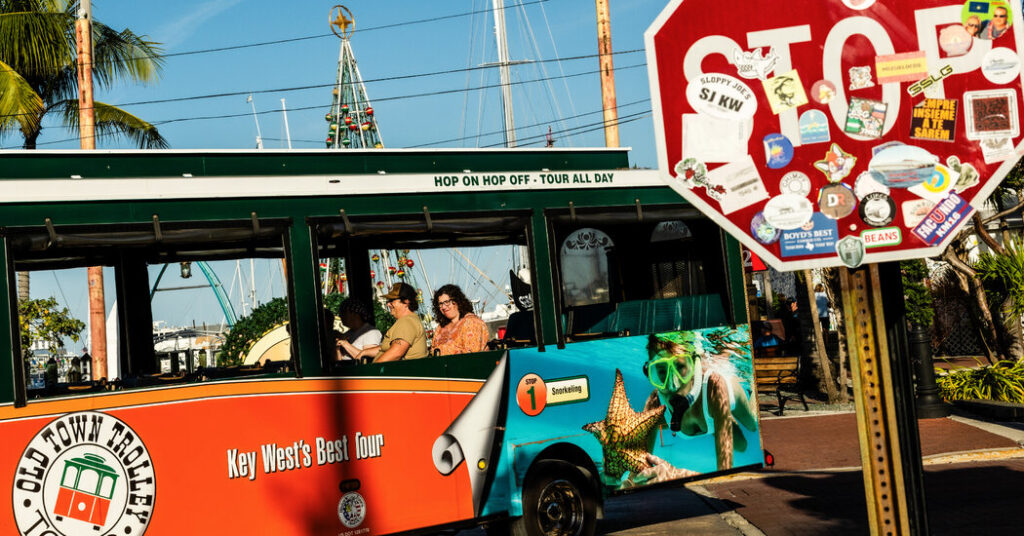
For 30 years, Lloyd Mager, 72, has delighted in leading bike tours of Key West, Fla., sharing the city’s tropical charm with a steady stream of tourists, especially those fleeing the winter chill in places like Canada. He said bookings are down more than 25 percent so far this year, leaving him anxious about peak season, Christmas through Easter.
“May was terrible. June was terrible. July was terrible. August was terrible, September and October and November,” Mr. Mager, said, adding, “That’s not going to pay the rent.”
This was supposed to be the year that the international tourism market recovered to prepandemic levels. Instead, for the first time since 2020, the number of international visitors is projected to fall, according to the U.S. Travel Association, which has pushed back the expected recovery to 2029.
Owners of businesses across the country, from souvenir shops along Hollywood Boulevard in Los Angeles to sightseeing tour companies in Las Vegas, say they are cutting back on tours and nervously eyeing their sales numbers.
“It’s been so bad,” said Adesh Barua, 38, who owns a souvenir shop in Hollywood. “Every month my business is like 30 to 40 percent down,” he added. “There’s no people here.”
International tourists, on average, stay longer and spend more than domestic travelers do, making them highly sought-after. Last year, international visitors spent nearly $179 billion on travel in the United States, a number expected to fall by $6 billion in 2025, Tourism Economics data shows.
Industry experts and owners of tourism-focused businesses cite negative sentiment about the United States, economic uncertainties, long visa wait times and a less welcoming U.S. stance as the primary factors driving visitors away.
“The reality is that it’s a very competitive world right now,” said Gloria Guevara, the W.T.T.C’s interim chief executive and president, and there are many destinations that are “actually offering incentives for people to travel there.”
In recent months, the U.S. government has proposed and enacted a series of policy changes that affect tourists. This month, the government announced a plan to scrutinize the social media of many foreign tourists and to collect information about their family members.
The Trump administration also expanded a travel ban; more than 35 countries are now under travel restrictions. This is in addition to pending plans to collect a new $250 visa fee from many visitors and to charge foreign visitors an additional $100 to enter major national parks as of Jan. 1.
Last summer, Congress cut the federal funding of Brand USA, a marketing organization promoting international tourism to the United States, by 80 percent. Legislation to restore funding has recently been introduced.
These actions have opened a rift between the government and the travel industry. Over the past year, tourism organizations like the U.S. Travel Association have consistently reiterated the importance of foreign tourism and the billions that visitors spend in the country.
Geoff Freeman, the association’s president and chief executive, said that for international tourism, 2025 was among the “most disappointing years that we’ve confronted.” He noted that the United States, the world’s most powerful travel economy, typically enticing tens of millions of international travelers each year, will be the only major nation to experience a downturn in spending this year.
The United States has performed the worst among the top 10 destinations in terms of growth in visits and spending this year over last, according to Tourism Economics. At the same time, countries like Britain, Japan and Greece have posted double-digit percentage gains. By 2031, China is expected to overtake the United States as the world’s largest travel and tourism market, with the industry projected to contribute $3.8 trillion to its gross domestic product, according to the W.T.T.C.
“Why would we do anything that would discourage travel when what we want international travelers to do is spend?” Mr. Freeman said, adding, “We can’t be vocal enough that we want your business.”
Anna Kelly, the White House deputy press secretary, said in a statement that President Trump has “done more for American tourism than anyone,” including “making our cities safe and beautiful again for all to enjoy.”
Holiday Spirit, Sales and Snow
The scale and nature of the downturn depend on the destination. New York City expects just over 12 million foreign tourists this year, 5 percent fewer than last year. California tourism officials have seen visits from Mexico rise nearly 6 percent, but anticipate that visits from overseas, excluding Canada, will fall more than 3 percent this year. In the first six months of the year, Florida reported 5 percent more tourists from overseas, but an 18 percent decline in Canadian visitors.
Karen Toon, 50, traveled from Birmingham, England, to fulfill her dream of visiting New York during the holiday season. Despite the high prices of airfare and hotels, she said she impulsively booked her weeklong visit a month beforehand, and didn’t regret it.
“It’s a magical thing,” she said, adding that she wasn’t deterred by political sentiment. “The lights, the trees, the decorations, everything.”
Businesses in states that typically welcome Canadian travelers have tried to lure them back with special room discounts and deals on shopping and dining, but Canadian travel to the United States has still declined every month since President Trump’s second term began.
“I feel like stopping travel to the U.S. is like I’ve stopped seeing a good friend,” said Corinne Roth, 70, of Vancouver, British Columbia. She doesn’t envision returning for several years.
Extremely low bookings by Canadians early this year worried the owners of Jay Peak, a Vermont ski resort about two hours by car from Montreal, said Steve Wright, the resort’s president and general manager. But a few solid winter storms have reversed the trend, and Canadian bookings were now on track with last year.
“They put snow in front of their feelings about the U.S. government, and it shocked us, frankly,” Mr. Wright said.
In Las Vegas, the total number of visitors, both international and domestic, fell more than 7 percent through October. Ivan Phillips, 48, who owns a bus tour company there, said he noticed more shows offering discounts, and lighter crowds on the Strip.
The perception from foreign visitors, valid or not, he said, was that “it’s hard to get to America, that you’re lucky to get in, that you’re taking a risk.”
High Hopes for 2026
American are taking more trips, and their dollars are filling some of the gaps left by fading international tourism. The industry expects 2.4 billion domestic trips this year, a nearly 2 percent increase over last year.
But American travelers are also spending more outside the country than international tourists are spending in the United States. That number, called the travel trade deficit, is expected to reach an estimated $70 billion this year, according to U.S. Travel. In contrast, in 2019, that figure was a surplus of $51 billion.
Two blockbuster events next year, the FIFA World Cup and the 250th anniversary of American independence, could turn the tide. The tourism industry forecasts that about a million foreign visitors could travel to the United States for the World Cup alone.
“As an industry, as a country, we’re putting a lot of our eggs in the World Cup basket and in the America’s 250th basket,” Mr. Freeman of U.S. Travel said, though the 250th may be a tough sell for international visitors.
The travel industry is cautiously optimistic about the coming year, with international visits estimated to rise more than 3 percent, to 70.4 million trips, according to Tourism Economics. World Cup matches are expected to create nearly $900 million in additional room revenue for host cities, or “the equivalent of 10 Super Bowls in six weeks,” the research firm said.
Kansas City, Mo., another World Cup host city, doesn’t generally draw a large number of international tourists. Last year, the entire state of Missouri drew fewer than 500,000 foreign visitors, according to state data.
But the World Cup could bring a “huge” $654 million boon to Missouri in just 26 days, said Jim Rowland, Visit Missouri’s sports tourism expert. The city will host soccer powerhouses Argentina and the Netherlands as well as a July 11 quarterfinal match. Mr. Rowland expects tickets and hotel rooms to sell out.
But in non-World Cup cities, the future doesn’t look so rosy.
“International guests are booking six to nine months out. So all the people that came this summer were the ones that booked last year,” said Mr. Phillips, the bus tour operator in Las Vegas. “Now, with everything that’s been happening in the news, maybe they’ll figure, ‘We’ll go somewhere else.’”
Follow New York Times Travel on Instagram and sign up for our Travel Dispatch newsletter to get expert tips on traveling smarter and inspiration for your next vacation. Dreaming up a future getaway or just armchair traveling? Check out our 52 Places to Go in 2025.
Christine Chung is a Times reporter covering airlines and consumer travel.
The post How Much More Can the U.S. Travel Industry Take? appeared first on New York Times.