There’s nothing like the feeling of a brand-new planner. As the new school year kicks off, we’ve found the best planners to deliver that satisfying rush of a fresh start and a blank page. The sensation of writing things down not only feels satisfying but helps improve retention, and paper planners give a sense of delight in a world that can feel bleak.
A great planner will help you keep your life on track, but that means something different for everyone—do you need room for multiple to-do lists? Places to track all your calls and meetings that week? Open space for whatever strikes your fancy? From daily and weekly planners to planners designed for a specific type of person, here are all of our favorite planners that we’ve tried and tested. My number one recommendation after over a year of planner testing is the Roterunner Purpose Planner ($30), an undated weekly planner with lots of premade list space and two blank pages for notes for each week. If you’re more of a daily person, the Hobonichi Techo ($41) or Techo Cousin ($65) is my go-to. I’m also a big fan of the Kokuyo Jibun Techo First Kit ($45) and Plum Paper’s A5 Vertical Priorities Planner ($48).
Once you find your perfect planner, don’t forget to check out other great gear from stories in our Home Office directory, from the best digital notebooks and computer monitors to everything you need for your work-from-home setup.
Updated December 2025: The Roterunner Purpose Planner is now our top pick in this guide, followed by the Hobonichi Techo and Jibun Techo. We’ve updated this guide with prices and links for 2026 planners.
Our Favorite Paper Planners
Table of ContentsLargeChevron
- Best Weekly Planner
- Best Daily Planner
- Another Great Weekly Planner
- Another Great Daily Planner
- Best Customizable Planner
- Best Monthly Planner
- Best Affordable Planner
- Great for Students
- More Planners We Tested
- Planner Alternatives
- Planner Accessories
Our Favorite Planners
From weekly and daily planners to planners for specific use cases (and even a completely custom planner!), here are all the top planners we recommend buying.
Best Weekly Planner
This was my standout planner of 2025, and it’s one I’ll be grabbing again in 2026. I love having space for lists and thoughts, and it takes a lot of room to corral my ideas, so I usually need both a planner and a journal. But not anymore, thanks to the Purpose Planner. It’s the only planner that actually becomes the one-stop shop for every list, idea, plan, and goal I have without requiring extra steps or lots of flipping between sections of the planner to get to it.
The Purpose Planner’s weekly spread includes six to-do list areas, already labeled with things like work, home, projects, and even stuff to buy, plus smaller checklists for each day and plenty of space to write in my schedule. Not only that, but there are two full dotted pages after each weekly spread for me to doodle, brainstorm, and write more lists all over for that specific week.
The monthly spread has six lists, plus six sections to reflect on when the month ends. It’s a six-month, undated planner, so you can pick it up any time of the year and start using it, and you can skip a month without feeling guilty since you won’t have a month of pages left blank. You do need to sit down and write in things like the months and dates, but I found that fun and satisfying to do. There are also some fun pages in the front to reflect and plan for your roles in life, goals you want to achieve, and books you want to read. I love the massive B5 size since it’s finally enough space for me (almost too much, which feels like a miracle), but there’s also a smaller (and cheaper!) A5 ($25) size.
Best Daily Planner
If you’re getting into planners, there’s no way you won’t hear about Hobonichi at some point. There are a few different planners the brand makes, and while the Techo is the most popular model, I tested the similar Hobonichi Cousin that adds weekly spreads to the front of the planner after the monthly overviews. While I wouldn’t describe myself as much of a daily planner person, I really liked using the Hobonichi Cousin. All of Hobonichi’s planners use Tomoe River S paper, which is super thin but won’t bleed through the other side. It’s also super smooth to the touch and to write on. I liked using the Cousin’s weekly spread section to plan my week, and then the daily pages, I sketched a box to separate my to-do lists and habit trackers from my hourly agenda for the day. The Cousin is an A5 size, while the standard Techo is the smaller A6. I found the larger A5 to be plenty of space for my daily lists and schedule, and it gave me a little extra room for other notes or thoughts I had that day.
There are tons of colors, covers, and other accessories you can get for it, too. I recommend picking out a cover since I did ding up my soft cover quite a bit, and that was just from being used around the house with an occasional trip in a bag. (The Techo also has a nice faux leather cover option if that’s more your style than a separate cover.) There are little quotes in the corners, but I got a Japanese version instead of an English one, so I can’t actually read mine. But honestly, I’m glad I did; I prefer the Japanese lettering to distracting words on the corners of each page.
Another Great Weekly Planner
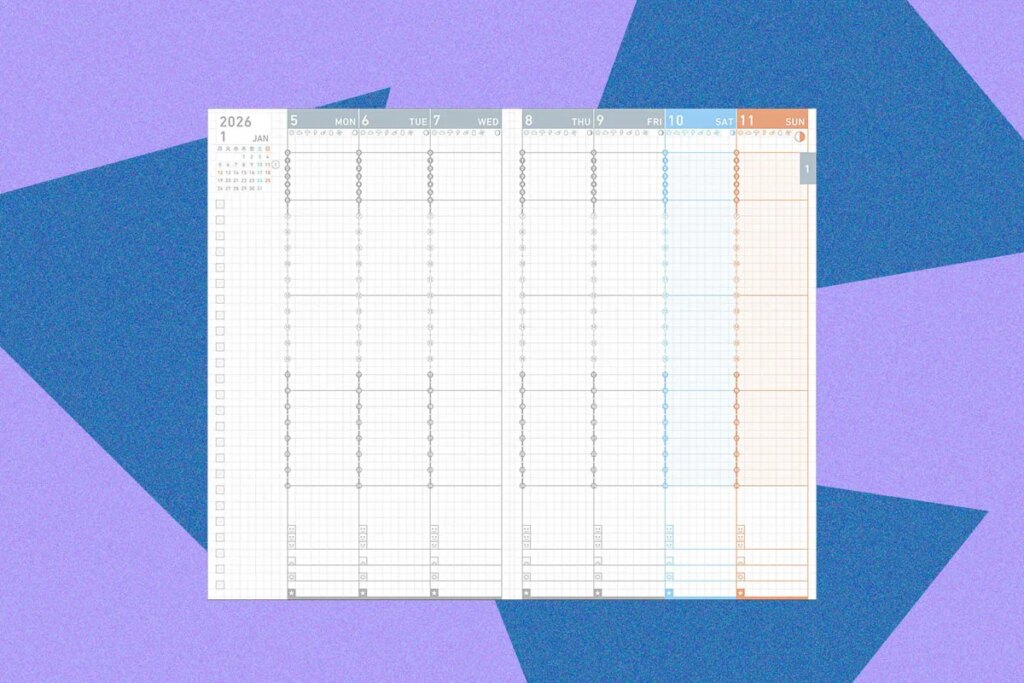
The Kokuyo Jibun Techo is another Japanese planner (as revealed by the Japanese word “techo” for notebook or planner), but this one is a weekly style planner. It’s also more customizable with a cover and multiple books that fit into it. I’ve started using the Jibun Techo First Kit, which comes with three books that fit into the included cover: the Diary (labeled simply with the year 2026), Life, and Idea books. The Diary is in the center and is the true planner, with monthly spreads and weekly spreads for the whole year, plus other fun pages like a book list, movie list, project tracker (which I’ve turned into a habit tracker), money plan, and more.
The Life is in the front, and is full of pages with specific prompts like the 100 Wishes List and places to track specific information, like the passwords page. Finally, the Ideas booklet in the back is simply full of grid paper so you can write out ideas, lists, and doodles to your heart’s content. All three books are laid out in an interlaced style to stay put inside the cover, but you could easily switch one out if you needed without needing to replace all three. The Ideas notebook ($8) is the only one available on Amazon, and the one I’m most likely to need to replace before 2026 ends.
Similar to the Hobonichi above, the Jibun Techo uses super thin, super soft paper that makes it possible to include all of these pages and books without making it a super-thick planner. I tested the B5 Slim size, which is taller but skinnier than an A5, and I was surprised how happy I was with the space I had for my weekly plans and so much more with all the included pages. I also really like the Ideas book in the back for my never ending lists and notes, and that I could easily swap it out if I filled it before the year is up. It’s a bigger investment than the Roterunner and I don’t have everything on a single page on the Jibun, but I really love it and find myself reaching for it more and more.
Another Great Daily Planner
Daily planners give you an entire page for each day, and the Day Designer is great for anyone who wants space for both a full calendar and a nice long to-do list for each day. The schedule half of the page goes from 5 am to 9 pm, giving you plenty of room to schedule meetings, plan workouts, or block out client appointments. The other half has a long to-do list you can fill in, plus the top of the page has a space for the three most important things, any due dates, and dinner.
It’s a bit on the bulky side, since there’s a page for every single day of the year along with monthly spreads, but it’s not so big that you can’t bring it in a spacious backpack or tote bag. I also like that it’s not too tall, with a square A5 design, but still has plenty of room for a nice long to-do list. I wish it had room for more miscellaneous lists and notes, but if that’s not something you need, then you’ll be happy with this planner.
Best Customizable Planner
The Plum Paper A5 Planner has the perfect amount of customizability without feeling like I have to do too much work to create it, and has a lot of beautiful covers and color options to choose from. I personally love the Vertical Priorities layout, which I customized to include a priority section for my son, but you can choose from other layouts—there are 10 different types of layouts, going from vertical and horizontal to student and goal setting, then anywhere from two to four types of layouts within each type. You also choose from a huge variety of covers that you can customize with things like your name or the year, and choose from a huge range of add-ons like monthly workout summaries, baby tracking pages, and so much more.
The A5 size is easy to use and tote around wherever I want, and you can have the planner start on any month you wish—great for if you want an annual planner suddenly in March or July without needing to skip all those extra months. You’ll find a two-sided folder in the back, which I usually use for stickers and urgent paperwork I need to handle. Speaking of stickers, I love Plum Paper’s chic sticker sets ($5+) that range from matching their add-on pages to cute seasonal stickers, and that I can make my own custom stickers on Plum Paper’s website.
Best Monthly Planner
Not surprisingly, given the name, there’s nothing discreet about this planner. With its bright-blue cardstock cover and 11- by-14-inch profile too big to fit in any purse or small bag, this is for people who live—or plan to live—large. The companion to motivational speaker and entrepreneur Jesse Itzler’s Big A## Calendar (as seen in our Gift Ideas for People Who Work From Home), this spiral-bound “planner for highly visual people” depicts each month in its entirety across a two-page spread, with oversized 2.5-by 2.5-inch squares for each day. Motivational quotes top each page (sample: “To do exceptional things, put yourself in exceptional situations”), and the back of the planner contains a goal-tracker version of the Big A## Calendar—every day of the year at a glance.
There are five lined pages for notes, a running-pace chart should you find yourself overcome with a sudden burst of energy, and a Year in Review worksheet with boxes for keeping track of year highlights such as “favorite new music,” new things I tried,” and “career milestones.” If sudden inspiration strikes that needs to be shared, there’s a 300-square-inch dry-erase board in the back that can be propped up for impromptu meetings or demonstrations. I feel more energized just looking at it. I do wish the days of the week were on one page instead of across both, so I could keep it open folded in half on my desk (when opened, its footprint sprawls just under 2 feet wide—a significant amount of desk real estate), but as someone who takes copious handwritten notes, it’s a worthy trade-off for me for the sheer amount of daily writing space. —Kat Merck
Best Affordable Planner
There are a lot of quirky planners, but Ban.do is one of the most fun options that’s within just about everyone’s budget. From a page to track the books you read to an entire page dedicated to your astrological birth chart, it’s hard to resist the fun that Ban.do’s planners offer. The weekly layout has enough room for daily planning, and you’ll get fun extras like monthly meal planning and three pages of included stickers. There are also undated ($25) versions if you want full date flexibility.
There are lots of different cover options, and while these are available on Amazon, each cover tends to have its own separate listing, so it can take some time to comb through and find your options. It’s a little easier on Ban.do’s own site to shop all the designs. You can also get the 17-month planners on sale since the start date is in August 2025, but the planner goes through the end of 2026.
Great for Students
The Happy Planner has a huge range of planners, with tons of designs ranging from a vertical layout to a large dashboard to even a design made for work. There’s lots of space in these spacious planners, but the design seems like it would be perfect for students, whether they’re full-time or just taking classes in the evenings or after work. The divider pages are cute and sometimes include phrases and quotes, but definitely have a youthful feel to them.
You can choose between Classic, Skinny Classic, Mini, or Big sizes, and dated or undated pages. There are daily planners, ones tailored to teachers and students, among many others. The unique binding design makes it easy to take pages out or add them back in, and you can also get extension packs to add a few more months or to keep track of things like your budget and fitness goals.
More Planners We Tested
We’ve tried tons of different planners. Here are all of our thoughts on everything we’ve tested.
Agendio Planner starting at $47: If you can’t seem to find the right planner for you, it might be time to design your own. That sounds intimidating, but Agendio makes it pretty easy with its fully custom planners, allowing you to choose from premade pages or designing your own (with some limitations—it’s not as open-ended as a program like Canva) to create the perfect monthly, weekly, and daily spreads. You can also design your own additional pages, like workout trackers or reading lists, that you can either add for each month or to the end of the planner. The price can vary greatly depending on what you choose to add onto it.
At-a-Glance Refillable Planners: I tried one set from At-a-Glance that isn’t available any longer, and while it was a fine set that you can refill, I found the spaces too small on the pages and the shopping experience a little frustrating. There aren’t enough starter kit options, in my opinion, so it feels difficult to get into this system.
Be Rooted Academic Planner for $24: This is a weekly planner with about a paragraph of space for each day, with an entire week spanning two pages at a time. It includes some stickers in the front, plus some intention-setting sections for each month. What’s especially cool is that Be Rooted is a female-owned small business making paper planners and accessories (like these pen sets), plus other lifestyle goods like candles and wall calendars.
Blue Sky Weekly Planner starting at $10: Several members of our team like Blue Sky. Its affordable planners give you space to jot down tasks without cluttering up the page. They’re also a good size—much easier to tote around than some on this list. As with the Happy Planner, you can find different layouts, sizes, and formats to suit you, and there’s a collaboration with Day Designer, another favorite of ours. —Medea Giordano
Blue Sky Monthly Planner starting at $10: Blue Sky’s Monthly Planners have a different layout than the weekly, where each day of the month has a few lines for jotting down multiple bullet points, and there’s a notes section for anything that would require more writing room. The yearly overview lets you track from an eagle-eyed perspective. It’s the smallest monthly planner we’ve tried, with 10-by-8-inch pages, but incredibly affordable.
Erin Condren Coiled LifePlanner for $61: If Plum Planner’s designs aren’t quite for you but you want something similar, then explore the Erin Condren LifePlanner (ECLP for short). It’s one of the most popular for weekly-spread enthusiasts, with tons of layouts to choose from and room for notes or doodles. You can customize it similarly to the Plum Planner above, though it doesn’t have quite as many options for the pages you can add. There are cheaper options at retailers like Target, but you can’t customize these.
Laurel Denise Nancy Planner for $59: Previously called the Horizontal Week + Month, I’ve never seen a planner designed like the Nancy Planner. It’s wider than a traditional planner, and the left side is for laying out the month—it’s undated—while the right has a spot for the month’s to-dos and a dotted area for whatever else. In the middle are five half-pages for organizing each specific week. You turn the week page and still get to see everything else you already wrote for the month. It’s an interesting planner, but I struggled to use it with the small daily area.
Levenger Circa smartPlanner Weekly Agenda for $60: This is another solid weekly planner with little frills. If you just need lines and days, this is your match.
Moleskine Classic Weekly Planner for $20: This is another weekly planner. It’s easy to use and comes in multiple sizes: large ($19), XL ($31), and pocket ($12). The large size is 5 by 8 inches, similar to an A5 size, which I wouldn’t usually call large. I preferred the B5 style XL, since it gave me more room to write things down for each week, but it wasn’t a planner I found myself coming back to.
My PA Business Planner for $49: The PA stands for personal assistant, but this planner is more than that—it doubles as both a planner and a full-on business plan workbook, helping growing entrepreneurs organize and plan their business plans, ranging from product pitches to social media strategy. The beginning of the book is dedicated to organizing your business plan, and then there are weekly checklists and goal lists, plus space to track your water, exercise, and meditation. There’s also space at the end of the planner to brainstorm for the year ahead and some extra lined and graph pages for miscellaneous notes. It’s a hefty planner that works best for entrepreneurs with a product they’re selling, but the workbook pages and focused weekly spreads could help any kind of business owner. Plus, it comes in a handful of fun colors and looks nice enough to blend in on a bookshelf.
Papier Daily Productivity Planner for $35: Papier has incredible cover design options to match nearly any style or mood. For layouts, I like the undated Daily Productivity Planner best. Each week has a box per day, lines for notes, areas for three priorities, a long to-do list, and a habit tracker. Plus, there’s a meal planner and shopping list for every week. There are also a few pages dedicated to outlining each day’s schedule. I didn’t need these pages as much during my usual week, but people with rotating weekly schedules might appreciate it. Papier is also the only brand I found that lets you scroll through every single page before you buy. I’m so specific about what I like and need, this should be standard. —Medea Giordano
Papier Wellness Journal for $35: This is a great journal for building daily habits, and if you’re a fan of daily journaling à la The Five Minute Journal. It’s not technically a planner, but it is something you’d use daily and to plan out your day like a planner. The goal is to fill it out morning and night with your intentions for the day followed by the results, and it operates on the focus of six pillars: energy, mind, movement, nourishment, connection, and rest. It’s a lovely journal with a really nice way of looking at your day and how you spend your time, but I did find it easy to forget to do it both morning and day. It would be a great gift for someone you know wants more intentional goal-setting and reflection each day.
Passion Planner Weekly Planner for $55: This is a fantastic weekly planner for mapping out the hours of my day. It doesn’t have as much room for to-do lists, but you do have a section for each week for a single personal and work to-do list, which I use for my primary projects, and some doodle space. I really love Passion Planner’s accessories, and how nice the pages feel to write on.
Studio Tigress Seasonal Planner for $18 (Per Season): These Seasonal Planners from Portland, Oregon-based Studio Tigress aren’t your standard planner. These are large individual sheets covering an entire three-month season, allowing you to have it pinned on a wall or lying across your desk for easy access. The 10-by-16-inch sheets are certainly bigger than most planners and aren’t easy to travel with, but rather serve as a handy at-a-glance look for your key goals, to-do items, events, and deadlines that you write down. There’re five undated weeks for each month, so you’ll have to check your digital calendar to confirm which dates are where, but that also means there’s plenty of room for each month to write down what’s coming up and extra notes if you need. There are 25 spots on the to-do list, and I liked using it for my main seasonal goals (like apple picking in the fall, seeing the zoo holiday lights in the winter) and major to-do items (like getting my car emissions checked and purchasing train tickets). While it can’t replace a weekly or daily planner if you like daily to-do lists, I loved using these sheets to get a birds-eye view of the upcoming season.
Planner Alternatives
Not everyone needs or wants a rigid planner. If you just need daily to-do lists or are a fan of bullet journals, consider getting a great notebook instead.
A Classic Notebook
Former WIRED reviewer Jaina Grey opts for a plain lined notebook. After trying dozens, her favorite is the Midori MD Notebook with paper made from cotton pulp (just like money!). It comes in lined, unlined, or dot-grid. Grey says there’s just something meditative about turning over a blank page at the beginning of each week and carefully jotting down her schedule, plans, and workload. Midori’s notebooks are designed to fit inside notebook or journal covers (which you can find all over Etsy). The pages are a subtle off-white and have a weight and texture that draws you in. There are also other versions that are more planner-like, like the Midori MD Diary ($20), which has the same lined pages but has a monthly calendar at the front of the journal.
Add Some Index Cards
WIRED reviewer Scott Gilbertson says he doesn’t use a planner, but each day he writes down the handful of things he’s going to do on a single 3-by-5 index card. The index card with this to-do list lives in his pocket, along with a small notebook in which he jots down notes throughout the day—often the source of the following day’s to-do list. The notebook and index cards fit inside this very cool waxed canvas notebook cover. Gilbertson says he copied this system from one of the most successful people he has known, and after nearly 20 years, it’s still better for him than any other system he’s tried. It’s cheap, lightweight, and easy to manage. —Medea Giordano
Planner Accessories
Maybe all you need is paper and a good pen and you’re good to go. But we like to get creative. Stickers are a popular accessory, and they’re a delightful slippery slope. Once you make your first “spread” (a collection of themed stickers on a planner page, similar to a scrapbook), you will never go back. Etsy is the central hub of planner stickers. You can order printed stickers or buy digital files and print and cut them yourself. You can also opt for a full kit (an entire spread’s worth of stickers) or just the individual components you like the most.
Make sure your purchase will fit the layout of the planner you have. WIRED reviewer Louryn Strampe likes the shops SimplyWatercolorCo and CricketPaperCo, while my favorite stickers come from Plum Paper; I especially love the seasonal ones to decorate my monthly layouts. You can also get sticker books at craft stores, but the variety pack usually lands you with some stinkers, and the cost can add up.
More Accessories We Love
Washi Tape (various prices): This cheap accessory levels up your planner without much effort, and there are colors and prints available. You might find some at the dollar section of Target too (the arts and crafts playground).
Calendar tabs: Turn anything into a planner with some monthly tabs. We like the sets from Aiex Monthly ($6) and Passion Planner ($13). I’m especially impressed by the range of colors Passion Planner offers for its monthly tabs—there’s truly something for every kind of style.
Pens: Get creative with your pens and colors. Pens are personal, so you may want to go play with a few at a craft store that has a testing station. But some of our favorites are the Sakura Pigma Micron Fineliner ($12) and Paper Mate InkJoy Gel Pens ($13).
Markers: Fine-tip markers make great pen alternatives to add some pizzazz. We like the Tombow Fudenosuke Hard Tip Brush Pen ($4), Tombow TwinTone ($15), and iBayam Fineliner ($14).
Highlighters: I’m obsessed with Passion Planner’s array of highlighters. I have both the Essentials 12-Pack ($20) and the Vintage 12-Pack ($20) sets, and I use both often in every planner I test. The colors are gorgeous and fun to use, and I frequently use colors from both sets.
FAQs
Why Choose a Paper Planner?
LargeChevron
Studies show that it’s good for your brain to write things down. Sure, you could put your calendar in an online tool, but putting pen to paper activates more brain connectivity. We’re more likely to remember and learn things if we write them down by hand, so using a paper planner for your to-do list can make it easier to remember. Plus, it’s fun! You’re given a creative space to let out everything you need to remember, from appointments to the day’s tasks, and customize it in a way that best helps you stay organized.
What Style Paper Planner Is Best for You?
LargeChevron
Paper planners mainly come in two styles: weekly and daily. Daily planners have an entire page dedicated to each day, while weekly planners have an entire week spread across just two pages. These aren’t the only options (monthly is another popular one, for example, but not as popular as these two styles), but they’re the most common you’ll see. I like daily planners for folks who have a really busy schedule they want to plan out and long daily to-do lists. Weekly planners are great if you want to be able to write down a few things per day but don’t need an entire page.
What Sizes Do Planners Come In?
LargeChevron
Here are a couple common planner sizes. My favorite are the larger sizes since I like lots of room to doodle, but the smaller A5 is a popular choice for a book-sized planner that won’t take up too much space. Not all paper planners use the same sizing names—Moleskine, for example, calls its A5 size a large—so you’ll want to check measurements before you purchase.
- A5 (5.8 by 8.3 inches)
- Regular / Medium / B5 (7 by 9 inches)
- Large / Letter (8.5 by 11 inches)
- Personal / Pocket (3.5 by 5.5 inches)
Power up with unlimited access to WIRED. Get best-in-class reporting and exclusive subscriber content that’s too important to ignore. Subscribe Today.
The post 8 Best Planners of 2026: Roterunner, Hobonichi, Kokuyo appeared first on Wired.