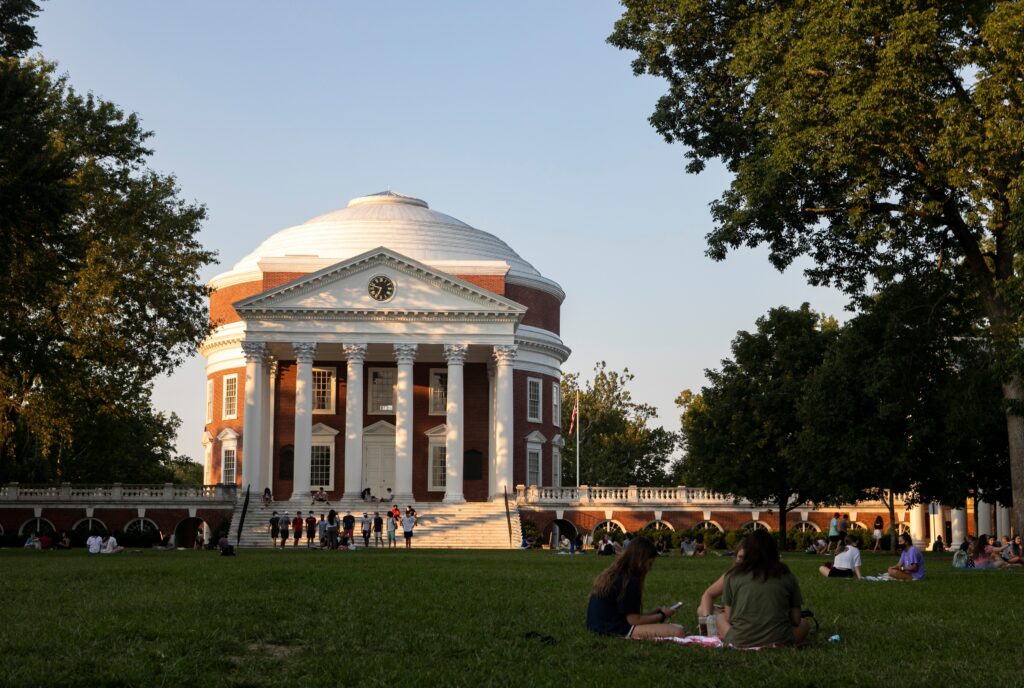
CHARLOTTESVILLE — The University of Virginia on Friday named its longtime business school dean as the flagship’s next president, sparking near-immediate condemnation from some faculty, alumni and state Democrats who wanted the board to wait until Gov.-elect Abigail Spanberger takes office next month.
The move caps a tumultuous year for U-Va., which saw former president James E. Ryan resign this summer amid pressure from the Trump administration over diversity, equity and inclusion policies, as well as protests and jockeying among state politicians over how the institution should move forward.
Scott C. Beardsley, dean of the Darden School of Business since 2015, was unanimously approved as U-Va.’s 10th president during a special meeting of the Board of Visitors, which is full of appointees of Republican Gov. Glenn Youngkin. His contract will begin Jan. 1 and is set to last five and a half years. Further details of the contract will be left to the board’s rector.
“It’s the honor of my professional life,” Beardsley told the board after the vote. “I aspire to no higher office.”
Wearing a blue and orange U-Va. tie, he hugged rector Rachel Sheridan to applause and a standing ovation from friends, family and board members in the room.
The Washington Post reported Thursday that Beardsley had emerged as the top candidate in a months-long process that included dozens of applicants but drew concerns from some faculty, students and others over the effectiveness of the school’s governing board. After winning in last month’s election, Spanberger (D) had asked the board to pause the search.
Ahead of the meeting, a few dozen protesters gathered outside and called for the board members to resign. They held signs reading “pause” and “no confidence, no new president.” The anger was largely aimed at what was seen as a rushed selection process, not at Beardsley as the board’s pick — though some criticized him for accepting the position when he did.
Virginia Senate President Pro Tem L. Louise Lucas (D-Portsmouth) warned Beardsley that the legislature controls much of the university’s funds.
“Buckle up,” she wroteon social media.
Ryan, who led U-Va. for nearly seven years (2018-25), drew the ire of the Trump administration and other conservatives who said he was slow to unwind DEI initiatives at the institution. During negotiations with the Justice Department over several probes, Ryan, board member Paul Manning and others have said the Justice Department made clear that the university would risk losing its federal funding if there wasn’t a change in leadership. Ryan said he stepped down to avoid a costly fight.
The presidential search committee was announced in July, held its first meeting in August and has said it received dozens of applications.
But last month, Spanberger, a U-Va. graduate, urged the board to pause its workuntil after she took office as governor and could appoint five new members. Virginia Senate Democrats have rejected several of Youngkin’s picks over the last year, and the board only has 12 of its 17 voting member seats filled.
The faculty senate and nine of U-Va.’s 14 deans echoed the call for a delay in recent weeks. “We believe the risks of a quick appointment far outweigh any benefits,” the deans wrote this month in a letter to the board.
Beardsley did not sign the letter.
The calls drew criticism, and Youngkin said the search should continue as planned. Members of the U-Va. board and search committee defended the process as thorough and praised the candidates as extraordinarily qualified.
Last week, the university announced three meetings: one of the search committee and two special meetings of the Board of Visitors for Friday and Jan. 6.
At its meeting, the search committee recommended as many as four finalists, said two people familiar with the matter. Interim president Paul Mahoney, a former law school dean who has been active in the Federalist Society, was a favorite of some conservatives to stay on as U-Va. president. But he was not one of the four, the people said.
Since becoming interim president, Mahoney struck a deal with the Trump administration in October to pause its investigations, an agreement that did not require the university to pay a fine or be under an external monitor but did require the school to submit quarterly reports to show it is in compliance with civil rights law. Some on campus objected to the deal, but others defended it, saying it was better than deals struck by other universities with the administration.
But Sheridan pushed back on an attempt to include Mahoney as a finalist for the permanent job, according to three people familiar with the matter. Several committee members said they would resign or go public with issues with the search if Mahoney was chosen, the people said. Sheridan declined to discuss the board deliberations before Friday’s vote.
David Leblang, a politics professor and member of the presidential search committee, praised the search process and quality of the candidates in an interview. But he said the decision not to wait until Spanberger takes office will cause turmoil to continue through the new year at the 40,000-student university.
“It’s an unforced error,” he said. “It strikes me as straight up vanity. If you detect anger in my voice, it’s because it’s there.”
Jeri K. Seidman, U-Va. faculty senate chair, said she felt the board put their political allegiances over the best interests of the university in making the decision Friday.
Students also weighed in. Before the vote, student council leaders warned that a rushed selection could be damaging for the university. “We fear that at its current pace, an appointment is motivated by partisan interests, and not those of the university and its student body.”
On Friday, Beardsley acknowledged the tensions on campus but said he is not politically driven. He added that he took the job now because that is when it was offered to him and said he looked forward to working with both Youngkin and Spanberger.
In a post on X, Youngkin congratulated Beardsley and thanked the board for conducting “a robust, world-class search process.” “I know Dean Beardsley only by his reputation, which is stellar,” Youngkin wrote.
A consultant turned dean
Beardsley, who lives on the lawn on the heart of the Charlottesville campus and named his golden retriever Lawnie, was reappointed to a third term as dean of the Darden school last year. During his tenure, the business school has expanded academic programs, grown its enrollment and received more than $610 million in gifts for the schools, the university said in a news release on his reappointment.
Beardsley also is serving as chair of a search for U-Va.’s next provost.
Speaking to reporters following the meeting, Beardsley said he learned he’d been nominated for the job in August or September. He interviewed in D.C. about a week ago, he said, then left for a family vacation to Costa Rica. He got the call from Sheridan that the job was his while he was playing tennis, and made plans to return home by Thursday.
He said his first priority would be to get input from students, faculty and staff, and acknowledged he had to work to rebuild trust.
“I don’t think I can stop all forms of division,” he said.
Beardsley thanked both of his predecessors for their service. He did not comment on the Trump administration investigations, though he praised Mahoney as a man of integrity.
Before joining U-Va., Beardsley spent more than two decades at the consulting firm McKinsey & Co., including serving as a senior partner.
The Jefferson Council, a group of conservative alumni, congratulated Beardsley in a statement saying that they hoped the transition could help the university return to “the core UVA principles that have been strained in recent years.”
“Given President Beardsley’s deep experience within UVA, we trust his understanding of this institution’s unique character will guide a renewed emphasis on creating a real level playing field for the free and civil exchange of ideas,” the council wrote in a statement.
But another coalition, Wahoos4UVA, criticized what it called a “rushed, opaque” process and questioned the legitimacy of the appointment and whether Beardsley was the only candidate who would accept the position in the current circumstances.
“He has regrettably eliminated the possibility of beginning a presidency with the trust and confidence of the UVA community that both a new president and the University deserve,” the group’s leaders said in a statement.
Karina Elwood in Washington contributed to this report.
The post U.-Va. names new president, sparking outcry from some who sought delay appeared first on Washington Post.