A nerdy economics essay recently went viral. It asserted that the federal measure for the poverty line was woefully outdated and that for a family of four, the income needed today to function in American society was $140,000.
The essay, by Michael Green, a financial market strategist, struck a nerve and set off another round of debate about affordability, focused this time on whether people with six-figure incomes should feel strapped.
Economists derided the essay. They pointed out that the typical middle-class family today is actually much richer than its counterpart in the 1960s, when the poverty measure came about. And, they added, most Americans eat out, have smartphones and take flights, unimaginable luxuries generations ago.
President Trump has tried to dismiss the issue of affordability, saying in a speech last week that it was “a hoax” and “you don’t need 37 dolls for your daughter.” On Wednesday, he returned to the topic, defending his record and asserting that gas and drug prices had come down.
But in interviews with Americans in their 20s and 30s, they said that the raw numbers did not come close to capturing the reality of their lives. They were all what economists regard as middle class, some making well over $63,360, the median for full-time, year-round workers.
They knew they were not poor. They could afford to buy eggs. But they are contending with an economy that has grown increasingly unequal in recent decades.
They described feeling that the basics of a middle-class life — owning a home, providing for the children, dining out occasionally — seemed unattainable or required unpalatable trade-offs. Is it worth sacrificing a yearly vacation to save for a down payment, when housing prices keep rising? What about buying a home that is 90 minutes from work — or a two-bedroom for a family of four? Are children even possible?
For many, the answer to these questions was a hard “no.” Whether realistic or foolhardy, their views seemed to reflect the quiet quitting of a long-held American expectation: that by working hard and acting responsibly, people can attain a life appreciably better than their parents’.
“Upward mobility is sort of dead,” said Gray Thurston, 27, an electrical engineer in Philadelphia, who earns about $90,000 a year. His parents are baby boomers. “My parents’ generation did great. Everybody I work with at that age has big retirement accounts, are taking vacations and own multiple houses. Good for them.”
But things are supposed to get better for each generation, he said. “And it feels fundamentally broken that they’re not.”
Expectations Versus Reality
Fundamentally, this is an argument about the dimensions of need. The poverty line is a measure of privation — do you have enough to eat?
But in his Substack essay, Mr. Green said $140,000 represented “the price of participation” — how much it costs to build a middle-class life in America today.
This price has been the subject of public debate for centuries. The 18th century economist Adam Smith drew the line at being able to appear in public without shame, said David Brady, who teaches public policy at the University of Southern California. In Smith’s Scotland, that meant being able to buy a linen shirt.
“We need water, food and shelter,” Dr. Brady said. “But beyond that? It is impossible to have a coherent definition of needs that does not reflect our culture, our values, our norms, our expectations, given the societies we live in.”
In other words, what is considered necessary is relative.
For Americans, the price of participation is often measured by the cost of a home. And even with two incomes, many people interviewed said homeownership felt ever more distant, particularly in urban areas where most Americans now live.
In 1991, the typical first-time home buyer was 28 years old. This year, that buyer was 40, according to the National Association of Realtors.
Eric Fuqua, 25, a structural engineer earning $86,000 a year, said he had known for a while that he could not afford a house in the Atlanta neighborhood where he grew up and where his parents still live. He had pinned his hopes on a small condo.
But rising prices and high mortgage rates mean settling for a place far from the city center, he said, adding as much as 90 minutes each way to his commute.
He does not want to live that way. So, he keeps renting and splurges a little, visiting friends in other cities.
“There’s a sense of futility at this point,” he said. “I’m not going to rough it for five years to save for a house I’ll never be able to afford. So why not live my life the way I want to?”
This financial pessimism is being felt en masse. In a study published last month, economists at the University of Chicago found that young adults with few prospects of buying a house are disproportionately more likely to spend on leisure or risky investments like cryptocurrency. Those who own a home, or have a better chance at homeownership, take fewer risks and strive harder at work.
Of the homeowners interviewed, nearly all got financial help. Jesse Iverson, 28, an energy researcher, and Macy Mack, a graphic designer, bought a house last fall in East Grand Forks, Minn. They relied on a loan backed by the Department of Veterans Affairs, which meant there was no down payment. (He enlisted to help pay for college.)
Geography mattered. Mr. Iverson said he was also offered a job in New York State, but with housing prices there significantly higher, he chose Minnesota.
“Is it theoretically possible?” he said of buying a home. “Yes, and I’m proof of that. But I don’t think the bar to entry should be joining the military, having to work full time during college, and getting a loan from the V.A.”
It’s not just housing. Adults under 35 are not accumulating wealth as fast as they once had, said Edward N. Wolff, an economics professor at New York University. That is a sharp contrast with baby boomers, who are gaining an ever larger share of the country’s wealth.
Keyana Fedrick, a full-time manager at a department store in northeastern Pennsylvania, said she and her friends feel stuck in jobs that do not pay enough to rent an apartment, never mind buy a house.
She lives with her parents and said she had paid off her student loans. But she still feels as if she is waiting for her life to begin.
“I’m 36, and I don’t have children yet,” she said. “I should have a flipping life by now. I should be traveling. I should have a luxurious closet. But instead all I have is a good credit score and a paid-off 2013 Nissan.”
Ms. Fedrick sees a stark contrast between her generation and that of her parents. Both worked hard, as a teacher and a bus driver, and retired with pensions.
“I don’t know if I’ll ever be able to retire,” she said, adding, “Boomers made out like bandits.”
But What About the Kids?
Since the beginning of time, economists point out, people on limited budgets have managed to successfully raise their children.
But many people interviewed were hesitant. They want to provide a better life for their kids — and for themselves.
Mr. Iverson, from Minnesota, said that he remembers his anxiety as a child when his family could not buy gas for the car.
Being poor “led to a whole bunch of fights and a whole lot of stress and some really nasty memories for me,” he said. “That’s affected me a lot in what to accept if I bring another person into this world.”
Mr. Thurston, from Philadelphia, said he wanted children. But right now, he and his partner must climb three floors to their rental apartment. Their car is a two-door “death trap.”
His salary, about $90,000, would need to cover student loans and child care. He also wants to live in a good school district and pay for extras, like music lessons and sports leagues.
“I know you don’t need those things,” he said, “but as a parent, my job is to set my child up for success.”
Even for those who own a home, the thought of children can be daunting. Stephen Vincent, 30, and his partner, Brittany Robenault, a lab technician, first went to community college to save money. Then, he said, they “ate beans and rice” for several years to save for a down payment.
Now an analyst for a chemical company with a household income of about $150,000, he likes his lifestyle in Hamburg, Pa., and wants to keep it.
“We live in the richest country in the history of human civilization, so why can’t I eat out twice a week and have kids?” he said.
To the skeptics who say these trade-offs are simply lifestyle choices, there was a rejoinder: Hey, you try it.
“It’s very easy from a place of wealth and privilege to say, ‘You should be happy with something more modest,’” Mr. Thurston said.
But, he said, “it would kind of suck to live that way.”
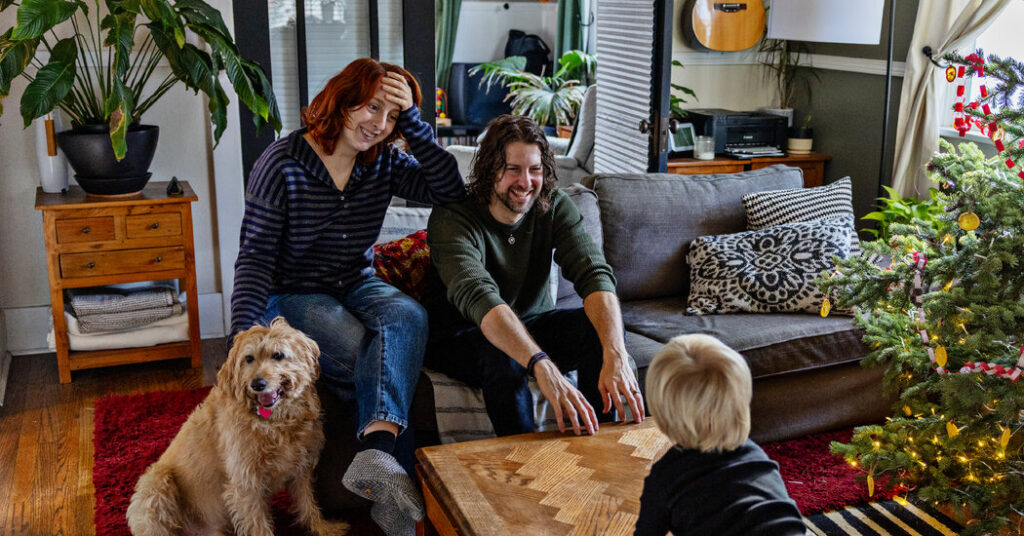
Alicia Wrigley is grappling with the trade-offs. Ms. Wrigley and her husband, Richard Gailey, both musicians and teachers, own a two-bedroom bungalow in Salt Lake City and feel lucky to have it — they say they could not afford it now. But juggling in-home music lessons with their 2-year-old’s needs can feel like a squeeze. They want another child, but wonder how it would all work.
“I know it’s possible,” she said, looking through the window at her next-door neighbor’s house, which is exactly the same size.
That neighbor raised six children there in the 1970s. One way mothers then would cope, Ms. Wrigley said, was to “turn their kids out all day, and they’d just run around the neighborhood.”
She said she would not do that today, not least because someone might report her.
“The world,” she said, “is fundamentally different now.”
Sabrina Tavernise is a writer-at-large for The Times, focused on political life in America and how Americans see the changes in Washington.
The post These Young Adults Make Good Money. But Life, They Say, Is Unaffordable. appeared first on New York Times.