Over her decade as a curator at the Frick Collection, Aimee Ng found herself drawn to a painting of an English aristocrat, Selina, Lady Skipwith. Sir Joshua Reynolds had depicted her in 1787 wearing a constricting white dress. Scholarship focused on the artist’s technique, in particular how the loose brushstrokes that captured the ribbons and feathers emanating from Skipwith’s hat were hallmarks of Reynolds’s “late” style.
What captured Ng’s attention, though, was Lady Skipwith’s forlorn expression. Was she as miserable as she appeared in the painting?
To find out, Ng traveled to Stratford-upon-Avon and Ireland, where she pored over Skipwith’s journals and letters. She discovered Skipwith had good reason to be unhappy. Her father had forbidden her from marrying her chosen suitor and insisted on his friend, who was nearly two decades her senior.
Scholars have not traditionally delved into the lives of the people featured in portraits — at least not when the people are women. “Often art historians are more attuned to how David”— Jacques-Louis David, the French neoclassical painter — “painted a chin rather than, ‘Who was this person?’” Ian Wardropper, the former director of the Frick, told me. “Aimee brought women into the story.”
That line of inquiry is all the more unusual for a museum that epitomizes the establishment. It is, after all, housed in the Fifth Avenue mansion built by Henry Clay Frick, the union-busting, coke-and-steel titan who founded the collection. Recently reopened after a $220 million renovation, it contains the work of only a handful of female artists.
But Ng’s ascent last month to the positions of deputy director and chief curator is an indication the museum is breaking into a new era. To be sure, she has a Ph.D. in art history and can expound with gusto on the correspondence between Frick and his dealer Joseph Duveen about British portraits. But she’s also known for getting creative about how to bring her scholarly interests to the public. During the pandemic, when museums were closed, Ng and her then-boss at the Frick, Xavier F. Salomon, hosted a YouTube video series, called “Cocktails With a Curator,” in which they talked about a piece of art in the collection and paired it with a bespoke drink. The series cumulatively reached more than two million viewers.
Many of the paintings Ng chose featured women; she also acknowledged individuals whose contributions to European art have largely gone unnoticed. Sometimes that has entailed delving into the legacy of slavery and colonialism: Ng pointed out how a beaver felt hat and pearls in Vermeer’s paintings arrived in the Netherlands through European economic exploitation of swaths of North America and South Asia. She has also brought contemporary artists into the mansion, including painters of color.
Ng traces her desire to acknowledge those who have been overlooked in part to her upbringing. Born in Manila to a Philippine-Chinese mother and Chinese father, she and her family moved to Canada when she was a baby. When she was 7, they moved to a suburb where she was a distinct minority. “Growing up on the fringe of things, I knew there were many more people than those who make it into the story,” she said.
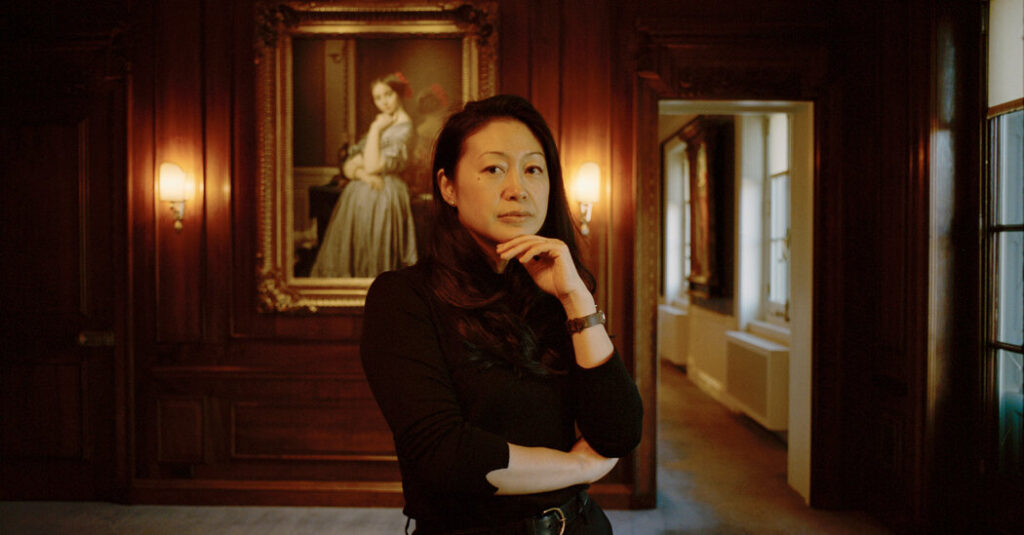
The curator describes New York as the place she feels most at home, and at 43 she looks the part of a downtown denizen. On an October morning, clad in black slacks and a silk shirt, her long hair in a ponytail, she led a tour of the museum’s galleries, gesturing as she detailed the interior lives of the women peering out from the Frick’s walls.
Few have as dramatic a trajectory as the woman featured in George Romney’s “Lady Hamilton as Nature.” Painted in 1782, it portrays the fresh-faced Emma Hart, daughter of a blacksmith who in her teens became pregnant by one British aristocrat and then the paramour of another. When the second aristocrat decided to marry a wealthy woman, he offloaded Emma to his uncle Lord Hamilton, a diplomat in Italy nearly 40 years her senior. Emma subsequently hooked up with a married friend of Hamilton’s, the naval hero Sir Horatio Nelson, and she bore him a daughter. After his death in the Battle of Trafalgar, Emma fled to France to evade creditors. She died at 49, destitute.
In her younger days, one of Emma’s aristocratic benefactors introduced her to Romney, who, besotted, made dozens of portraits of her in various states of undress. In the Frick painting Emma is clothed, but Ng pointed out clues indicating the 17-year-old was not a privileged member of society. Her breasts are obscured only by the cocker spaniel she holds in front of her, and her voluminous chestnut hair tumbles down her back. “No upstanding woman would have been shown with her hair loose like that,” Ng said. (The museum’s many paintings of aristocratic women sporting poofy gray wigs back her up.)
The portrait was a favorite of Henry Clay Frick, who hung it over the fireplace in his bedroom. Ng doubts Hamilton’s experience entered the robber baron’s mind. “If these stories figured into the public perception, it was on the scandalous aspect,” she said. “They didn’t think about the women.”
As she passed by Sir Thomas Lawrence’s portrait of Julia, Lady Peel, hanging in the collection’s library gallery, Ng stopped to admire the way the painter had depicted a sleeve adorned with bejeweled bracelets. She also noted that a modern viewer might cast judgment on the sitter for not having done much aside from supporting her husband, who served as prime minister. But that was the only path available to a woman of her station, Ng observed. (She also confessed she’s sometimes jealous of the women she sees at the school her two daughters attend, who drop off their kids and then head off to yoga.)
In addition to unearthing the experiences of women in the collection, Ng has focused on how marginalized populations provided tools artists utilized. In her video series “Where in the World?,” which ran from 2021-23, she pointed out how gold from West Africa adorned the background of Italian renaissance paintings. In a discussion of Vermeer’s “Mistress and Maid,” she noted that pearls woven into the subject’s hair were often sourced from Dutch colonies, where residents risked their lives to harvest them.
Ng broke a major barrier at the museum in 2023, when she and a consulting curator, Antwaun Sargent, led the Frick’s first solo exhibition devoted to a Black artist, Barkley L. Hendricks. Salomon described that show as landing with the resonance of an “atom bomb.”
“She’s been a visionary in expanding what the Frick can be,” he said. (Salomon left the Frick earlier this year to become director of the Calouste Gulbenkian Museum in Portugal.)
Hendricks’s widow, Susan, says Ng scavenged through the artist’s collection of photographs in search of answers about the sitters in his paintings. “She has a scholar’s brain,” Hendricks said, “but more than that an all-encompassing curiosity.”
Ng’s specialty is the Italian Renaissance, and in Hendricks’s use of gold, for example, she found an echo of techniques of Renaissance painters. In a 2019 exhibition on the painter Giovanni Battista Moroni, she highlighted women’s needlework on collars and sleeves. “Even when the artist was a man,” she said, “there is still the presence of female makers.” An upcoming exhibition will showcase Suzanne de Court, the earliest-known female enamels painter and one of the few women artists whose work is featured in the Frick’s permanent collection.
In a similar vein, Ng recently brought Flora Yukhnovich (b. England, 1990) to the Frick to create new work that spars with an old master’s — François Boucher’s “The Four Seasons.”
Her first show as chief curator will be a retrospective of the painter Thomas Gainsborough, “The Fashion of Portraiture,” opening Feb. 12. While Gainsborough is a mainstay of the collection, a companion book includes an essay from a contemporary figure, the performer and fashion designer Isaac Mizrahi.
Ng, he said, gave him an intimidating tutorial on Gainsborough’s biography and portraits. “The whole time I’m thinking, ‘I’m supposed to get something from this?’ I’m superficial. When I look at one of his paintings I’m like, ‘Why is she wearing that ugly necklace?’ But Aimee knew every goddamn thing about him!” he exclaims.
The exhibition will bring together two paintings of Grace Dalrymple Elliott, an 18th-century British aristocrat, that for more than a half century have hung 12 blocks apart, one at the Metropolitan Museum of Art and the other at the Frick.
Elliott, the daughter of the governor-general of Grenada, was married at 17 to the much older physician John Elliott. Three years later he divorced her for adultery and she became the consort of George Cholmondeley, the 4th Earl of Cholmondeley. The Met portrait, painted in 1778 when she was 24, is six feet tall and shows her wearing a glimmering gold dress. She looks stately and ethereal.
In 1782, after Elliott gave birth to a daughter who was rumored to be the child of the Prince of Wales, Gainsborough painted her again, this time from the waist up. Her breasts spill out from her bodice, and she gazes at the viewer languidly. The critics were vicious. “Her eyes,” one wrote, “are too characteristic of her Vocation.”
The Prince of Wales never claimed paternity of Elliott’s daughter. When Gainsborough died, however, his widow sent the prince a bill for the portrait.
As for the paper trail Ng unearthed about the unhappy Lady Skipwith, in the Reynolds painting, it seems Thomas Skipwith may not have been pleased to see his bride immortalized looking so sad. Reynolds wasn’t paid until Skipwith died, three years after the painting was completed.
Lady Skipwith, however, lived another 42 years. She adopted a child in her 50s and continued riding horses into her 70s. At the age of 76, she paid for the artist Thomas Lawrence to paint her picture — and she looks much happier in it than she did as a newlywed.
Ng says it was gratifying to learn through her journals that Skipwith matured into a formidable old woman. Armed with that information, visitors might take notice of the woman at the center of the frame. “More people will think, ‘I know who that is,’” Ng said. “She has a story.”
The post She Knows the Secrets of the Women on the Frick’s Walls appeared first on New York Times.