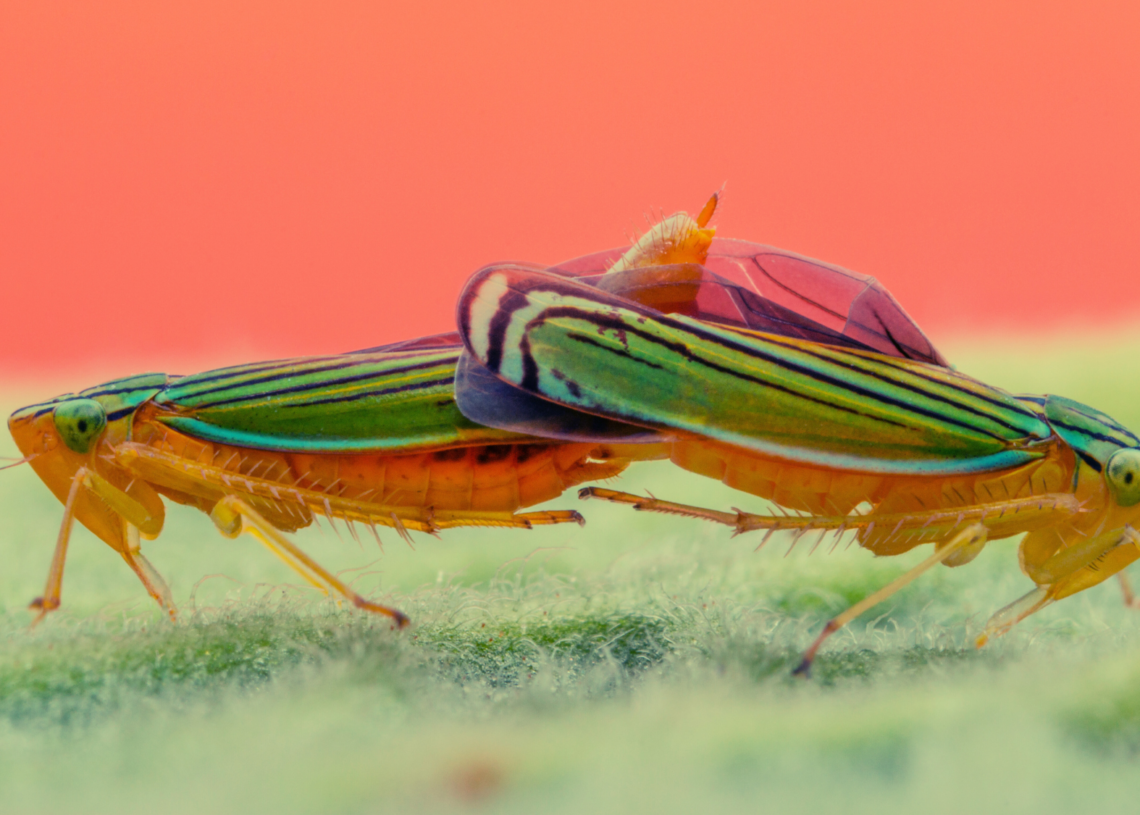
Leafhoppers are common insects. You’ve probably seen one without even knowing it, a small green shape that blends into leaves and disappears almost immediately. That disappearing act is actually quite fascinating. Leafhoppers coat themselves in microscopic particles that drastically reduce glare, making them harder to detect by animals that hunt using reflected light.
Scientists at Penn State recently published research in ACS Nano explaining how they replicated that effect in the lab. The study focuses on structures called brochosomes, tiny hollow particles that leafhoppers produce inside their bodies and spread across their wings and exoskeletons. Each brochosome looks like a mini soccer ball, covered in precisely arranged holes that scatter light rather than bounce it straight back.
Measurements show the effect is substantial. The particles reduce reflected glare by roughly 80 to 96 percent across visible and ultraviolet light, according to the researchers. That reduction removes the flashes that would otherwise give the insect away.
Rather than carving these shapes using traditional nanofabrication methods, the Penn State team used a chemical approach. They built a microfluidic system that creates microscopic droplets containing dissolved polymers, suspended in water. As the solvent evaporates, surface forces pull the polymers into hollow spheres with patterned pores that closely resemble the natural versions found on leafhoppers.
By adjusting the polymer chemistry, the researchers controlled both the size of the particles and the shape of their pores. Some designs match the pentagon and hexagon patterns seen in nature. Others form circular openings. In total, the team recreated five brochosome designs observed in different leafhopper species, with sizes ranging from a few hundred nanometers to about two micrometers.
The production speed is notable. The system can generate more than 100,000 particles per second, far faster than most nanoscale manufacturing techniques. That rate suggests the method could be used beyond a lab setting.
Possible uses extend across multiple industries. Surfaces that reflect less light could improve the performance of energy devices. Optical materials could benefit from better glare control. Military camouflage is often mentioned, though the researchers note that practical applications would require additional testing. The paper also raises the possibility of biomedical uses, such as drug delivery, based on the particles’ shape and surface properties, though that work hasn’t been done yet.
What makes the study compelling is how ordinary the source is. A backyard insect evolved a way to manage light that scientists are now learning to reproduce at scale.
The post Scientists Replicated This Bug’s Natural Talent for Turning ‘Invisible’ appeared first on VICE.