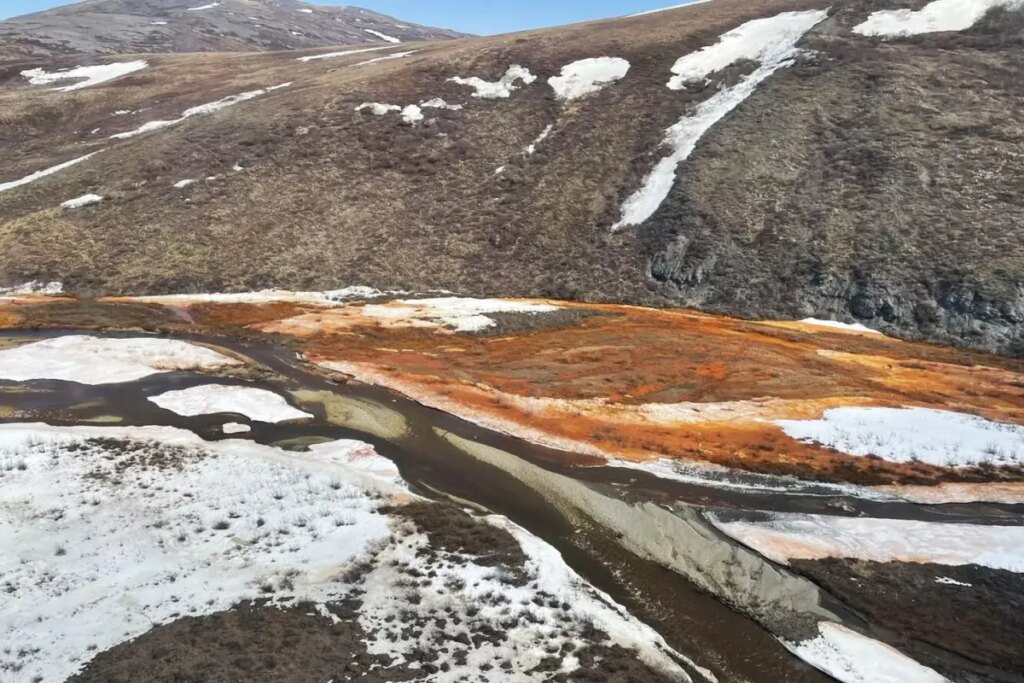
Some of Alaska’s scenic rivers and streams look downright apocalyptic this year because they turned a flagrant orange color — but it’s not due to local pollution, according to scientists at the National Oceanic and Atmospheric Administration (NOAA).
In actuality, the orange tinted water is rust, released as the frozen ground in Alaska thaws out due to unchecked greenhouse gasses driving global warming. And it’s leaking into the state’s waterways, according to NOAA’s annual report on the Arctic region, where it’s posing a danger to local wildlife, residents and commercial fisheries.
The day-glo rivers are also a bright orange flag that the Arctic is warming faster than the rest of the world. The massive defrosting is also anticipated to increase sea levels and screw up weather patterns, according to scientists who talked to NPR.
“When the Arctic thaws and warms, it’s having an impact on the global climate,” Matthew Druckenmiller, lead author of the report and senior scientist with the Boulder, Colorado-based National Snow and Ice Data Center, told the broadcaster.
The planet is already showing signs of distress from global warming, such as large-scale forest fires and extreme summer temperatures outside the Arctic, which Druckenmiller described as a giant fridge for the planet.
“The Arctic is warming several times faster than Earth as a whole, reshaping the northern landscapes, ecosystems, and livelihoods of Arctic peoples,” reads the NOAA report. “Also transforming are the roles the Arctic plays in the global climate, economic, and societal systems.”
Zooming back to Alaska, people started noticing the orange waterways in 2018, according to NPR.
“ We heard from people who live in the region — pilots who are often flying over, people in the national parks,” US Geological Survey research hydrologist Josh Koch told the broadcaster.
As temperatures heats up in the most remote parts of Alaska, permafrost — ground that usually stays continuously frozen — is melting, and that’s unlocking iron in the soil, which oxidizes from exposure to water and air, causing rivers and streams to turn orange. Surveys revealed that this contamination is far reaching, covering hundreds of miles of terrain in Alaska.
“It’s often not orange until it reaches the stream, and then all the iron and other metals can precipitate and create this iron staining,” Koch added.
It’s not clear if residents are being harmed from the polluted water, but local scientists are monitoring the situation, NPR reports.
The other problem with these rusty rivers is that they increase the acidity level in the water, according to the NOAA report, and this may harm fish like Dolly Varden char, whose juvenile offspring have experienced a sharp decrease in numbers most likely due to iron in its aquatic habitat. And that’s pretty bad for everybody in Alaska.
“The food chain is connected to the lives of people living in the Arctic,” Druckenmiller said.
More on climate change: Melting Glacier in Alaska Floods State Capital
The post Rivers Turn Bright Orange in Alaska appeared first on Futurism.