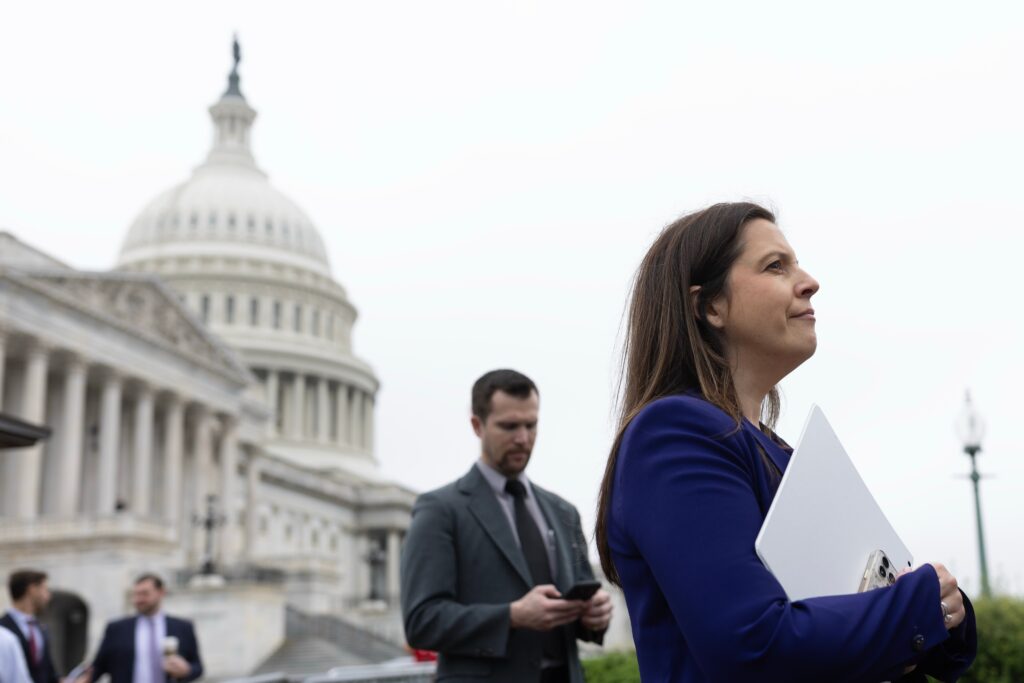
Twenty minutes apart Friday afternoon, Sen. Cynthia Lummis (R-Wyoming) and Rep. Elise Stefanik (R-New York) both announced they would retire from elective politics next year.
Lummis, 71, faced no real opposition in either next year’s Republican primary or the general election in her deeply conservative state. But she said she did not have “the energy” for another six-year term.
Stefanik, 41, stunned the political world by both abandoning her statewide campaign for governor and turning down another House term.
She hadn’t won the endorsement of President Donald Trump, despite spending the past six years refashioning herself into a MAGA warrior. Stefanik said she would rather spend time with her family than fight through a GOP primaryagainst a Long Island county official in which either Republican would be an underdog in the liberal-leaning Empire State in the general election.
“I have thought deeply about this, and I know that as a mother, I will feel profound regret if I don’t further focus on my young son’s safety, growth, and happiness,” Stefanik said in a statement.
Those are the latest blows to the ranks of Republican women in the House and Senate, whose numbers had grown steadily in recent years to record or near-record levels.
In 2019, just 13 women served in the House Republican Conference, the lowest level of this century, according to the Center for American Women and Politics at Rutgers University. By 2023, the number grew to 34, before dropping to 31 this year.
Twice as many Republican women now serve in the Senate — 10 out of 100 — as served in 2017.
Lummis’s pending retirement follows the September announcement by Sen. Joni Ernst (R-Iowa), a rising star ever since her arrival in 2015, that she had decided against running for reelection. Sen. Marsha Blackburn (R-Tennessee) has decided to run for governor after just winning a new six-year term last November.
With Sen. Susan Collins (R-Maine) in a tough reelection race, the number of GOP women could drop precipitously depending on how the Senate elections turn out.
Some GOP women are already angling to succeed Republicans such as Ernst and Lummis, and others are running in different races. So it’s possible their overall numbers come January 2027 won’t have dipped significantly.
Regardless, a few departing Republican women believe the party still treats them to a different standard than their male colleagues face.
“There’s a lot of weak Republican men, and they’re more afraid of strong Republican women. So they always try to marginalize the strong Republican women,” Rep. Marjorie Taylor Greene (R-Georgia) told The Washington Post’s Kadia Goba in an October interview.
“Women will never be taken seriously until leadership decides to take us seriously, and I’m no longer holding my breath,” Rep. Nancy Mace (R-South Carolina) wrote in a New York Times op-ed headlined “What’s The Point of Congress?” earlier this month.
Greene, 51, first elected in 2020, plans to resign in early January, having spent the last few months fighting with Trump and senior administration officials.
Mace, 48, also first elected in 2020, is running for governor in a crowded Republican field in South Carolina in which, so far, Trump has not endorsed any candidate.
Other Republican women have defended House Speaker Mike Johnson (R-Louisiana) and the Trump administration for their promotion of women into Cabinet posts and into leadership ranks in Congress.
“Speaker Johnson has empowered women by treating them — and all members — with the respect they have earned,” Rep. Lisa C. McClain (R-Michigan), who replaced Stefanik in the No. 4 leadership post this year, said in a statement in October. “He believes in merit, not identity politics.”
Together, Greene, Mace and Stefanik represented the leading edge of MAGA women in the Trump era. Younger than most colleagues and fairly new to Congress, they embraced a take-no-prisoners approach that focused on promoting a more theatrical style of combative politics rather than a dealmaking posture aimed at legislative results.
Earlier this year, each seemed very much on the rise. Trump picked Stefanik as his first choice for U.N. ambassador, while Mace jumped into the South Carolina governor’s race and Greene eyed a Senate race in Georgia.
Then Republicans ran into trouble getting legislation through the House because of their narrow margins, making it more difficult to lose Stefanik’s vote for months until a special election could be held to replace her. Meanwhile, Michael Walz, first chosen to be Trump’s national security adviser, clashed with White House officials and needed a new post — so he was sent to the United Nations. Stefanik was told to stay in the House and encouraged to run for governor next year.
Trump advisers, meanwhile, did not see Greene as Senate material, sharing polling data that showed her losing to Sen. Jon Ossoff (D). She declined to run but released a blistering statement accusing Trump’s political advisers of getting “filthy rich off consulting on as many campaigns they can get the president to endorse.”
Mace has openly pleaded for Trump’s endorsement in her bid for governor.
“I’ve done a lot for the president, and if you talk to him, I would really like his support for governor,” she said in an August campaign event in Myrtle Beach, adding: “I am Trump in high heels.”
In her race, polls show no clear front-runner, with undecided voters outnumbering those favoring any candidate.
For sure, some Republicans will quietly rejoice at the idea of the 120th Congress starting in January 2027 without this trio inside their conference. Ideological consistency is not their forte. Their penchant for drawing attention to themselves often grated on others who wanted to advance conservative legislative causes.
Mace has spent weeks fighting with airport workers in Charleston over whether they provided her the proper VIP treatment during an arrival there — at a time when those workers were not being paid because of the government shutdown.
Stefanik arrived in Congress in 2015 as the great young hope for the Bush-Cheney wing of the GOP, having served in the last days of George W. Bush’s White House and worked for Mitt Romney’s 2012 presidential campaign.
After the 2018 Democratic wave wiped out so many Republican women, Stefanik started her own political committee to recruit and raise money for GOP women candidates.
In 2019 she pivoted to a strong embrace of Trump and appeared a lock to win his endorsement for New York governor — until he snubbed her during an Oval Office appearance a week ago.
Compared to Democrats, Republican women face a glass ceiling in Congress.
Rep. Nancy Pelosi (California) got elected Democratic caucus leader 23 years ago. Rep. Katherine Clark (Massachusetts) got elected to the No. 2 Democratic post three years ago when Pelosi’s leadership team stepped aside after their long reign.
This year, 94 Democratic women serve in the House, almost 45 percent of the entire caucus and almost triple the GOP tally, according to the Rutgers center.
No Republican woman has ever gone higher in leadership than conference chair, which is currently No. 4 and sits at No. 3 when they are in the minority.
Senate Republicans have never elected a woman to a top-three leadership post.
Ernst was poised to shatter that. Within weeks of taking office in early 2015, GOP leaders picked her to respond to President Barack Obama’s 2015 State of the Union address.
Trump met her in the summer of 2016 as he was considering vice-presidential picks. In January 2019, Ernst easily won a junior leadership post, and in early 2023 took over the No. 4 leadership slot.
But a year ago, when she ran for the position of conference chair, the No. 3 slot, Ernst got thumped by Sen. Tom Cotton (R-Arkansas), who had never before shown interest in a leadership track.
By September, Ernst announced she would not run for reelection.
Lummis could have coasted to another term or two, but she sized up the state of politics — a near constant rush of action with little to show for it — and decided to take a pass.
“The energy required doesn’t match up,” she said Friday.
On Thursday, the last day on which she could cast votes, Greene decided to skip out on House action. She did not cast any votes.
And Saturday morning she took to social media to declare her freedom.
“Breaking the chains from the bully is freeing. It’s also taking hold of real power over one’s self and the future,” Greene wrote.
The post Republican women shrinking their ranks in Congress appeared first on Washington Post.