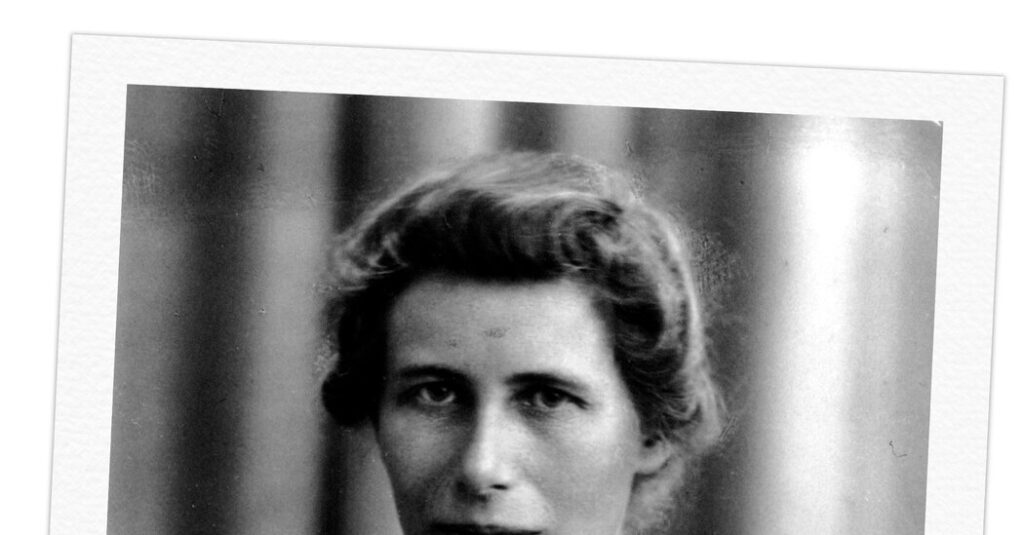
This article is part of Overlooked, a series of obituaries about remarkable people whose deaths, beginning in 1851, went unreported in The Times.
Seismology in the 1930s was a small world, almost entirely male. Inge Lehmann, a Danish scientist who had eschewed marriage for her career and who worked largely alone in Copenhagen, was certainly not expected to revolutionize it.
But that was what she did in September 1936, when she published an article with the cryptic title “P’” in a French scientific journal — a title that belied the article’s importance.
With meticulous details, calculations, tables and hand-drawn graphs that she laid out across nearly 30 pages, Lehmann presented a startling theory about the Earth: That it had a deep inner core made of a dense substance quite different from what scientists at the time believed.
Until then, the Earth was known to have a molten, liquid interior. But while Lehmann was studying seismic readings from a 1929 earthquake in New Zealand, she noticed something unusual.
Earthquakes produce primary or pressure waves, also called P waves; secondary, or S waves; and two types of surface waves. Pressure waves, which are the fastest and can pass through solids, liquids or gases, are longitudinal compression waves — like those that travel along a Slinky. Secondary waves, which can travel only through solids, are perpendicular to the direction of the wave — like the curves in a rope when someone is shaking it from one end. Surface waves travel through the Earth’s mantle, the mostly solid bulk of the Earth’s interior, lying between the core and the crust, the relatively thin outer layer.
As expected, some of the P waves had traveled at an angle from the source of the earthquake to another point on the Earth, completely missing the core. Others had passed through the center of the Earth and been deflected a bit as they traveled through the solid mantle, and then through the core, and then through the mantle again.
But there were some P waves that had been detected between the other two sets of P waves — in an area called the “shadow zone” — that should not have been there if the center of the Earth had only a liquid core. Lehmann concluded that the most likely explanation was that the P waves had encountered an even more dense, superheated inner core, one that deflected the waves in a new direction.
Her paper — in which the P in the title referred to P waves and the apostrophe stood for “prime,” the kind of waves that had passed through the core — concluded not with a triumphant declaration but with an understatement: “The assumption of the existence of an inner core is, at least, not contradicted by the observations.”
To geophysicists, however, the implication was, well, seismic.
Lehmann made her discovery in the same decade that Pluto was discovered with telescopes. But “instead of taking telescopes and turning them towards the sky,” Hrvoje Tkalcic, a geophysicist at the Australian National University, said in a 2019 interview with the American Geophysical Union, “she took a seismograph and, in the mode of a telescope, she turned it towards the center of the planet.”
What made her work additionally remarkable was that she had to do everything by hand. In that predigital age, seismic stations recorded tremors with pens that scratched ink onto spinning drums, capturing the Earth’s shudders in real time. She compared the results by eye, computing in her head and on index cards the calculations that today’s software performs in an instant.
Other scientists supported the theory that Lehmann presented in her paper, which appeared in the publications of the International Central Seismological Bureau. But it wasn’t until 1971 that the equipment existed to confirm her hypothesis.
Lehmann’s discovery marked a turning point in geophysicists’ understanding of the Earth. It explained how the Earth generates the magnetic field that protects the planet from cosmic radiation, and it became essential for exploring the planet’s interior. It was also useful for monitoring the seismic waves created by nuclear tests during the atomic age.
Inge (pronounced IN-gah) Lehmann was born on May 13, 1888, near Copenhagen, the eldest of two sisters of Alfred Georg Ludvig Lehmann, a noted experimental psychologist, and Ida Sophie (Torsleff) Lehmann, who came from a family of booksellers.
Inge studied at Faellesskole, a progressive school founded by Hanna Adler, who was one of the first two women in Denmark to earn a master’s degree in physics.
“No difference between the intellect of boys and girls was recognized,” Lehmann wrote in a biographical essay in 1980. But she faced “disappointments later in life” when she encountered discrimination in the sciences.
In 1907, Lehmann enrolled in the University of Copenhagen, where she studied mathematics, chemistry and physics. After graduating, she was admitted to Newnham College at the University of Cambridge in England, where opportunities for women were limited. While women could attend lectures, they could not matriculate, attain full university membership or be appointed to academic posts.
There, Lehmann befriended a young Niels Bohr, a fellow Copenhagener, who would become a founder of quantum physics and be awarded the Nobel Prize in Physics in 1922. (Adler, the founder of Faellesskole, was his aunt.) Bohr sought Lehmann’s advice on which lectures to take, but they could not visit each other unless she were accompanied by a chaperone.
When she went home for Christmas in 1911, her father saw that she was mentally burned out and insisted that she take a break from her studies. Taking his advice, she took a low-level job in the actuarial office of an insurance company.
During that time, she was briefly engaged to a man but broke off the relationship to return to the University of Copenhagen, where she earned the equivalent of a master’s degree in mathematics in 1920. After an interlude of studies at the University of Hamburg, she was hired by the University of Copenhagen in March 1923 to be an assistant to a professor of actuarial mathematics.
Two years later, Niels Erik Norlund, a mathematics faculty member who had been made director of Danish geodetic services, which tracked seismological data, hired Lehmann for a new project: setting up seismological stations in Denmark and in Danish-controlled Greenland. As part of her work, Lehmann visited seismological stations in other parts of Europe.
In 1928, the Royal Danish Geodetic Institute (now the Danish Geodata Service) was established, with Norlund as its first director. Lehmann was soon appointed No. 2 and made director of the seismology department, overseeing Denmark’s seismological stations.
She had finally found her niche. “It is no small thing to have the opportunity and permission to use all one’s strengths,” she wrote to Norlund in a letter profusely thanking him.
She published 35 papers while at the institute and retired in 1953, though she continued with her research. A year later, she discovered that the speeds of P and S waves suddenly increased at depths of about 220 kilometers (137 miles) in the Earth’s mantle, a seismic boundary that has since been named the Lehmann discontinuity.
Among other awards, Lehmann received the Gold Medal of the Royal Danish Academy of Sciences and Letters, in 1965; the William Bowie Medal by the A.G.U., in 1971; and the Harry Fielding Reid Medal from the Seismological Society of America, in 1978.
She died on Feb. 21, 1993, in Copenhagen. She was 104.
Since her death, recognition has continued to build. In 1996, the A.G.U. created the Inge Lehmann Medal to honor “outstanding contributions to the understanding of the structure, composition and dynamics of the Earth’s mantle and core.”
In 2017, the University of Copenhagen erected a monument to Lehmann in front of its main building.
And in 2028, the Danish central bank will place her portrait on new bank notes — making this once-neglected seismologist a familiar face to millions of Danes.
The post Overlooked No More: Inge Lehmann, Who Discovered the Earth’s Inner Core appeared first on New York Times.