You are watching the 2016 Republican primary campaign, trying to figure out if Ted Cruz or Marco Rubio can stop Donald Trump from winning the Republican nomination. A man from the future steps out of a shimmering portal and informs you that the winner of the primary campaign will go on to be the Republican president who will finally bomb Iran’s nuclear program.
“Hmm,” you say, “maybe Ted Cruz.”
But there’s more, the traveler says. The same Republican president will ship armaments to support Ukraine in a brutal war against Vladimir Putin’s Russia.
“OK,” you say, “then we can probably scratch Trump off the list.”
And finally, your visitor informs you, this president will put in place a naval blockade of socialist Venezuela, aiming at a Latin American realignment that might undermine Venezuela’s ally Cuba as well.
You immediately log onto a novel website called a prediction market and bet your entire savings on Marco Rubio.
The presidency in 2026 belongs to Trump, and the language of his administration sounds nothing like the idealistic neoconservatism that defined Rubio’s political brand a decade ago. Depending on the document or day of the week, Trumpism can sound like Nixonian realism, pre-World War II isolationism or just a swaggering mercantile imperialism.
But look at what the administration is actually doing, not just how it talks, and the hawkish foreign policy that you might have once expected from a President Rubio is palpably present in the policies of Trump’s second term.
.op-aside { display: none; border-top: 1px solid var(–color-stroke-tertiary,#C7C7C7); border-bottom: 1px solid var(–color-stroke-tertiary,#C7C7C7); font-family: nyt-franklin, helvetica, sans-serif; flex-direction: row; justify-content: space-between; padding-top: 1.25rem; padding-bottom: 1.25rem; position: relative; max-width: 600px; margin: 2rem 20px; }
.op-aside p { margin: 0; font-family: nyt-franklin, helvetica, sans-serif; font-size: 1rem; line-height: 1.3rem; margin-top: 0.4rem; margin-right: 2rem; font-weight: 600; flex-grow: 1; }
.SHA_opinionPrompt_0325_1_Prompt .op-aside { display: flex; }
@media (min-width: 640px) { .op-aside { margin: 2rem auto; } }
.op-buttonWrap { visibility: hidden; display: flex; right: 42px; position: absolute; background: var(–color-background-inverseSecondary, hsla(0,0%,21.18%,1)); border-radius: 3px; height: 25px; padding: 0 10px; align-items: center; justify-content: center; top: calc((100% – 25px) / 2); }
.op-copiedText { font-size: 0.75rem; line-height: 0.75rem; color: var(–color-content-inversePrimary, #fff); white-space: pre; margin-top: 1px; }
.op-button { display: flex; border: 1px solid var(–color-stroke-tertiary, #C7C7C7); height: 2rem; width: 2rem; background: transparent; border-radius: 50%; cursor: pointer; margin: auto; padding-inline: 6px; flex-direction: column; justify-content: center; flex-shrink: 0; }
.op-button:hover { background-color: var(–color-background-tertiary, #EBEBEB); }
.op-button path { fill: var(–color-content-primary,#121212); }
Know someone who would want to read this? Share the column.
There’s a continuing quest for peace with Russia, yes, but almost a year after Trump promised an immediate deal, the war continues with American military support. There’s more daylight between the United States and Israel than vintage neoconservatism would favor, but the military action long desired by Middle East hawks was delivered by Trump. And while the justifications for attempting regime change in Venezuela have Ping-Ponged around — drugs! oil! the Trump corollary to the Monroe Doctrine! — we’re clearly engaged in the kind of old-fashioned anti-Communist action that you’d expect with a son of Miami as the secretary of state.
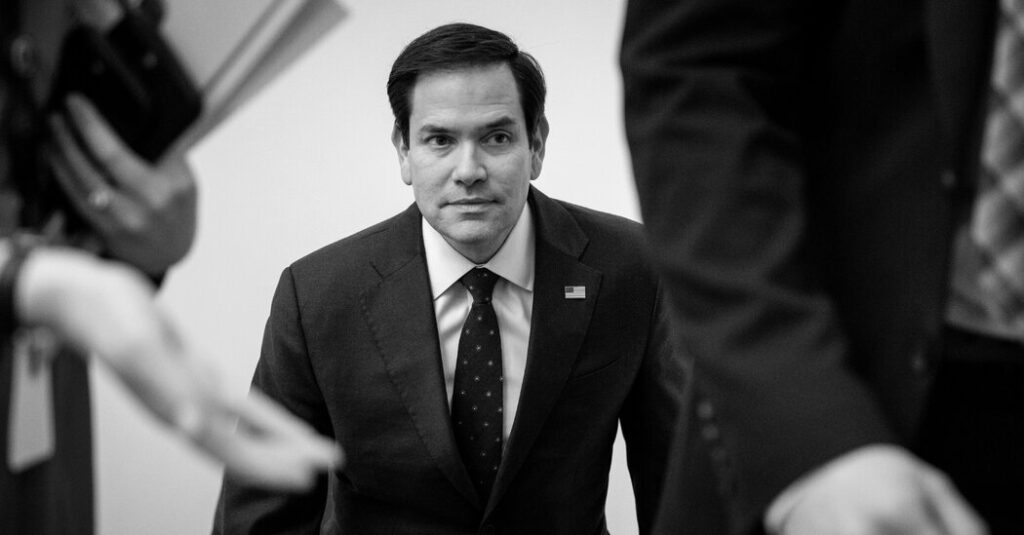
In exerting this apparent influence, Rubio has somehow avoided becoming either a media fixation or a major player in the right’s unfolding psychodrama. He has accumulated formal power (adding the national security adviser’s portfolio in a Kissingerian consolidation) without accumulating many open enemies. It helps that he has officially subordinated his political ambitions, promising to support JD Vance if he runs in 2028. But a lack of formal presidential intentions hasn’t prevented everyone from Pete Hegseth to Susie Wiles from becoming a temporary lightning rod. Yet Rubio remains powerful and relatively aloof, not bulletproof but at least wearing a little bit of Teflon.
This makes him the most interesting figure in the administration right now. A running theme in the critique of Trump-era Republican politicians is that in accommodating themselves and making moral compromises, they ultimately earn only humiliation. Rubio has certainly had to compromise his principles. It’s difficult to imagine that he took any pleasure in what Elon Musk did to foreign aid or that he enjoys the amoral style in which White House officials are expected to talk about world affairs. But it is also very clear what he has earned from working within the contours of Trumpism: the power to shape foreign policy in ways consonant with his pre-Trumpian beliefs.
Whether that power is worth the compromises is one question; whether he is exercising power wisely or well is another. I was a skeptic of Rubio’s foreign policy vision in 2016, and I remain a skeptic of armed interventionism. That said, the current administration approach in Ukraine — negotiating intensely and shifting burdens to Europe while recognizing that Putin may not want a deal — has balanced hawkishness and dovishness in a reasonable way. And the bombing of Iran’s nuclear program has not produced any of the feared blowback or drawn us into a regime-change war.
Venezuela is the major test right now, the place where Rubio’s longstanding interests are most in play and where the administration’s just-war arguments are thinnest. Nicolás Maduro’s regime is deplorable, and to have it fall peacefully, under economic pressure and the threat of war, would be a triumph for the Trump administration, even if the justifications are dubious. But it’s as easy to imagine a scenario in which we end up saber rattling and blowing up suspected drug boats for nothing, or alternatively act rashly and create a Libya in Latin America, as to envision a smooth restoration of democracy.
But it’s the nature of power that its possession puts your ambitions to the test. And just the fact that we’re testing a strategy of Latin American regime change is strong evidence that what never materialized in the 2016 campaign — the Marco Rubio moment — might have finally arrived.
The Times is committed to publishing a diversity of letters to the editor. We’d like to hear what you think about this or any of our articles. Here are some tips. And here’s our email: [email protected].
Follow the New York Times Opinion section on Facebook, Instagram, TikTok, Bluesky, WhatsApp and Threads.
The post How We Got to This Marco Rubio Moment appeared first on New York Times.