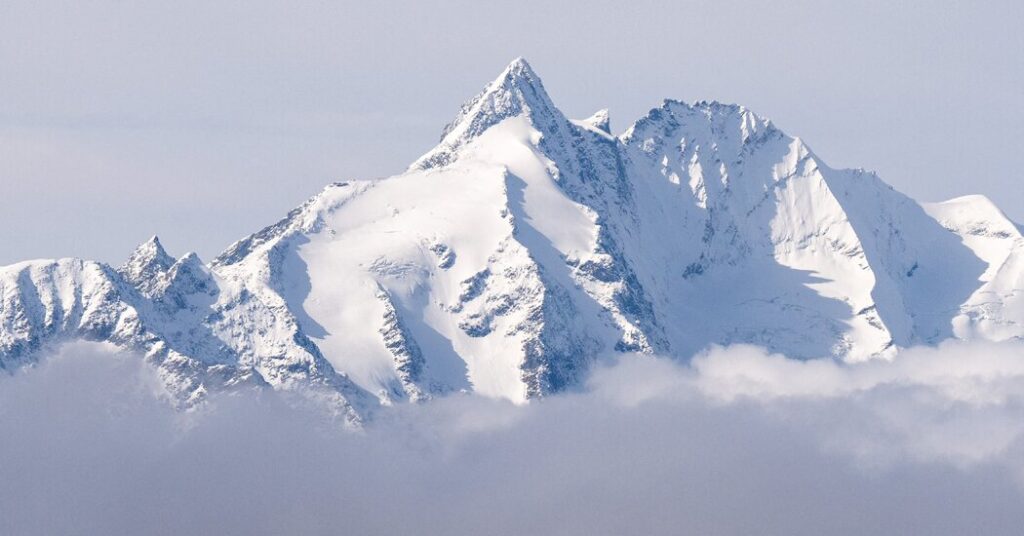
A distant webcam captured the moments the couple’s hiking trip started to unravel.
The pair, a boyfriend and girlfriend, were nearing the summit of Grossglockner, the tallest mountain in the Austrian Alps, when their lights appeared on its dark peak.
Around midnight, the man said, his girlfriend was struck by sudden exhaustion and could not continue. He said the two made a contentious, if not uncommon, decision: He would leave her behind and continue alone to find help.
Hours later, he was out of harm’s way, and the woman was dead. Rescuers found her frozen body later that morning not far from the summit, officials say.
Now, nearly a year later, the authorities have accused the man of making a series of mistakes that led to his girlfriend’s death, charging him this month with gross negligent manslaughter.
The unusual case has roiled the mountaineering community and could have ramifications for Austria’s large alpine tourism industry. Mountaineering in Austria has surged in popularity in recent years, and experts say underprepared visitors are taking more risks and accidents are reaching record highs.
The case has also provoked a broader debate in Austria, as questions of personal responsibility collide with a long-established legal tradition that requires people to protect others and avert danger.
“This is the open question,” said Severin Glaser, a professor of criminal law at the University of Innsbruck in Austria. “When people are doing something risky or dangerous together, how much is one person responsible for the other?”
The Night Climb
The couple, a 36-year-old man and a 33-year-old woman from Salzburg, began their climb on Jan. 18. They chose one of the most challenging routes to Grossglockner’s summit, according to prosecutors and the man’s defense lawyer.
The two, whom the authorities did not name, set off on a day that would experience what locals call the Foehn winds, a weather pattern that can cause hazardous and frigid gusts on exposed peaks.
Accounts of what happened next differ between the man and the police. He described through his lawyer an expedition plunged into turmoil by his partner’s sudden exhaustion, while the authorities listed a slew of missteps they say were avoidable.
Around 1:30 p.m., the man said, the couple arrived at a hut roughly 9,200 feet in elevation, a point of no return before the summit where many hikers rest for the night to get used to the altitude. The couple felt fine, the man said in a statement to his lawyer, and pressed on — a decision that some mountaineers said was a grave mistake.
Around five hours later, after dark, the lights from their expedition appeared on a mountain webcam.
The weather soon began to worsen, dropping to 17 degrees Fahrenheit. An Alpine Police helicopter flew to check on the couple around 10:30 p.m. The man told his lawyer that the couple felt fine at the time, and were close to the summit, so did not signal for help.
Shortly after the helicopter left, however, the girlfriend “suddenly showed increasing signs of exhaustion,” the man’s lawyer said. He described the change as “completely unexpected and objectively unforeseeable” for his client.
The man said he then decided to request a helicopter rescue, calling the police at 12:35 a.m. When he pulled out his phone, his lawyer said, he found he had missed several calls and messages from a police officer, but said he hadn’t noticed because his phone only vibrated slightly for them.
The man said he was convinced during the call that the police knew he was in danger and that they understood a rescue was urgently needed. The police, however, said that the man told them that “everything was fine,” according to police records cited by the defense.
Prosecutors, who collected data from the couple’s phones and smartwatches, said that the man then put his phone on silent and did not contact the authorities for three hours.
After the call, the man said, he told his girlfriend that the police had said a helicopter rescue was not possible, and that they had to keep moving to stay warm. “However, the situation was hopeless,” his lawyer said. “The woman was so physically exhausted that she could no longer continue the ascent.”
The man said the couple then agreed to separate. He called the police around 3:30 a.m. and told them he had left his girlfriend behind, he said, and asked them to send a helicopter as he headed down the mountain.
Prosecutors and the defense agree: The woman died alone, exhausted in the freezing darkness.
Nine Critical Errors
The case has brought to the fore a legal doctrine known as Garantenstellung, a broad concept in Germanic law that establishes a responsibility to intervene for people who have a “duty of care” in a range of situations, including parents caring for children or a driver who hits a pedestrian — and can put liability on those people.
It is often invoked on trips with hired guides, but has rarely been applied to a private hike like the couple’s excursion, experts said.
Prosecutors argue that the man was liable for his girlfriend’s death because he planned the trip and was much more experienced than her.
They detailed nine errors they said the man made that led to the woman’s death. They said the two did not bring sufficient emergency equipment, left too late in the day and did not turn back in time when conditions worsened.
They also blamed the man for allowing his girlfriend to wear snowboarding boots on the hike, which they said were inappropriate for the conditions, and faulted him for not reaching out to the police sooner for help.
Prosecutors also said the man did not take steps to protect his girlfriend before he left her. He did not put her in the small tent or emergency blankets they had packed, officials said, nor did he remove her heavy backpack or her splitboard, a type of snowboard she was carrying.
The man has denied any wrongdoing. His lawyer, Kurt Jelinek, declined last week to comment on the case. But in a June news release, Mr. Jelinek said both hikers were experienced and both had planned the trip.
“My client is deeply saddened by the death of his partner,” Mr. Jelinek wrote, adding that the man “wishes to express his profound condolences, especially to the family of the deceased.”
Since the charges were filed this month, the mountaineering community has been grappling with the accusations, with many saying it was difficult to cast blame even as they questioned the man’s actions.
Herbert Wolf, who has been a mountain guide on Grossglockner for 23 years, wondered why the two undertook the hike during the Foehn winds and didn’t stop to rest at the mountain hut, which he advises all of his clients to do. When he runs into serious trouble on the mountain, he said, his first instinct is to call for a helicopter, noting that “everywhere on the mountain, there’s cell service.”
As for leaving someone behind, that was a “no go,” he said. “I don’t know what happened in this case, but normally, I as mountain guide, I never leave someone alone on the mountain.”
Alpine rescue workers said it was not uncommon for people to leave groups or partners behind to seek help, or to change locations after calling for assistance, which dispatch operators often specifically tell them not to do.
But some noted that the unpredictable conditions on such hikes make it difficult to parse individuals’ decision-making.
“I don’t want to be in people’s places to decide if or not to leave because that’s so dependent on the situation and the circumstances and on the environment,” said Tobias Huber, a doctor and the vice president of the Austrian Mountain Rescue Service.
“You can judge things easier afterward where you have a lot of information that people didn’t necessarily have at that very moment,” he said.
‘An Alpine Disneyland’
During the pandemic, visitors surged to the Alps seeking to escape their homes and enjoy the outdoors. In recent years there has been an influx of “last-chance” tourists who come to the region to see its shrinking glaciers.
Those trends produced a wave of new, less-experienced visitors, local workers said. It has also led to an increase in injuries and deaths.
Since 2021, the Austrian Mountain Rescue Service has recorded large increases in accidents each year. In the state of Tyrol, which includes Grossglockner, rescue workers conducted nearly 1,400 missions in the summer of 2024, their most ever.
Mr. Wolf, the mountain guide, said his recent clients are often more eager to climb tall mountains without acclimatizing and push to set out in unfavorable weather.
“They have a lot of money, but they don’t have time,” he said.
Dr. Huber, of the Austrian Mountain Rescue Service, said he’s also rescued more people who are taking larger risks, including exploring remote areas on the hunt for social media content or hiking at night.
“It’s sort of an alpine Disneyland,” Dr. Huber said. “And that’s the mentality people are increasingly having.”
Dr. Huber said the mountaineering community was largely opposed to more regulations, and said that for many in Europe, mountaineering was an expression of freedom in a heavily regulated society.
Experts said the limits of that freedom will be tested during the man’s trial, which is scheduled for February and could see him punished with up to three years in prison.
“This is a real question for all mountaineering people,” Prof. Glaser said. “How much can you count on somebody’s responsibility for himself or herself? And how much are you liable for other people?”
Jonathan Wolfe is a Times reporter based in London, covering breaking news.
The post A Woman Froze to Death on an Alpine Trek. Is Her Boyfriend to Blame? appeared first on New York Times.