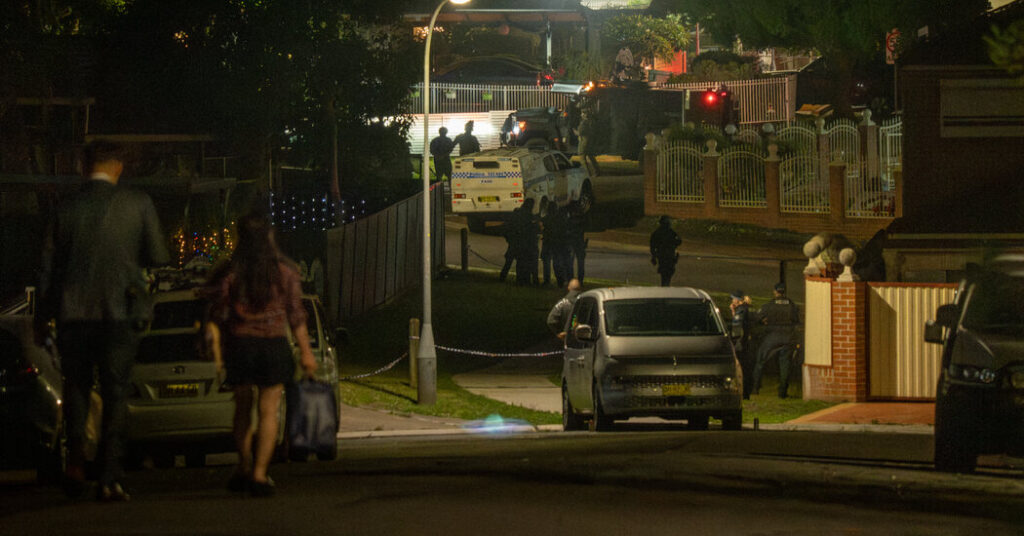
Two men opened fire at a Hanukkah celebration on Bondi Beach in Sydney, Australia, on Dec. 14, killing 15 people and wounding dozens of others.
The authorities later identified the gunmen as Sajid Akram, 50, who was shot and killed by police, and his son, Naveed Akram, 24, who was shot by officers but survived.
Two days after the shooting, Naveed Akram awoke from a coma and was charged with 59 offenses, including murder, terrorism and causing grievous bodily harm with intent to murder.
Here’s what we know about the two suspects.
Officials said the men were motivated by Islamic State ideology and had visited the Philippines.
Prime Minister Anthony Albanese of Australia said the attack was motivated by “Islamic State ideology.” He added that there was no evidence the gunmen were “part of a cell.”
In addition to finding six firearms used in the shooting, the authorities said they also found two black Islamic State flags and improvised explosive devices in the vehicle that the suspects had driven to the site of the attack.
Neither Naveed Akram nor his father had a criminal history, but Naveed had come to the attention of law enforcement in October 2019, the authorities said, and both men were interviewed then. The country’s intelligence service determined at the time that there was no evidence to suggest the two had been radicalized, Mr. Albanese said.
Australian officials said that Mr. Akram and his son spent most of November in the Philippines.
The Philippine Bureau of Immigration said the father and son arrived together Nov. 1, reporting their final destination as Davao, a city considered the gateway to the south of the country. The men spent weeks at a budget hotel, rarely leaving their room, workers at the hotel said.
The Philippine authorities have long battled Islamist militant groups in the country’s southernmost islands, including some with ties to the Islamic State.
The National Security Council in the Philippines said the country had found “no validated report or confirmation that the individuals involved in the Bondi Beach incident received any form of training in the Philippines.”
They lived in a small suburb in western Sydney.
Sajid Akram grew up in Hyderabad, in south-central India, and moved to Australia in 1998 in search of a job, according to a statement released by the police in the Indian state of Telangana. The statement said that he had married in Australia, where he had two children who are Australian citizens: a son, Naveed, and a daughter.
Home Affairs Minister Tony Burke of Australia confirmed that Mr. Akram entered the country in 1998 on a student visa, before obtaining a partner visa in 2001, and had since been living in the country on a resident visa.
The Akrams lived at a three-bedroom home in Bonnyrigg, a small and diverse outer suburb of western Sydney with a population of less than 10,000 people.
Mal Lanyon, the police commissioner of New South Wales, said that before the attack, the two men stayed at an address in Campsie, a suburb of southwest Sydney. An online booking platform lists the building as a short-term rental property.
The police have conducted raids on both addresses.
The son has been described by acquaintances as quiet and a hard worker.
One high school classmate of Naveed, Loris Trimarchi, remembered him as an initially shy student who grew in confidence.
“He was quite the chipper kid. Always had a smile on his face, always laughing,” Mr. Trimarchi recalled in a phone interview with The New York Times. He said Naveed was an observant Muslim who belonged to a prayer group.
In Naveed’s later high school years, he became more vocal in stating his opinions about religion and was increasingly absent, Mr. Trimarchi said, although he added that none of what Naveed said suggested he had been radicalized. After high school, Naveed went quiet on social media and seemed to focus more on boxing, Mr. Trimarchi said.
Naveed also attended a local Arabic and Quran institute for about a year, according to a video statement provided to Australian media by Adam Ismail, the institute’s founder and Mr. Akram’s instructor.
Mr. Ismail said that he had taught Naveed “Quran recitation and Arabic only.”
He said he condemned the violence “without any hesitation,” adding: “What I find deeply ironic is that the very Quran he was learning to recite clearly states that taking one innocent life is like killing all of humanity.”
In 2019, Naveed became involved with the Street Dawah Movement, a Sydney-based volunteer group whose aim is to “peacefully spread the message of Islam,” according to a statement by the group.
While describing him as “a keen visitor” at its faith awareness programs who also volunteered to help film a video, the group said Naveed was not an official member.
The same year, Naveed joined a bricklaying company as an apprentice. He was diligent and learned quickly, according to Geoff Olson, a co-worker who helped train him.
At lunchtime, Naveed would go to the park to pray, Mr. Olson said, recalling how he and the other bricklayers used to try to persuade him to swear, but that he always refused. “He’d just be smiling, like a sheepish kid,” Mr. Olson said.
“Put his head down. That was it.”
The father had a hunting license that allowed him to own guns.
The authorities said that the older Mr. Akram held a recreational hunting license issued in 2023 that allowed him to own long arms weapons as part of a club. The police said he had six guns registered under the license.
Although he traveled back to India six times since moving to Australia, with his last visit taking place in 2022, Mr. Akram had limited contact with his family there, Shivadhar Reddy, the Telangana police chief, said.
“We have not been able to establish any connection between Sajid’s radicalization or terrorist activities and India,” Mr. Reddy said.
Pragati K.B. contributed reporting. Sheelagh McNeill and Alain Delaquérière contributed research.
Livia Albeck-Ripka is a Times reporter based in Los Angeles, covering breaking news, California and other subjects.
The post What We Know About the Suspects in the Bondi Beach Attack appeared first on New York Times.