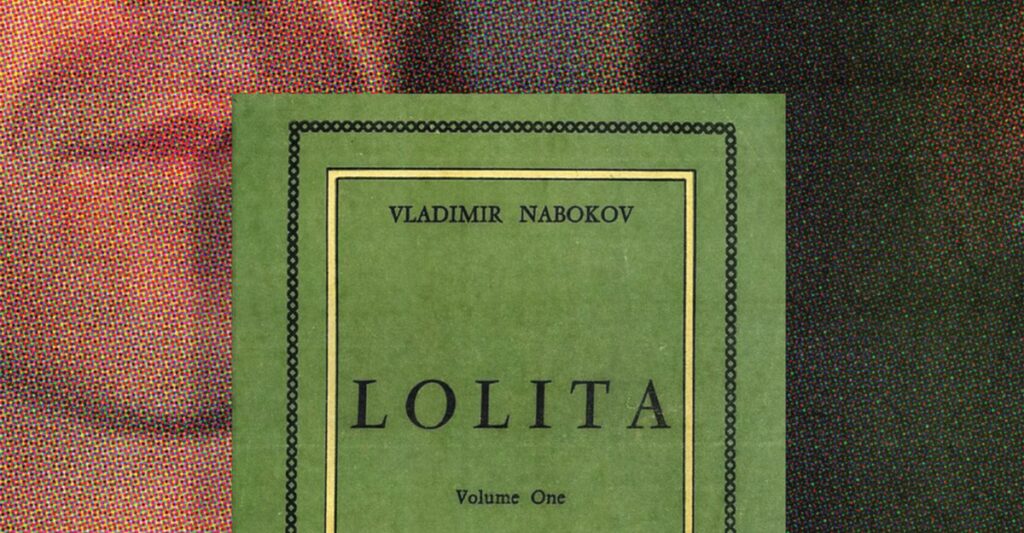
One of the minor annoyances of being an incorrigible pervert is that you risk having your own bookshelf testify against you. Some spines are better turned inward. A pederast might hide away Thomas Mann’s Death in Venice, in which a middle-aged German author ogles a lithe young Polish boy. A hyper-literate rapist should camouflage his copy of A Clockwork Orange with a more consensual dust jacket. It is therefore curious that the late financier and convicted sex offender Jeffrey Epstein—who died in jail in 2019 while awaiting trial on charges of trafficking minors—flaunted his supposed love of Vladimir Nabokov’s Lolita. The book, first published in France in 1955, is so closely identified with pedophilia that it spawned not one but two words, Lolita and nymphet, for girls whom grown men find sexually tempting. Rather than take the obvious advice—Under no circumstances advertise your obsession with Lolita—Epstein apparently did the opposite.
The Epstein files released by Congress yesterday include photos of a young woman or girl, with Lolita’s horny opening lines clumsily inscribed on her skin in fine black ink. Lolita crops up here and there in the documents released in November, too. The journalist Michael Wolff, who was working on a profile of Epstein, wrote that he kept a copy of Lolita, and no other book, on his bedside table. Wolff added that Epstein “is, beyond the joke, a great Nobokov [sic] fan.” When a fact-checker wrote to Epstein to confirm these details, Epstein forwarded the message to Wolff, with a note suggesting that he would not cooperate with the checking process: “nfw,” as in no fucking way. In the end, the profile was never published.
Whether or not he kept a copy by his bed, we know that Epstein owned a first edition and ordered The Annotated Lolita for his Kindle in 2019, 43 days before he was arrested. As to the claim that Epstein was a “great Nobokov fan,” the only possible response is: nfw. He may have wanted others to believe he was, and he may also have tried to impress certain people with polite conversation about the book—maybe the kind of people who do not know how to spell Nabokov, or who wanted his money too much to call out his superficiality. The novel makes a cameo in his 2018 correspondence with the Harvard English professor Elisa New, wife of the hapless Larry Summers, whose poetry project he funded. “I’m going upstairs to hunt for my copy of Lolita,” New says in an email, seemingly at Epstein’s urging. She then suggests that Epstein read Willa Cather’s My Ántonia, writing that Cather’s novel has “similar themes to Lolita in that it’s about a man whose whole life is stamped forever by his impression of a young girl.” The titular girl in Lolita is a 12-year-old who is kidnapped and serially raped by a much older man. To compare Lolita to My Ántonia in this way is a bit like saying Moby-Dick and Deliverance are both about fishing trips.
[Read: The Ghislaine Maxwell emails]
Still, I doubt that Epstein ever read Lolita, or that he understood it if he did. The book’s pleasures are intense but not erotic, and not congruent with Epstein’s essentially philistine taste. Like Nabokov’s great novel Pale Fire, Lolita is about an intelligent writerly type who is not intelligent enough to realize that he is also completely nuts. It accesses levels of pathos that a psycho like Epstein would struggle to appreciate.
We know from his emails that Epstein purchased an eclectic array of nonfiction, including books on finance, power, and sex, plus random books that might endear him to the powerful men in his orbit. These orders were not all lowbrow. He bought Norman Mailer’s fiery but cerebral anti-feminist polemic The Prisoner of Sex and a Don DeLillo novel, Zero K. Among the down-market acquisitions were installments of the Flashman series—think James Bond, but more bumbling and Victorian—and of The Man From O.R.G.Y., a pulpy 1960s spy-sex romp for readers who considered Pussy Galore too subtle. I found excerpts online: They were so lame and dated that, may God forgive me, I actually felt bad for Epstein. A mega-millionaire is spoiled for company, with outstanding people and experiences available for purchase or rent. To prefer the solitary consumption of a novel with lines like “I was strumming her little passion switch like a banjo player mad with palsy” is beyond pitiful. It shows a simultaneous unfamiliarity with both human sexual response and bluegrass music.
Reading escapist crap now and then does not preclude reading great prose at more serious moments. But if your literary tastes favor the dashing heroism of a spy, a lover, a man of mystery and intrigue—and I suspect that Epstein could read fiction only in this vicarious way—then Lolita is a comically bad choice. Humbert Humbert, the narrator, is unhinged and obtuse. The novel is a joke on him. The actors cast by Hollywood to play Humbert in the two movie adaptations of the novel, James Mason and Jeremy Irons, give a sense of the type: Both are known for playing reptilian creeps, even more grotesquely mismatched for an American tween than the average adult man would be.
Humbert is one of the most odious and self-absorbed creations in all of literature. He is a rapist, a murderer, a world-class deflector of blame (“It was she who seduced me”), and a pompous piece of child-molesting Eurotrash. It is a scandal that he can express himself so well—with the linguistic ingenuity, come to think of it, of Vladimir Nabokov. Much of the plot follows this continental sophisticate and Lolita as they drive across America in a “jalopy,” shacking up in motels and passing vulgar roadside attractions. (Epstein, by contrast, was too much of a snob to debase himself with terrestrial travel. He flew private, in a 727 known unofficially as the “Lolita Express.”)
[From the September 2018 issue: Caitlin Flanagan on how Lolita seduces us all]
The end of the novel, however, is even more hateful to someone with Epstein’s predilections. Humbert meets his ex-nymphet again when she’s 17. Lolita has grown distant—which is to say, she has grown up—and has sexually emancipated herself from Humbert, though she still wants his money. Now married and pregnant, Lolita has become unattractive to Humbert, and to some extent Humbert has become unattractive to himself, even remorseful about his crimes against her.
To these indignities (the aging of his lover, the seedy motels, the discovery that he is a worm), Humbert adds one more, perhaps the only one with which Epstein could sympathize. At the novel’s end, he refers back to the reason for his writing all of this down in the first place: He is in jail awaiting trial, and these are his notes. Before he can face justice, he will be dead of a heart attack, and Lolita herself will die in childbirth. Note the irony in the plot (a childhood stolen by an adult, and an adulthood lost to a child) and also in the parallel to Epstein, who, like Humbert, cheated justice through an early demise.
Epstein could, I suppose, have seen himself in Humbert, understood Humbert all too well, and simply not regarded him as loathsome. Epstein was, after all, Epstein, and did not inhabit the same moral universe as you and I do. It is a dark thought: Epstein curled up alone under the covers, studying his nightly installment of the novel because he recognized the lust and moral frailty and could not get enough of it. This Humbert fellow—so relatable. A pompous lecher just like me! For that to be the case, Epstein would have needed a capacity for self-deprecation and insight into his own perversity. No evidence for these traits exists.
More likely, Epstein confused Lolita for some kind of Booker Prize–level version of Penthouse Forum, which is a stupid error. The opening lines, the ones written on a female body in the Epstein-file photo, are more autoerotic than erotic, with Humbert self-pleasuring at the thought of his own mouth (“Lo-lee-ta: the tip of the tongue taking a trip of three steps down the palate to tap, at three, on the teeth”).
Reading Lolita as erotica would be a further irony, because in making that category error, he would have been aligning himself with the book’s early moralist critics. “Highbrow pornography,” The New York Times’ Orville Prescott wrote when the book came out in America, noting that even the French had banned it. I suppose it would be unfair to ding a reviewer in 1958, when smut was scarcer, for seeing pornography in all the wrong places, and mistaking this very unsexy book for titillation.
But just as the notion that Epstein read and understood Lolita is implausible, the alternative—that he read the novel and got off on it—is almost too gross to contemplate. To find Lolita sexy would not only mean finding child-rape sexy. It would also mean finding Humbert Humbert sexy. And that is a level of perversion probably beyond even Jeffrey Epstein.
This article appears in the February 2026 print edition with the headline “What Jeffrey Epstein Didn’t Understand About Lolita.” When you buy a book using a link on this page, we receive a commission. Thank you for supporting The Atlantic.
The post What Jeffrey Epstein Didn’t Understand About Lolita appeared first on The Atlantic.