President Trump signed a law late Thursday repealing a final batch of crippling economic sanctions on Syria, raising hopes for the country’s recovery a year after the fall of dictator Bashar al-Assad ended the family’s half-century of autocratic rule.
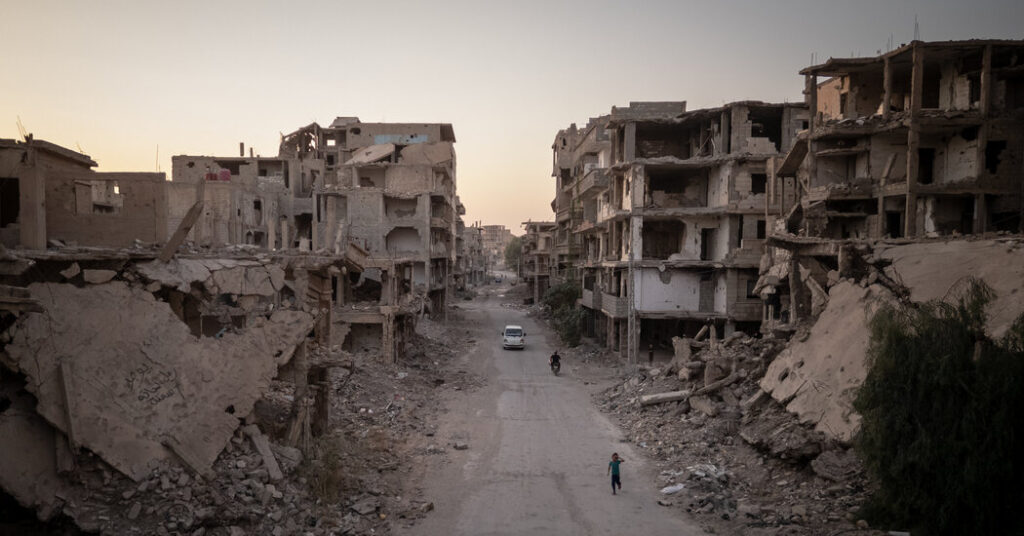
The repeal of the measure, known as the Caesar Act, follows the earlier removal of other U.S. sanctions. It bolsters the new government’s efforts to attract foreign investment, rebuild a nation in ruins and revive an economy long crippled by corruption and cronyism. But the path to recovery remains long and uncertain, as the government must address rampant inflation, widespread unemployment and the destruction of infrastructure — all exacerbated by years of conflict and international isolation.
American sanctions on Syria trace back to the 1970s, when Washington labeled the country a state sponsor of terrorism. Additional punitive measures were imposed in the past 14 years as civil war ravaged Syria, and Mr. al-Assad’s brutal crackdown intensified.
Among the toughest measures was the 2019 Caesar Act, named after a photographer who smuggled out images of torture in Syrian prisons. The legislation, signed into law by Mr. Trump, imposed severe financial restrictions on Syria’s economy in an effort to hold the regime accountable for its atrocities.
The removal of those sanctions is a victory for President Ahmed al-Sharaa, a former Al Qaeda leader who broke with the group years ago and whose forces toppled the Assad regime last December.
In recent months, the Trump administration has thrown its support behind Mr. al-Sharaa and his government. In June, Mr. Trump signed an executive order lifting most of Syria’s economic sanctions. Mr. al-Sharaa met with Mr. Trump at the White House in November.
The removal of the Caesar sanctions required the extra step of Congressional approval. It passed the Senate on Wednesday as part of a larger defense spending bill.
“Lifting the sanctions was the frontrunner in our mission to revive Syria’s economy,” Abdulkader Husrieh, Syria’s central bank governor, said in an interview.
After Mr. Husrieh’s appointment in April, he said that many observers and officials advised him to be patient, warning that it could take years before the sanctions were lifted. He met with Trump administration officials and other global financial institutions several times in Washington.
“What has happened is nothing short of a miracle,” he added.
For decades, the al-Assad family controlled Syria’s economy, much to its benefit and the suffering of the Syrian people.
As the civil war escalated, they took extreme measures to squeeze the population, including hiking passport fees and banning foreign currency in business deals. The regime also profited from the illicit Captagon drug trade, with the proceeds serving as a crucial lifeline amid tightening restrictions and ongoing conflict. .
After years of brutal conflict, Syria’s commercial hubs are slowly reopening. In Aleppo, the sound of hammers and drills fills the air as workers rebuild businesses shattered by airstrikes. In Homs, street vendors call out their wares, mixing with the chatter of customers and the call to prayer in once-empty streets. And in Damascus and its outskirts, centuries-old markets are teeming with traders selling everything from spices to textiles.
While the sense of renewal is palpable, many Syrians understand that reversing decades of economic damage will take time.
“It is the signs of good things to come,” Mohamed Zuheir Maghribi, 70, a trader at the Al-Hal fruits and vegetables market in Damascus, said of lifting the sanctions. “But we need to be patient. The government needs time.”
As part of the repeal of the Caesar Act, Congress is requiring Syria to take several specific actions, including combating the Islamic State terrorist group, which has ramped up its activities in parts of the country. Mr. Trump blamed the Islamic State for killing three Americans in central Syria this month.
The government must also ensure the safety of religious and ethnic minorities, who have been targeted in recent massacres; prosecute those responsible for such attacks; and refrain from taking “unilateral, unprovoked military action” against its neighbors, including Israel.
“We now have a half-century opportunity to move the country forward,” Senator Jeanne Shaheen of New Hampshire, the top Democrat on the Foreign Relations Committee who visited Syria in August, said in an interview.
Syrians, she said, “need to be able to see that their lives are going to improve with a new government.”
This potential for improvement is already attracting interest, Syrian and American officials say.
Qatari, Saudi, Turkish and American construction companies, investment funds and financial institutions have all shown interest in investing, according to a Syrian and two American officials who spoke on the condition of anonymity to discuss sensitive matters. Kuwait and Oman have also indicated interest in investing in Syria, according to one of the U.S. officials.
Investors are unlikely to rush in immediately, experts say, as they closely monitor how the government addresses sectarian violence, militant threats and political uncertainty.
Despite these challenges, businessmen like Mazen Derawan are forging ahead.
The co-founder of a food processing company that produces canned meats and vegetables, Mr. Derawan is seeing steady progress in his operations on the outskirts of Damascus in Al Kiswah city. Over the past year, he has shifted some of his factory operations for Amana Foods from Turkey and Jordan, more than doubled his staff and ramped up production.
He is now selling products from the Damascus factory nationwide. He is able to import factory parts and materials freely and is even exploring the possibility of exporting to the United States.
“We don’t have the luxury of time,” said Mr. Derawan, who also briefly served as a senior adviser to Mr. al-Sharaa’s economic minister. “We have to move, build quickly and improve the lives of our people.”
Muhammad Haj Kadour contributed reporting from Damascus.
Abdi Latif Dahir is the East Africa correspondent for The Times, based in Nairobi, Kenya. He covers a broad range of issues including geopolitics, business, society and arts.
The post Trump Signs Law Repealing Tough Sanctions on Syria appeared first on New York Times.