In one of the most iconic scenes of Federico Fellini’s 1960 classic film “La Dolce Vita,” the Swedish actress Anita Ekberg wades into the Trevi Fountain in Rome and turns to Marcello Mastroianni to coo “Marcello, come here. Hurry Up.”
Nowadays, she’d probably be arrested: Wading in the fountain is strictly forbidden (or förbjuden, in Swedish). And as of Feb. 1, foreign actresses and anyone else who is not a resident of Rome will have to pay 2 euros for the privilege of going down the steps to the fountain’s basin, the city’s mayor announced on Friday.
The decision to introduce the €2 fee, which Mayor Roberto Gualtieri described as “paltry,” came a year after city officials began limiting the number of people who could descend into the sunken area in front of the fountain to throw coins.
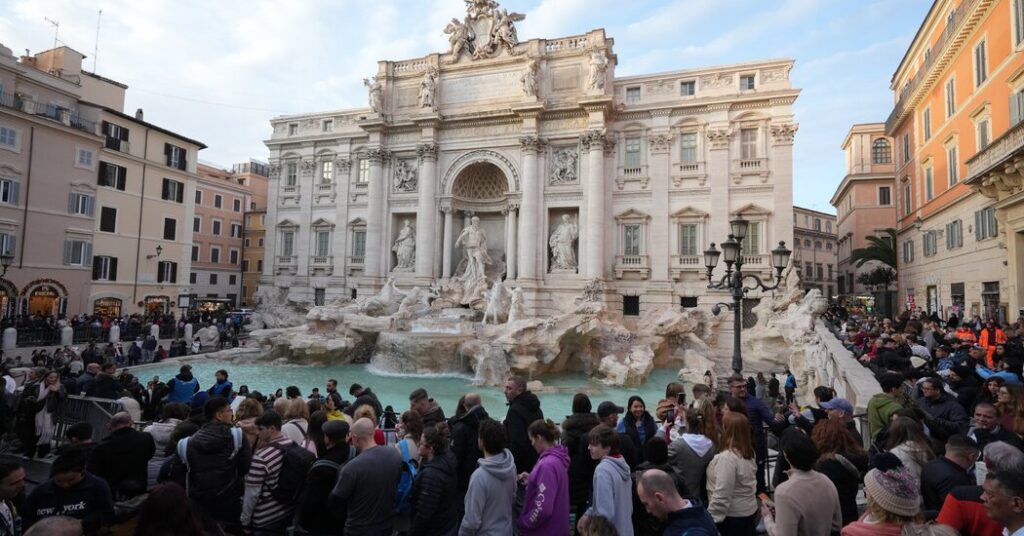
The limitation was imposed to help regulate traffic at one of Rome’s most popular monuments, where tourists go to toss a coin, guaranteeing, as legend has it, a return to the Eternal City. The restriction made viewing the 18th-century fountain — which is in a small square where crowds can turn into a crush very quickly — a much more pleasant experience.
“It’s good that they control the amount of people who come close to the fountain,” said Grecia Parra, a medical student from Mexico, who recalled visiting the fountain on a previous trip to Rome when it was “very, very crowded, so it’s much better this way.”
That said, Ms. Parra didn’t think it was a good idea to pay. “I feel like I can watch it from far away and not pay at all.”
At a news conference Friday, Claudio Parisi Presicce, Rome’s chief art official, said that “the view of the fountain will not be obstructed in any way.”
Tickets will be available through online apps and a dedicated website, as well as hotels and establishments that opt to sell them. The ticket sales will help cover the costs of caring for some of Rome’s many monuments.
Some nine million people have visited the fountain’s restricted area since city officials began counting a year ago. Officials believe, however, that there could be a significant drop in attendees once the fee is introduced, so Mr. Gualtieri conservatively calculated that they would make around €6 million a year.
The coins thrown into the fountain — along with stray rings, guitar picks, subway tokens, keys and other oddities — are collected on a weekly basis and are donated by the city to the Catholic charity Caritas.
A €5 fee will be introduced at five lesser-known sites in Rome, including the Villa of Maxentius on the Appian Way. On the flip side, Roman residents will now have free access to all Rome’s museums and monuments (participants at the news conference applauded at that announcement). They’ll need a document showing their local address.
City officials said that since Rome had imposed the limit on the number of people at Trevi, there had been a significant drop in crime there. “Before you had hundreds of people crushed against each other, holding food, ice cream cones or beers, it was a prime site for pickpocketing,” said Alessandro Onorato, the city official responsible for tourism.
The limit on visitors has also been “very effective and efficient” in discouraging “the kinds of behaviors that not only fail to ensure the decorum of the site, but are also risky for the site itself,” Mr. Gualtieri said. Like wading in the fountain alla Ms. Ekberg.
On Friday, the fountain was packed with tourists, and not everyone seemed to think paying was a good idea.
Abz Samad and Sujatta Begum, visiting from Britain, were against the ticket. “It’s a major attraction for Italy, so I think it should be free for tourists,” Mr. Samad said.
Ms. Begum said that people came to the fountain to make a wish, “and I feel like it’s not being fair to pay for it.”
But Dana Corbia, visiting from Sardinia, said she was happy to pay if the money would go to preserving the fountain and covering the costs of “keeping it clean and tidy.”
Elisabetta Povoledo is a Times reporter based in Rome, covering Italy, the Vatican and the culture of the region. She has been a journalist for 35 years.
The post Toss a Coin in the Trevi Fountain? That’ll Be 2 Euros, Wish Not Included appeared first on New York Times.