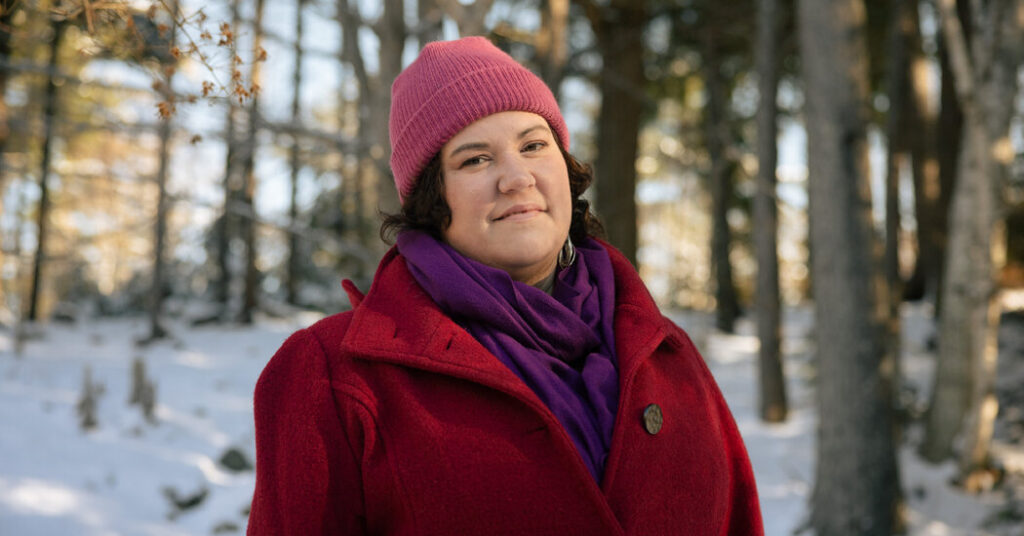
Rachel Reid braced herself for “Heated Rivalry” to be a punchline.
Her 2019 novel, about a secret romance between closeted rival hockey players, was being adapted for television by the Canadian writer and director Jacob Tierney. Early scripts were faithful where it mattered and clever where they strayed, which offered some reassurance.
Still, as the show’s debut loomed, Reid worried the hockey drama would be dismissed as a joke — a smutty novelty, especially in Canada.
It wasn’t. “Heated Rivalry” has become a breakout hit, not just in Reid’s home country but also in the United States, where HBO swiftly acquired the rights. Since its Nov. 28 debut, fans have gone back to devour the books — “Heated Rivalry” is the second of six steamy romances in Reid’s Game Changers series — outpacing supply and forcing Harlequin, the publisher, to play catch-up.
“People keep messaging me to ask if we have any in store,” said Claire Trottier, the co-owner of Joie de Livres, a romance-focused bookstore in Montreal. “It’s really quite the trip when your favorite thing gets discovered by the world.”
Last week, “Heated Rivalry,” along with several of Reid’s other novels, made the New York Times best-seller list. Reid — whose real name is Rachelle Goguen — was visibly overwhelmed during a Zoom call from her home near Halifax, Nova Scotia, far from how she had appeared weeks earlier, in a quiet hotel lobby in Montreal’s Old Port district, on the day of the series premiere.
That was before fans on social media and beyond obsessed over the rivals-to-lovers story of Shane Hollander and Ilya Rozanov, the captains of the Montreal and Boston hockey teams, whose clandestine hookups unfold over a period of eight years. The show has become especially notable for its unusually explicit, carefully choreographed sex scenes.
Years ago, Reid, 45, said she explained to her children that hitting the Times list was unlikely, especially since her early books rarely appeared in brick-and-mortar stores. “It’s been surreal,” she said. “I feel very, very lucky.”
Harlequin has now sold more than 650,000 books in the Game Changers series, according to Brent Lewis, the press’s executive vice president and publisher. “The community around these books felt like a small town before the show,” he said. “Overnight, it became a big city. We couldn’t be happier for Rachel.”
Reid’s fascination with hockey began in childhood. “I always wanted to be one of the boys,” she said. “I thought learning about hockey would make them respect me, which was ridiculous.”
She played for a single season at 14, when her town allowed her to join a boys’ team; there was no girls’ league. “I went to hockey camps, took power skating — anything that let me wear the gear. I was terrible, but I got to play just enough to know what it feels like.”
Her love of the sport was complicated. “Many things made me question why I was so devoted to it,” Reid said, citing multiple sexual assault and misconduct cases that went unaddressed by Hockey Canada. Instead of paying a price, the players “were celebrated — you’d see them in Tim Hortons ads.”
Each revelation left her more jaded. Sometimes she stopped watching for years. “But I always came back,” she said. “And I always hated myself for it. I can’t help it. I really, really love the game.”
Writing the Game Changers books gave Reid a way to work through her ambivalence. She kept circling the same question: What would it mean to be a closeted player in a league with such a homophobic culture?
“I thought a lot about what it would feel like to come out,” she said. “And then I started thinking about the ripple effect — what would happen to the other players?”
The series grew out of that imagined aftershock; to date, there has never been an active out player in the N.H.L.
“The league in Game Changers isn’t my ideal version,” Reid said. “But it’s one where players are just starting to create real change.”
Beyond hockey, the books have given her a space to grapple with patriarchy and toxic masculinity more broadly. “Hockey culture is just one piece of a much bigger problem — but it’s one I know well,” she said.
Reid published “Game Changer,” the first novel in the series, in 2018. She had written constantly as a child, but by adulthood had grown self-conscious about sharing her work. “I’m not great at being vulnerable,” she said.
Writing fiction — especially fiction that included sex — felt newly fraught. When she finished the manuscript, she told no one (not even her husband) that she had written it. Instead, she began posting each chapter anonymously to the fanfiction site Archive of Our Own, recasting her characters as figures in the Marvel universe. (Reid said she later realized that the platform allowed original characters, something she didn’t know at the time.)
After gathering feedback from readers, she took the chapters down and sent the manuscript to publishers. Even once it was set for release, she said, “I had a hard time telling people I had a book about to come out.”
While “Heated Rivalry” was released in 2019, it took nearly a year to gain traction. Then the romance novelist Cat Sebastian, one of Reid’s favorite writers, recommended it on social media. “That was a real turning point,” Reid said. Readers began to discover her work. Each subsequent release reached a slightly larger audience, and in 2023 “The Long Game,” the sixth book in the series, which continues Shane and Ilya’s story, made the USA Today best-seller list.
Her most recent novel, “The Shots You Take,” a stand-alone hockey romance published in March, is more melancholy than her earlier books. Reid wrote much of it in the months following a Parkinson’s diagnosis.
Though not entirely unexpected — Reid had noticed a constant tremor for over a year — the news was still a shock. “Hearing the words is a lot,” she said.
Not long after, momentum around the television adaptation accelerated: Promotion began, the audience grew faster than she had imagined, and the series was renewed for a second season. “The train hasn’t stopped,” she said.
For Reid, romance is first and foremost a character study. “You’re asking people to fall in love with your characters. If you don’t care about them, you’re not going to be interested in their stories.” That sensibility drives both the Game Changers books and Tierney’s adaptation: Audiences are drawn not just to Shane and Ilya, but to the wider cast of teammates, who evolve across the series.
Though her stories revolve around professional hockey players, Reid works to make each one emotionally distinct. That instinct goes back to her earliest reading life: as a child who was captivated by “The Baby-Sitters Club.”
A Stacey book, she remembered, felt nothing like a Claudia or Kristy book. Even then, she was imagining a world readers could return to — one where they could follow and care for different characters over time.
While women make up the bulk of her fans (as for most romance writing), many men — including former hockey players — say the books and the series hit uncomfortably close to home. Some write to thank Reid; others admit they struggle to keep reading because it brings up memories of being a closeted athlete. “It’s really sad to hear, but it’s also kind of a compliment,” she said. The adaptation has amplified the response: “I’ve never gotten this many emails. Tons and tons, from all over.”
Most exciting to Reid has been the hockey world’s response. Sports-focused podcasts are engaging seriously with the material; Canadian news outlets are interviewing former players about homophobia in the sport. During Pride Night at Montreal’s Bell Center, the adaptation’s trailer played on the Jumbotron.
“There are boys kissing on the Jumbotron during an N.H.L. game!” Reid said. “This is kind of incredible.”
The last episode of “Heated Rivalry” will air on Dec. 26. Next month Reid will announce her next book, another stand-alone hockey romance. On the health front, she said, “I’ve finally been given some good information about my disease, and I’m going to focus on doing things that will make it better.”
Even so, she feels pressure to travel and attend as many events as possible now. “I don’t know how much longer I’ll be able to sign books comfortably,” she said.
Before “Heated Rivalry” hit the air, Reid was skeptical that her work could make a difference. Now, her outlook is markedly more hopeful. Could “Heated Rivalry” push men’s hockey toward real change?
“Everything I didn’t think was possible is happening,” she said. “I think it’s definitely starting a conversation.”
The post She Put the Heat in ‘Heated Rivalry’ appeared first on New York Times.