Milk had “Got Milk?” Beef had “Beef: It’s what’s for dinner.”
But Christmas trees don’t have anything, and, “Uh, please don’t buy a fake tree?” is a bit choppy.
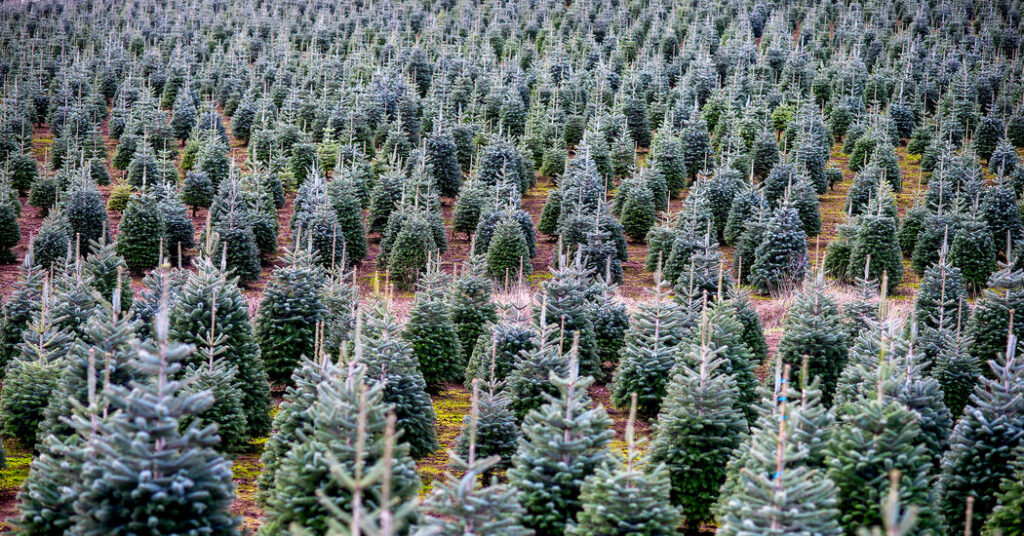
“All these fake trees coming from out of the country have really taken a bite out of our industry,” said Ben Stone, one of three brothers who own BTN of Oregon, a Christmas tree farm.
“Buy America, support America,” his brother, Tyler Stone, chimed in, from their farm in Salem. “That is the message we need to get out, but our budget is low.”
Advertising is difficult for agricultural products, even those in high demand. Consumers might know a few brands, at best, but not the thousands of farmers who produce for them. So for almost every fruit, vegetable or animal, there is an organization dedicated to marketing it, funded by small fees paid by producers.
These groups advertise, develop new recipes, buy a Super Bowl commercial for Mexican avocados or, in the case of raisins in the 1980s, create Claymation characters and a television series. They hope these efforts will persuade consumers to buy more of their products.
But most people aren’t going to buy multiple Christmas trees, purchase them in July or find new uses for them. So figuring out how to induce demand in a declining industry falls upon the shoulders of Marsha Gray, executive director of the Real Christmas Tree Board.
The board’s mission is to persuade Americans to buy live-cut trees, and its main point is that live-cut trees are real, while plastic trees stored in a box are fake.
“Consumers are not buying real Christmas trees in the numbers that they were 50 years ago, 40 years ago,” Ms. Gray said. “It is due to a lot of factors I’m certain, but primarily we have an artificial tree competitor.”
The fight is daunting. According to the American Farm Bureau Federation, an agricultural lobbying organization, the value of imported artificial trees has doubled in the last decade, though that fell this year as fewer were imported because of tariffs on China. The United States also has 35 percent fewer acres dedicated to producing Christmas trees than it did 20 years ago.
Ms. Gray has an advertising budget of less than $1 million annually, mostly spent on media awareness and some small online search campaigns. Which is why the entire Christmas tree industry is so excited by Home Depot’s latest ad.
Its big Christmas commercial this year features a North Carolina Christmas tree farm and follows a young boy picking out a live-cut tree at one of its stores. Home Depot has spent about $10 million to air the commercial on national television over 1,000 times, according to iSpot, a television analytics company.
“It’s more than just a transactional purchase, the way we look at Christmas trees,” said Dan Stuppiello, the Home Depot executive in charge of live goods. “We try to create more of that festive environment.”
Over the years, Home Depot has increasingly transformed the areas in its stores where trees are stocked, turning barren corners of parking lots into environments with lights, holiday music and hot chocolate, a budget version of the experience of going to a tree farm and cutting down your own.
Mr. Stuppiello was careful not to talk down artificial trees — Home Depot sells those, too — but it is harder to create an experience around a plastic tree dragged down from the attic.
“There is something very old world, or even yesteryear, about Christmas tree lots,” said Rikk Dunlap, a writer and maintenance worker at a high school near Chicago. “It is like they connect us to a more innocent or more simple time.”
Mr. Dunlap used to commute past a Christmas tree lot that had an old caravan and circus tent. He became so enchanted by it that he wrote a book set at a tree lot. The book was never published, but the manuscript found its way to Hollywood. It became the basis for the Hallmark movie “Christmas Under the Stars,” featuring a banker who takes a job at a tree lot when he is fired from his job.
It is this romance that Christmas tree growers want to tap into to turn the tide against artificial trees. Research by the Real Christmas Tree Board has found there are three big moments in peoples’ lives when they make what Ms. Gray calls the “Christmas tree decision”: when they get married, have a child or buy a house. That is when people engage more deeply in Christmas traditions or think about what they want their house to look like, and often opt for a great-smelling live-cut tree, Ms. Gray said.
It is tough, then, for the live-cut Christmas tree industry, that fewer Americans are getting married or having children, and that the ones who choose to are doing so later in life; and fewer Americans can afford to buy a house.
The artificial tree industry has its own marketing groupthe American Christmas Tree Association. Jami Warner, its executive director, wrote in an email that consumers choose artificial trees that are “easy to set up, low-maintenance, and cost-effective over multiple seasons.”
She sees the debate between live-cut and artificial — or real and fake — as less existential, though perhaps because her side is winning. “At the end of the day, there’s room for both real and artificial trees,” she wrote.
As for the Christmas tree lot that inspired Mr. Dunlap’s book about the magic of real Christmas trees? It closed down this year after 40 years because of dwindling business, according to its owner. And Mr. Dunlap won’t have a towering Douglas fir or Scotch pine in his home this year. He has two kittens, and he needs to “let them get the kitten out of them.”
He got a small artificial tree.
Kevin Draper is a business correspondent covering the agriculture industry. He can be reached at [email protected] or [email protected].
The post Real or Fake? There’s a War Over Christmas … Trees. appeared first on New York Times.