Over the last year, Health Secretary Robert F. Kennedy Jr. and his appointees have taken tentative steps toward his longstanding goal of remaking the childhood vaccination schedule.
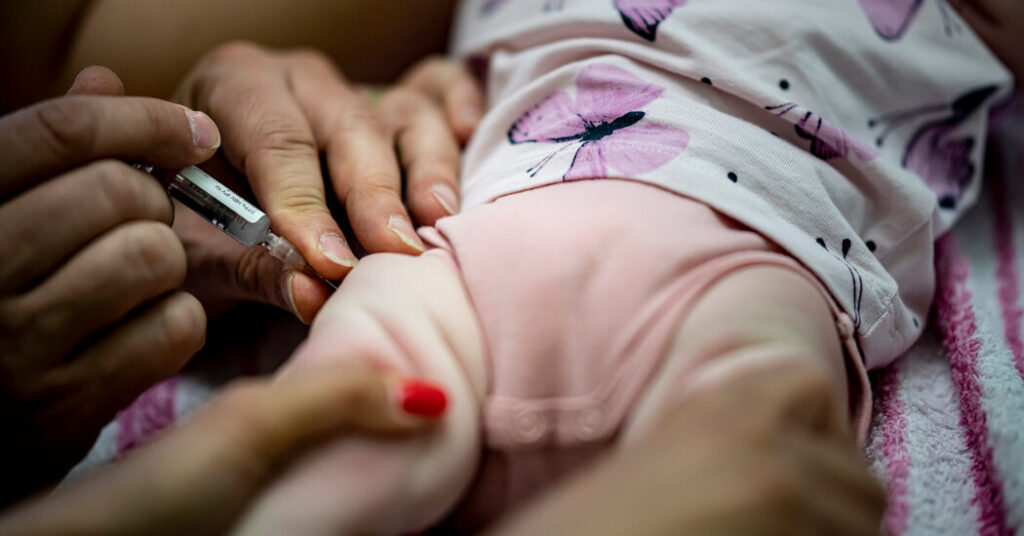
But emboldened by a directive from President Trump, Mr. Kennedy is now poised to make a seismic shift. He is expected to announce in the new year that American children should be immunized according to a different schedule with fewer vaccines, used by the much smaller, largely homogenous country of Denmark.
A wholesale revision of the schedule would bypass the evidence-based, committee-led process that has underpinned vaccine recommendations in the country for decades, and could affect whether private insurance and government assistance programs will cover the shots.
And many medical experts worry that losing strong endorsements of some vaccines will create financial and logistical hurdles to obtaining them, further erode Americans’ confidence in immunizations and increase the chances of disease outbreaks. Measles and whooping cough are already resurgent in multiple states because of dropping vaccination rates.
It is states, not the federal government, that decide which shots are mandated for children to attend day care or kindergarten. And the specifics of changes in the vaccine schedule are as yet unclear.
Also unclear is whether any changes will still protect vaccine manufacturers from being sued for claims of harm. Without that guarantee, companies might face “frivolous” lawsuits and flee the American market as they did before such protections were instituted in the 1980s, some vaccine experts warned.
Mr. Trump directed Mr. Kennedy to align recommendations for childhood vaccines with “best practices from peer, developed countries,” calling the United States “a high outlier in the number of vaccinations recommended for all children.” He pointed to Denmark, Germany and Japan as examples of nations that immunize against fewer diseases.
The directive said that health officials should make the changes “while preserving access to vaccines currently available to Americans,” suggesting to some public health experts that those who wish to get them may still be able to do so in consultation with a health care provider.
Still, even if only some Americans follow a reshaped schedule that includes fewer immunizations, medical experts said, it is almost certain to lead to more cases of infectious disease.
“They’re going to bring back suffering and death,” said Dr. Sean O’Leary, chair of the infectious disease committee for the American Academy of Pediatrics. “I don’t say that with any hyperbole, that’s exactly what’s going to happen.”
The Health and Human Services Department did not immediately respond to a request for comment.
Public health experts challenged the notion that United States is an outlier when it comes to the childhood immunization schedule.
With one or two exceptions, the schedule in the United States is nearly identical to those of Canada, Britain, Australia and Germany. Japan omits some vaccines in the American schedule but includes others, like a shot against Japanese encephalitis, that are not routinely administered in the United States.
On the contrary, they said, it is Denmark, a country with a population the size of Wisconsin’s and universal health care, that is the outlier among richer nations.
The United States currently recommends immunizing all children against 17 diseases. Adopting Denmark’s schedule would skip shots against seven of these: respiratory syncytial virus — the leading cause of infant hospitalizations in the United States — influenza, rotavirus, chickenpox, meningitis, hepatitis A and hepatitis B.
Health officials in Denmark and Germany said they were baffled by the Trump administration’s push to emulate their countries. Traditionally, they have looked to the United States as a leader for its meticulous process of review and recommendation of vaccinations.
The officials noted that the childhood vaccination schedule in the United States had been tailored for the country’s large and diverse population and patchy system of medical care. Denmark and Germany have comprehensive free prenatal care and an infant mortality rate that is about half of that in the United States.
“It’s not at all fair to say look at Denmark unless you can match the other characteristics of Denmark,” said Anders Hviid, who leads research on vaccine safety and effectiveness at the Statens Serum Institut, Denmark’s equivalent of the U.S. Centers for Disease Control and Prevention.
Denmark’s health care system purchases vaccines for its citizens. It omits shots for some diseases from the childhood schedule because they do not pose enough of a problem there to make the vaccines cost-effective, not because of concerns about safety, Dr. Hviid said.
He said he was struck by the irony of Mr. Kennedy and his associates holding Denmark up as an ideal because many of the studies that disproved Mr. Kennedy’s theories of vaccine harm were led by Danish health officials.
Research by Dr. Hviid and his colleagues recently showed that aluminum salts, which are used to enhance the immune response produced by vaccines, are not associated with any of 50 conditions including allergies, asthma and autism.
Mr. Kennedy has said that aluminum can harm the brain, and has panned that study as a “deceitful propaganda stunt by the pharmaceutical industry.” The federal vaccine committee plans to explore alternatives for alum, the members said at their meeting this month.
In the United States, “it turns out to get crazier and crazier in public health from month to month,” Dr. Hviid said. “It is surreal, and it is difficult, from a Danish perspective, to understand what’s going on.”
Dr. Reinhard Berner, a pediatric infectious diseases expert in Germany and chair of STIKO, the independent committee that recommends vaccines for Germans, said the decisions in his country were not based on safety concerns, but on the prevalence of diseases there.
He added, “We do not have concerns about the content of aluminum, and we do not have any concerns about the application of different vaccines at the same time.”
Most shots in Germany are not mandated, but in 2020, the country began requiring the measles vaccine for children and adults in nurseries, schools, hospitals and other communal facilities, after its vaccination rates for the disease fell below the 95 percent recommended by the World Health Organization, Dr. Berner said.
In the United States, a federal panel called the Advisory Committee on Immunization Practices recommends vaccines for Americans. By law, insurance companies are required to cover the shots that the panel recommends.
Over decades, the committee has built the childhood vaccination schedule after methodically reviewing data on the safety and effectiveness of each shot, the ideal timing for its administration, whether it should be given with other shots and other practical considerations.
The committee members typically included immunologists, pediatricians and other health care professionals with expertise in vaccines. Those experts were vetted over many months before being invited to join the committee.
In contrast, Mr. Kennedy in June dismissed all 17 voting members of the advisory committee. He later replaced them with 12 new members, few of whom have vaccine expertise and many of whom share Mr. Kennedy’s skepticism of vaccines.
In their first three meetings, the new members rescinded recommendations for some flu vaccines containing the mercury-based preservative thimerosal — which has been falsely linked to autism — and a combined shot for measles, mumps, rubella and chickenpox, claiming without evidence that the shots may harm children.
This month, in its most recent meeting, the vaccine committee voted to end routine immunization against hepatitis B at birth, instead recommending the shots only for babies born to women known to be infected with the virus or women whose status is unknown.
Other babies, the panel said, should be vaccinated after consultation with a health care provider, but not before 2 months of age.
The panel arrived at that decision after three failed attempts at a vote, several shouting matches and sharp criticism from professional groups. Mr. Kennedy’s unilateral adoption of the Denmark schedule would skirt that process entirely.
“I am glad to have this dealt with by executive action,” Dr. Robert Malone, who chaired the committee’s last meeting, said in a message. “Since everything vax-related has been politicized, then let the politicos make the call,” he said. “They have the ultimate authority anyhow.”
The new hepatitis B guideline mirrors the practice in Germany. But in Germany, nearly all pregnant women are screened for hepatitis B, while in the United States, about 18 percent of pregnant women are not tested, Dr. Berner, the German health official, said.
In voting for the change, the committee members said they were worried about harm from the hepatitis B vaccine to newborns. But Dr. Berner said he vehemently disagreed with that concern.
Billions of doses of the vaccine have been administered worldwide, he said, “and there’s absolutely no evidence that it does cause any harm to the baby.” He noted that universal vaccination at birth in the United States had nearly eliminated the disease in American newborns.
“It is very astonishing for us that such a program is scrutinized,” Dr. Berner said.
This week, the health department announced that it would cancel millions of dollars in grants to the pediatrics academy. The academy has been sharply critical of the Trump administration, and it has boycotted meetings of the vaccine committee.
Dr. O’Leary said the vaccines recommended for American children by previous advisory committees had been included after careful consideration of the risks the diseases posed to Americans. The rotavirus vaccine, for example, which is not included in Denmark’s list, nearly eliminated the tens of thousands of hospitalizations the disease caused in the United States each year.
Likewise, before routine vaccination, chickenpox led to as many as 13,500 hospitalizations and killed up to 150 people in the United States annually. Shingles, which can be caused by the same virus later in life, can be debilitating and excruciatingly painful.
“So which diseases are they choosing to bring back to the U.S.?” Dr. O’Leary said. “Do we want to bring back deaths from chickenpox?”
The pediatrics academy’s own recommendations still align with the schedule put together by the previous members of ACIP. At least for the moment, many states, and most professional societies and insurance companies, have signaled that, they, too, will stick with that schedule, rather than follow the changes Trump administration appointees proposed.
If states did follow a new schedule, they might open themselves up to lawsuits from parents who were unable to get the shots for their children.
Still, the disagreements among officials will undermine trust in vaccines, Dr. O’Leary warned.
So far this year, the country has recorded nearly 2,000 cases of measles in 49 outbreaks, the most since the United States was declared free of the disease 25 years ago. Most of the cases have occurred in pockets of low vaccination. If the outbreaks do not abate, the country is in danger of losing its elimination status in late January.
Dr. Hviid and Dr. Berner said they worried that the anti-vaccine trend would also seep into their countries.
“You think people in general are sensible and can see through stuff like that, but it’s turned out they cannot,” Dr. Hviid said. “That is, of course, something that we need to think carefully about how we can counter here.”
Apoorva Mandavilli reports on science and global health for The Times, with a focus on infectious diseases and pandemics and the public health agencies that try to manage them.
The post R.F.K. Jr. Likely to Swap U.S. Childhood Vaccine Schedule for Denmark’s appeared first on New York Times.