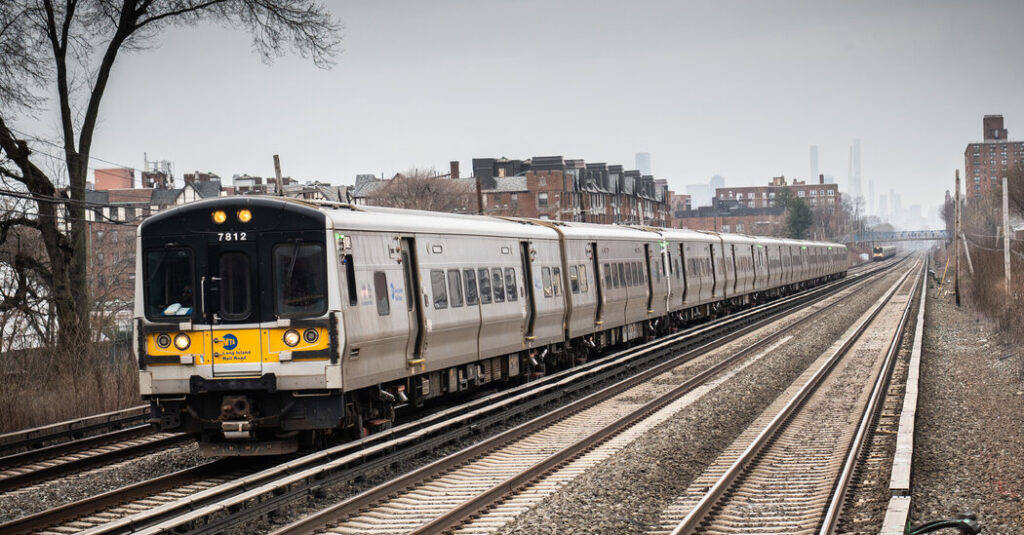
Starting on Jan. 4, passengers who consistently wait until after departure to purchase or activate their mobile tickets for Long Island Rail Road or Metro-North trains will incur an $8 surcharge, according to the Metropolitan Transportation Authority, the New York State agency that operates the two rail lines.
But first there will be “an escalating series of warnings,” the authority said in a description of the policy changes, which were approved in September.
A spokeswoman for the M.T.A., Kayla Shults, said there was no set number of late activations or late ticket purchases that would trigger the charge, and that the warnings would appear in the TrainTime app, which customers use to purchase tickets. “We look for patterns,” she said.
There is already a $6 surcharge for paper tickets purchased from conductors on trains. That fee will increase to $8 under the new policy.
Also starting in January, unused paper tickets and non-activated mobile tickets will expire at 4 a.m. the day after they are bought. They currently expire 60 days after purchase.
Standard fares are also increasing next month for L.I.R.R. and Metro-North customers, according to the M.T.A. On Jan. 4, the price of individual commuter rail tickets will rise by up to 8 percent, while the cost of monthly and weekly passes will increase by up to 4.5 percent.
Kyle Scheiner, 37, a real estate lawyer who was racing to catch a train at Grand Central Terminal in Manhattan on Thursday, chafed at the idea of the new surcharges, saying he usually buys and activates his mobile tickets after he finds a seat on a Metro-North train, which he takes to and from his home in Port Chester, N.Y.
“Using the app should be a measure of convenience,” he said. “If I have to run to my train, I don’t have time to run to the ticket booth.”
The new rules are intended to curb fare evasion, which poses a persistent problem for the M.T.A.’s finances. Fare and toll evasion cost the authority about $1 billion in 2024, according to a September report from the nonpartisan Citizens Budget Commission, including an estimated $46 million in losses from commuter rail fares.
Under the current system, passengers — especially those intending to ride for just a few stops — can try to evade the fare by waiting to buy a ticket or activate one they have already purchased until a conductor asks to see their ticket. If the conductor doesn’t walk through, the passengers can ride for free.
Sanjeev Handa, a 64-year-old consultant who was commuting through Grand Central, said a conductor on his Thursday morning trip had announced the new fine. “Some people — not me — don’t activate their tickets because the conductor might not come by,” he said, throwing his hands in the air.
“They think they can get a free ride,” he added. “Maybe this forces you to be more honest.”
In recent years, the M.T.A., which also operates the city’s subway, has rolled out new measures to reduce fare evasion across the system. These have included adding police officers and “gate guards” at subway stations, modifying turnstiles to make them more difficult to jump over and delaying the opening of emergency exit gates by 15 seconds.
Gov. Kathy Hochul said in January that subway fare evasion had decreased by 26 percent during the previous six months because of the new measures.
Nadine Logan, who was waiting at Grand Central for her train back to Hastings-on-Hudson, N.Y., on Thursday, said she thought the new surcharges would help hold fare dodgers accountable.
“I’m a big fan of public transportation,” Ms. Logan, 62, said. “People who can pay for it need to pay for it.”
Miles G. Cohen contributed reporting.
Camille Baker is a Times reporter covering New York City and its surrounding areas.
The post New York Commuters to Be Fined for ‘Repeatedly’ Activating Tickets Late appeared first on New York Times.