Lessons From Decades of Marriage
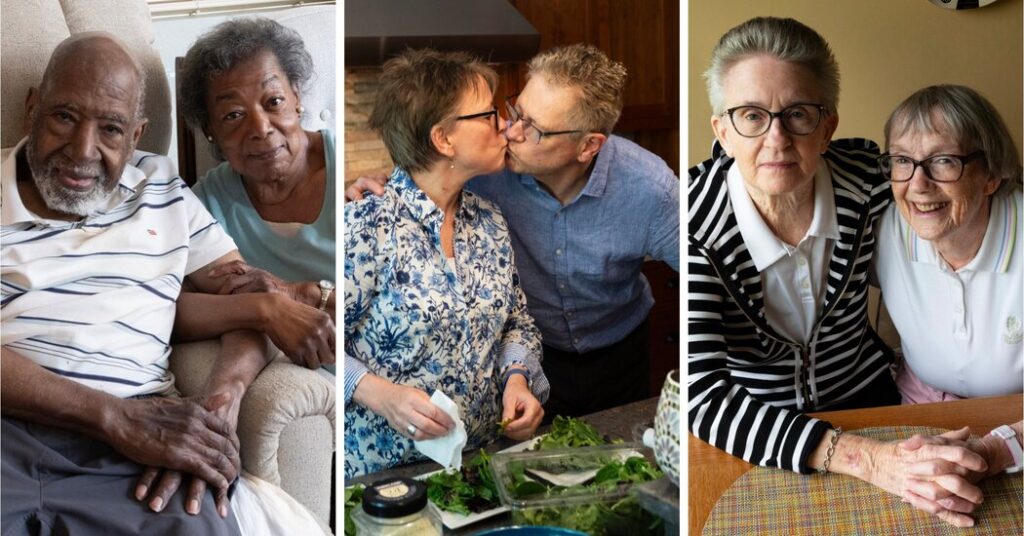
Couples married for decades reflect on how love, patience and resilience helped them weather life’s challenges and sustain lasting, meaningful unions.
Dec. 19, 2025
So what’s the secret to a strong, long-lasting marriage?
We could study rom-com movies or anniversary greeting cards to find the answers.
We turned instead to New York Times readers who have been married for more than 30 years to tell us what they have learned and what advice they might offer others. More than 2,200 people from all walks of life completed our questionnaire.
We read them all and spoke in depth with seven couples who have faced challenges, embraced change and found ways to sustain their love for three decades or more.
Here are their stories.
‘We fight all the time. We’re like oil and water.’
The secret to the longevity of Arnie and Susan Brooks’s 33-year marriage? Arguing.
“We fight all the time,” Ms. Brooks said. “We’re like oil and water.”
Fighting, they say, is important to their marriage: For Mr. and Ms. Brooks, even small arguments — often over small things like tone or her lateness versus his punctuality — have helped them navigate their different communication styles.
“It’s also important how you get past the fighting or through the fighting,” Mr. Brooks interjected, adding that couples counseling has given them the tools to resolve fights without destroying each other emotionally.
After a conflict-avoidant upbringing and a first marriage that faltered in part because fights were never addressed, Mr. Brooks turned to individual therapy, advice that ultimately led him to marry Ms. Brooks. He describes her as “a wonderful fighter.”
Mr. Brooks, 71, is a researcher, and Ms. Brooks, 64, is a real estate agent. They said they are at their best when they undertake large projects together, such as the Frank Lloyd Wright-inspired prairie-style home they live in and helped design in Bethesda, Md. The couple together have a daughter, Lauren, 30, and a son, Cal, 29; Mr. Brooks also has an older son, Max, 37, from his first marriage.
In 2013 (about 21 years into their 33-year marriage), Ms. Brooks told Mr. Brooks he was a “lousy kisser” during an argument about how often they had sex. He was hurt and angry; she worried that she might have ruined their marriage with a single remark.
“I wanted to have sex,” Mr. Brooks said. “She wanted intimacy.”
After a few days, he decided that he had to fix the issue. He found a kissing class at a sex toy shop for women in Washington, D.C. The class consisted of six couples and one throuple. According to both Ms. Brooks and Mr. Brooks, the class included an academic section and balanced theory with practice. And there was homework. Their first assignment was to make out in public for half an hour.
“It made so much sense,” Mr. Brooks said.
Today, Ms. Brooks said her husband is an excellent kisser.
“I give him an A.”
‘We saw that when we worked together on whatever we were doing, we would be stronger.’
Helen Singleton was resting at home in Los Angeles in early May 1961, deeply saddened after a series of miscarriages. Her husband, Robert Singleton, was organizing his fellow U.C.L.A. students to join the Freedom Riders, who were to ride buses and trains across the South starting that month to challenge and end segregation in public transportation. She joined him, and they arrived in a train station in Jackson, Miss., on July 30, walked into a whites-only waiting area and, along with other activists, were arrested. They were put on trial and endured cruel treatment at the notorious Parchman State Penitentiary. She was imprisoned for 25 days there. He served eight days more. By Nov. 1, 1961, the Freedom Rides led to the desegregation of interstate transportation in the South.
The Singletons were among the few married couples who participated in the Freedom Rides. They had “a very good marriage” before the Freedom Rides, Ms. Singleton said.
“But this drove us even closer together,” Mr. Singleton added, “because we saw that when we worked together on whatever we were doing, we would be stronger. It hardened our mettle.”
The couple met in a church in their hometown, Philadelphia, when she was 18 and he was 15. Smitten, Bob initially misled Ms. Singleton about his age. She made a checklist of traits she wanted in a spouse and checked off each item over the next few months as they dated.
They were married in July 1955 in Monterey, Calif., where Bob was studying German while serving in the Army. This year, they celebrated their 70th anniversary and have three sons and three grandchildren.
“We’ve been giggly teenage friends, passionate lovers, supportive activists, hopeful parents, teammates in every endeavor and, now, patient and caregiver,” Ms. Singleton said, in reference to his health.
When their grandson, Mekhi Robert Singleton, 27, got married last year, he asked for advice.
“Don’t sweat the small stuff; it can be managed,” Ms. Singleton told him. “The important thing is integrity. We agreed early on to respect each other, particularly in public. It’s just the normal way to behave toward someone you love.”
Also, “have fun together,” she added.
‘We needed the support of each other.’
Art Murr, by his own account, was shy and uncomfortable in social situations. But when he saw a striking, tall, brown-haired woman sitting across from him in a bar in 1977, he summoned his courage, walked over and blurted out: “You look bored.”
Denise Murr saw him approaching and noticed that he was also tall and “pretty nice-looking.” They discovered they were both 25 and grew up a couple of towns away from each other on Long Island — she in Williston Park, he in New Hyde Park. Ms. Murr was a special-education teacher; Mr. Murr worked with computers. They started dating and were married two years later, on June 23, 1979, in East Williston, N.Y. They adopted a baby son, Matt, who was born on Dec. 19, 1985. They brought him home that Christmas Eve.
“People used to say we were the perfect family,” Ms. Murr said.
When Matt was 17 years old, he became addicted to drugs. He went in and out of rehab, getting clean for a few months and then relapsing.
“We had lots of trouble dealing with it, separately and together,” Mr. Murr said. “We fought, and it was absolutely terrible. In my mind, we had to do it together because it could rip a family apart.”
After eight years of struggle, Matt finally seemed to be turning a corner. On his 25th birthday, Dec. 19, 2010, the three of them went to a restaurant in Manhattan’s Chinatown to celebrate.
Two months later, Matt died of an overdose. The Murrs’ world collapsed.
“We became even closer because we needed the support of each other,” Ms. Murr said.
“But it was hard —” Mr. Murr added.
“To go on,” Ms. Murr finished his thought.
“It was horrible,” Mr. Murr said.
Together, they threw themselves into drug rehabilitation advocacy work, lobbying lawmakers and speaking at halfway houses and churches.
In 2018, they moved to Oxford, Md., a small town near the Chesapeake Bay. And every year on Dec. 19, they eat at the restaurant in New York City where they dined on Matt’s last birthday.
“We have each other, and we adapt,” Ms. Murr said. “Plus, a sense of humor brings us back every time we drift. Marriage can be a challenge at times. Why would anyone want to make it any harder?”
‘Does that person make you want to be a better human being?’
Do you define the beginning of a 53-year love story by an engagement ring or a wedding? Was it that exquisite night when Debbie Hepburn and Kathy Hatch sat talking alone for hours with their fingers barely touching each other at Ithaca College in 1972? Was it the exhilaration they felt the next day when they had their furtive first kiss?
“Being lesbians in 1972 was very different than it is now,” Ms. Hatch said. “I knew that not only could you not get married, you could never be yourself in most places. I think the adversity that we faced because of the discrimination made us stronger.”
While there have been many external challenges, including opposition from their families, staying together never felt like hard work, Ms. Hepburn said.
“Once we were together, we just stayed together,” she added, “falling in love with each other over and over. In every couple’s life, there are going to be tribulations; there are going to be triumphs, successes, debacles of all kinds. That is the price we pay for living a lovely, fabulous life. We had our own world, and so we could define how we would operate within our own world, where we actually had power.”
For decades, their vacations in Provincetown, Mass., were the only times they felt comfortable holding hands in public. Although they had committed to each other by exchanging rings on Aug. 27, 1972, a few months after their first date earlier that year, they were married on the beach there on Aug. 27, 2008, with only an officiant and a photographer present, four years after Massachusetts legalized same-sex marriage — and seven years before it became legal nationwide.
Ms. Hepburn and Ms. Hatch, both 74, are retired now and live in New Hartford, N.Y. Ms. Hepburn was a high school English teacher for 40 years. Ms. Hatch was a women’s high school and college basketball coach and then a hospital administrator. Ms. Hepburn golfs whenever she can, and Ms. Hatch volunteers as an advocate for residents of a nursing home.
Ms. Hepburn was recently asked by a former student: How do you know if someone is the right person for you?
“Does that person make you want to be a better human being?” Ms. Hepburn asked. “If the answer is yes, that is your person.”
But she also advises people not to settle if they have any doubts or hesitations about a potential life partner.
“I have known too many people — wonderful, brilliant, vibrant, fabulous women — who, I have to say, have settled for men not of their caliber,” Ms. Hepburn said. I refuse to accept that that is necessary. I do not believe that is the way to lead a loving and happy life.”
‘Marriage is an enterprise.’
Arundhati and Tapas Sanyal met for the first time in 1984 at her parents’ house in Kolkata, India (then known as Calcutta). Mr. Sanyal was so shy that he couldn’t look her in the eyes when he spoke. She did not want to be there.
Their meeting was the first step in an arranged marriage. The couple were married the following year, on May 8, 1985.
Ms. Sanyal’s goal was to study abroad and pursue a career in academia. She thought marriage, at that point, would quash her aspirations. Mr. Sanyal wanted to get a Ph.D in engineering. They both were highly practical and focused on creating the lives they envisioned. Looking back after 40 years, they both say that their marriage is strong and that their parents chose well.
“Marriage is an enterprise,” Ms. Sanyal said. “There has to be romance, I’ll give you that, but there’s also the practical reality of making a life and moving it forward.”
The cold winters were uncomfortable for them when they moved to Newark, N.J., in 1985. Mr. Sanyal started getting up early to warm his wife’s shoes in the clothes dryer.
“Romance can be found in small gestures,” he said.
They have accomplished many of their goals. She was awarded a Ph.D in English literature from the City University of New York Graduate School of Journalism, and he received a master’s degree in engineering from the New Jersey Institute of Technology. Ms. Sanyal teaches writing at Seton Hall University, and Mr. Sanyal manages large transportation projects for the New York State Department of Transportation.
The Sanyals are Hindu and every evening they pray together at their home in Kendall Park, N.J., in front of a shrine that includes images of deities, gurus and their late parents. “It is a place of comfort,” Ms. Sanya said. “It is a place of quiet. It is therapeutic.”
Their son, Adit, 34, is a doctor, and their daughter, Ishani, 26, is a lawyer. Both are single.
Ms. Sanya said that her children regard an arranged marriage as “taking a huge leap of faith.”
“In certain ways, young people dating today are taking a huge leap of faith as well,” she said. “They are swiping left and right without getting anything. It’s tough.”
‘We desperately had to cling to each other.’
Nancy and Jim Otte grew up in Zeeland, Mich., a very small town that was split between those who attended the more conservative Dutch Reformed Churches and those who attended the less conservative Dutch Reformed Churches.
“We were actually a mixed marriage from two different parts of the Dutch Reformed Church that didn’t like each other very much,” Mr. Otte said.
Their wedding reception in Grand Rapids, Mich., on Aug. 14, 1970, “was dry and not much fun,” Ms. Otte said. There was no dancing and no alcohol in deference to the beliefs of Mr. Otte’s family. Mr. Otte sneaked a quote from the Lebanese American author Kahlil Gibran into the service.
Ms. Otte, who has been deaf since birth, grew up reading lips and speaking, which is how she communicates with Mr. Otte. She was attracted to him because “he was kind,” unlike most other men she encountered.
“Since I was a little deaf kid, I could always tell if somebody had integrity or was a liar,” she said. “I remember walking down the aisle in our wedding, and my inner voice said, ‘This is right, just keep going.’”
While her deafness is not a major difficulty in their relationship, they have faced other challenges.
The younger of their two sons, Benjamin, known as B.J., was born with severe disabilities. He could not walk or talk, used a wheelchair and had up to 50 seizures every day. B.J. lived at home until he was 7, when Mr. Otte and Ms. Otte could no longer care for him full time and placed him in a long-term facility. However, his coming home almost every weekend brought the couple, and the entire family, closer together and are among Ms. Otte’s fondest memories of the marriage, she said.
“We desperately had to cling to each other, even though we didn’t always agree on what to do,” she said. “There was so many moments of utter joy.”
B.J. died in 2013 at age 35.
Ms. Otte taught the deaf and hard-of-hearing. The couple moved several times for Mr. Otte’s career in retail management and eventually relocated to Portland, Ore., nine years ago to be near their other son, David, daughter-in-law and grandchild.
Mr. Otte, 80, and Ms. Otte, 78, often took long walks along the Willamette River. Lately, Ms. Otte has stayed closer to home to care for her aging service dog for the hearing-impaired, who is now deaf and blind.
Mr. Otte often reads or writes while Ms. Otte plays classical music on the piano. He hears the piano. She hears a bit of the music but feels the vibrations through her fingers and the floor beneath her feet.
“You have to be in love, but you also have to like each other,” Mr. Otte said. “You have to be willing to give and take. We’re very different, but somehow we’re compatible.”
‘He gives advice. Sometimes I take it, sometimes I don’t.’
Lillian and Arnold Mercado met as teenagers in New York City on a blind date in 1958 — she was a “stay-at-home girl,” and he was a quiet boy in a rush to work his way out of poverty.
“We saw a sad movie, then we went to Central Park and he took me on a boat ride,” she said. “We started going steady.”
Ms. Mercado, then 16, found him to be relaxed and fun. Mr. Mercado, then 18, admired her legs. They shared a Nuyorican heritage, born in the same town in Puerto Rico but raised in Washington Heights.
In 1961, he joined the Army and was stationed in Germany. The next year, he came home on leave, and they got married on a frigid day, Dec. 29, 1962. They honeymooned at the Americana, a fancy new hotel in Midtown. They kissed as the ball dropped in Times Square. The next year, they had the first of their two sons, although, now, looking back, Ms. Mercado thinks they should have planned more and been in less of a rush.
There were good times and hard times.
“He had some problems with drinking,” she said, “but I held on because of the kids.”
In the mid 1970s, realizing the seriousness of his problem, Mr. Mercado began attending Alcoholics Anonymous meetings and stopped drinking.
“I had no choice,” he said.
Now, they are retired and still living in Washington Heights in an apartment on a very steep hill that has become increasingly difficult for them to climb. Mr. Mercado, 87, worked mostly at hospitals assisting anesthesiologists. Ms. Mercado, 85, had several government jobs, including fielding complaints at a local community board. Ms. Mercado takes care of Mr. Mercado, who is diabetic and has difficulty walking.
“He’s always a sweet person, always gentle, always kind,” she said. “He gives advice. Sometimes I take it, sometimes I don’t, sometimes I forget what he said.”
“Make sure you say good night to each other each night,” Mr. Mercado added, “because you don’t know what the next day is going to bring.”
Produced by Charanna Alexander and Tanner Curtis
James Estrin is a photographer and writer who has been with The Times since 1992.
The post Lessons From Decades of Marriage appeared first on New York Times.