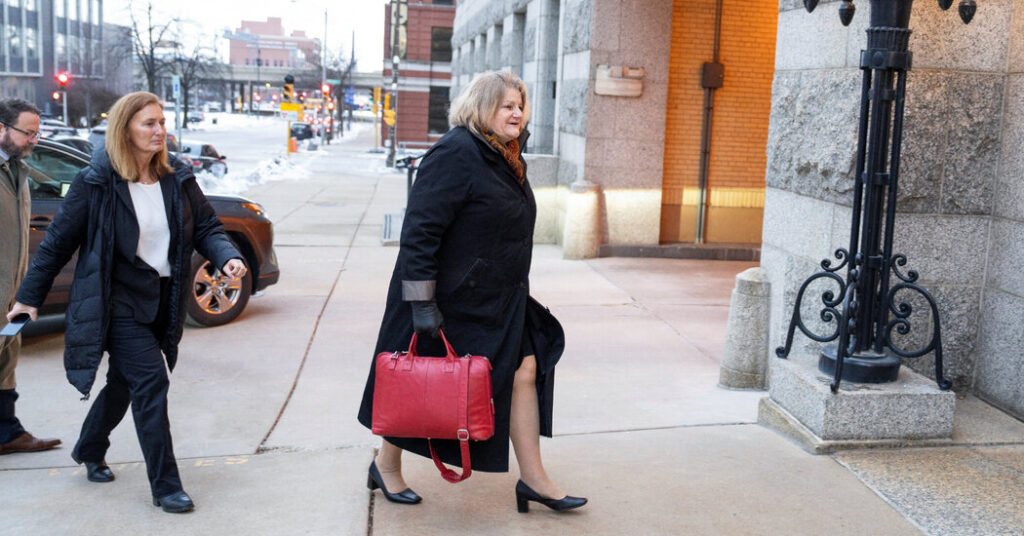
Hannah C. Dugan, a Wisconsin state judge, was found guilty on Thursday of obstructing federal agents, a high-profile victory for the Justice Department in a prosecution of a judge who it said was illegally aiding an undocumented immigrant. She was acquitted of a less serious charge of concealing a person from arrest.
The trial, which began on Monday, presented two starkly different views of Judge Dugan. Prosecutors argued that she was a judge who brazenly broke the law, letting her own views on immigration get in the way of her official duties.
Kelly Brown Watzka, a prosecutor, asserted in her closing argument that Judge Dugan had replaced the law with her personal preferences on immigration policy. “Common sense tells you that the defendant knew what she was doing was wrong,” she said, “and she did it anyway.”
The defense maintained that she was simply a judge using her broad authority. Judge Dugan was trying to act properly in her own courtroom, the defense said, while contending with a vague and confusing set of guidelines from her courthouse leadership on how to deal with Immigration and Customs Enforcement agents. Agents had recently begun making arrests in the county courthouse, testimony showed.
“She never acted corruptly in doing her job as a judge in the middle of a stressful, new and confusing situation,” a defense lawyer, Jason Luczak, said in closing arguments.
The jury, a panel of seven men and five women, was chosen from a pool of Wisconsin residents from 12 counties. They deliberated for six hours.
Over the course of four days, the jurors considered testimony from more than two dozen witnesses, audio recordings and video footage from April 18.
In testimony, witnesses described a frenetic morning in April at the Milwaukee County Courthouse, where Judge Dugan was preparing for a full calendar of misdemeanor cases. One of the criminal defendants on her docket was Eduardo Flores-Ruiz, a Milwaukee resident facing domestic battery charges.
As Judge Dugan was soon to begin the first hearing of her day, she was notified by a court clerk that ICE agents were in the hallway outside her courtroom.
“I was upset and a little bit outraged,” the clerk, Alan Freed, testified in court.
A team of six agents, all in plainclothes, were stationed throughout the public hallway, sitting on benches and waiting for Mr. Flores-Ruiz to complete his hearing so that they could arrest him. Witnesses said that Judge Dugan had abruptly left her courtroom, entered the nearby courtroom of another judge and motioned for that judge to follow her into the hallway, where they approached an agent.
Jeffrey Baker, a special agent for the Federal Bureau of Investigation who was a member of the arrest team, testified that Judge Dugan had “seemed to be angry at that point” as she asked him what his purpose at the courthouse was and then told him to go to the office of the chief judge.
After directing several other federal agents to the chief judge’s office, Judge Dugan returned to her courtroom and told Mr. Flores-Ruiz’s lawyer, Mercedes de la Rosa, that they could find a new date for his hearing. Audio recordings played in court revealed that Judge Dugan had conferred with Joan Butz, the court reporter, in a whisper, saying that Mr. Flores-Ruiz could leave through a side door that is not open to the public.
“I’ll do it,” Judge Dugan was heard saying on an audio recording. “I’ll get the heat.”
Judge Dugan did not testify in her own defense, and both sides sparred over what the judge had intended to do when she led Mr. Flores-Ruiz and his lawyer to the side door.
The side door leads to a hallway with two more doors: one that opens into a stairwell, and another that opens back into the public hallway, where two federal agents were waiting.
The pair proceeded down the hallway and back into the public hallway, rather than choosing the stairwell.
“Her intent was to send him where they went,” Mr. Luczak, a defense lawyer, told the jury.
But prosecutors said that Judge Dugan had intended for Mr. Flores-Ruiz and Ms. de la Rosa to exit down the stairwell and evade the agents.
“She intended to get Flores-Ruiz out of there fast, before the agents could find him,” Ms. Brown Watzka said. “And how was she going to do that? Sneak him out the back door, through the restricted hallway and down the stairs.”
Ms. Butz, the court reporter, testified about the conversation and acknowledged that she was concerned that they would not know how to head down the stairs.
Ms. de la Rosa, the defense lawyer for Mr. Flores-Ruiz, testified that she had been confused when Judge Dugan escorted her through the side door into a long hallway.
“I remember being scared and freaked out,” she said.
Two federal agents arrested Mr. Flores-Ruiz after a brief foot chase.
Throughout the trial, prosecutors portrayed Judge Dugan as frustrated by the idea of immigration arrests in the courthouse. In early April, emails presented in court showed, Judge Dugan pressed the chief judge of the courthouse, Carl Ashley, to develop a policy that would guide judges on how to handle the arrival of federal officials.
Judge Ashley testified during the trial that he had not been in the courthouse on April 18 but had been notified that immigration agents were present.
When he heard about the confrontation involving Judge Dugan and the agents that morning, he texted her, asking her to call him.
She responded by text hours later, saying that she had been at Good Friday services. Judge Ashley changed course, telling her not to return his call.
“I was concerned about what might have happened, and I just didn’t want to put her in a position to have to talk to me about it,” he said in his testimony.
Judge Lynn Adelman of U.S. District Court, who was appointed by President Bill Clinton, presided over the trial.
Judge Dugan, 66, has been on administrative leave since April but has continued to collect her $174,000 salary. She was temporarily removed from the bench by the Wisconsin Supreme Court while the case against her worked its way through the court.
Julie Bosman is the Chicago bureau chief for The Times, writing and reporting stories from around the Midwest.
The post Judge Convicted of Obstructing Agents as They Sought Undocumented Immigrant appeared first on New York Times.