The sham trial of media tycoon and democratic activist Jimmy Lai in Hong Kong has ended with an 855-page guilty verdict. Sentencing, which is expected next year, could mean the 78-year-old will die as he has lived since his arrest five years ago — in a cell the size of a closet, in solitary confinement with only his Catholic faith for comfort.
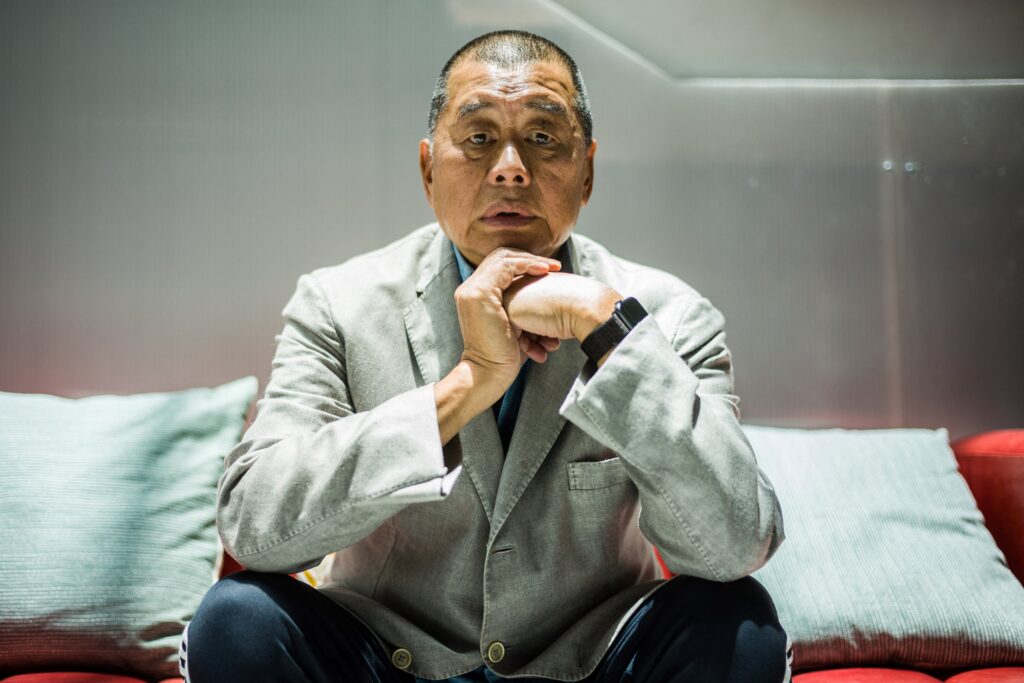
He faces a sentence of life, which many fear wouldn’t take long. Lai, a diabetic, is ailing and diminishing by the day. His daughter, Claire Lai, described her once-larger-than-life father at a news briefing Monday in D.C. Having lost significant weight, he suffers from heart disease and infections, she said, and is losing his vision and hearing. When she visits him, she sees that his nails are discolored and falling off. His teeth are rotting. In the courtroom where he was paraded before spectators for 156 days, Lai appeared pale. “You could tell he was shivering,” she said. Some days he couldn’t stand or walk.
This image contrasts starkly with the robust, bon vivant billionaire who arrived in Hong Kong as a child stowaway and grew up to become a successful businessman, eventually creating the pro-democracy Apple Daily newspaper, where Lai promoted free speech and the rule of law. China had promised to protect such freedoms when Britain handed over Hong Kong in 1997. But communist regimes aren’t widely heralded for their commitments to truth, justice and liberty for all. Thus, China imposed a national security law on Hong Kong in June 2020 following massive pro-democracy protests. The law criminalized secession, subversion and collusion with foreign forces. Lai was charged with conspiracy to collude with foreign forces and sedition.
Lai did nothing of the sort, though he did once meet with Rep. Nancy Pelosi (D-California) and then-Vice President Mike Pence. The activities for which he was charged, however, were before the national security law’s imposition.
“It was a test case,” Jonathan Price, a barrister on Lai’s international legal team, said at the Monday briefing. “The law was brought in to challenge people engaged in peaceful protest. It was essential that this showcase event end with a conviction.”
The court’s rendering, he said, is a “testament to the death of the rule of law in Hong Kong.”
In short, Lai is China’s warning to other activists and journalists who would dare speak freely against Beijing. Leaders in the United States and Britain, among others, have urged Lai’s release for humanitarian reasons, but Beijing hasn’t budged. I would argue China has made its point. Hong Kong’s Democratic Party disbanded on Sunday, a day before Lai’s verdict.
To some readers, Lai’s reprehensible persecution may seem worlds away and none of our business. Even Britain, where Lai is a citizen, has been slow to act on his behalf. With a few noble exceptions, the country was nearly mute, while President Donald Trump proved the more reliable advocate, mentioning Lai’s plight during recent trade talks with China. Inarguably, Lai’s fate should be a global concern.
Jodie Ginsburg, chief executive of the Committee to Protect Journalists, said at the briefing that a record number of journalists are in jail worldwide. “So, this case matters not just for Jimmy Lai and Jimmy’s family, but it matters for press freedom globally,” Ginsburg said.
Sadly, Lai’s suffering seems to have escaped most people’s attention, while China’s influence is vast and growing. Like a massive octopus, its tentacles are reaching around the globe, through technology, investments, acquisitions and not least through its massive Belt and Road Initiative. Launched in 2013, the BRI is modeled after the ancient Silk Road and aims to create trade routes by land and sea. The original goal was to physically connect Asia to Europe, but in the decade since it has expanded to Africa and Latin America.
In the U.S., Chinese companies have bought 384,000 acres of agricultural land and Smithfield Foods, the nation’s largest pork producer, raising concerns in D.C. that China might have control over these properties, especially since many of these purchases are near sensitive sites, including military installations. At least Chinese expats working in the U.S. will have little trouble adapting to the current government’s fashionable posture of hating the press. Maybe instead they’ll begin to appreciate our freedoms, all of which start with speech — and end when speech is censored or controlled. This is proving true in Hong Kong, as it has elsewhere and throughout history.
Lai’s only crimes were fealty to freedom, commitment to the Catholic Church and the unflinching courage to remain in Hong Kong with fellow freedom fighters to face his jailers rather than jump ship when he could have. Today, his only hope for release comes, ironically, from a man who shares China’s disdain for the press. Trump and China still have a few trade details to work out. Let’s hope one of them is Lai’s freedom.
The post Jimmy Lai’s last hope might be an unlikely figure appeared first on Washington Post.