
President Donald Trump and his Homeland Security chief have seized on the mass shooting at Brown University as an excuse to end an iconic immigration lottery that millions of people enter every year.
Officials announced Thursday that the suspect in last Saturday’s attack, which left two students dead and nine injured, had been found dead in a storage container of a self-inflicted gunshot wound.
Claudio Neves Valente, 48, was a Portuguese national who had been admitted to a Ph.D. program at Brown in 2000, though he never completed his degree, the university’s president said.
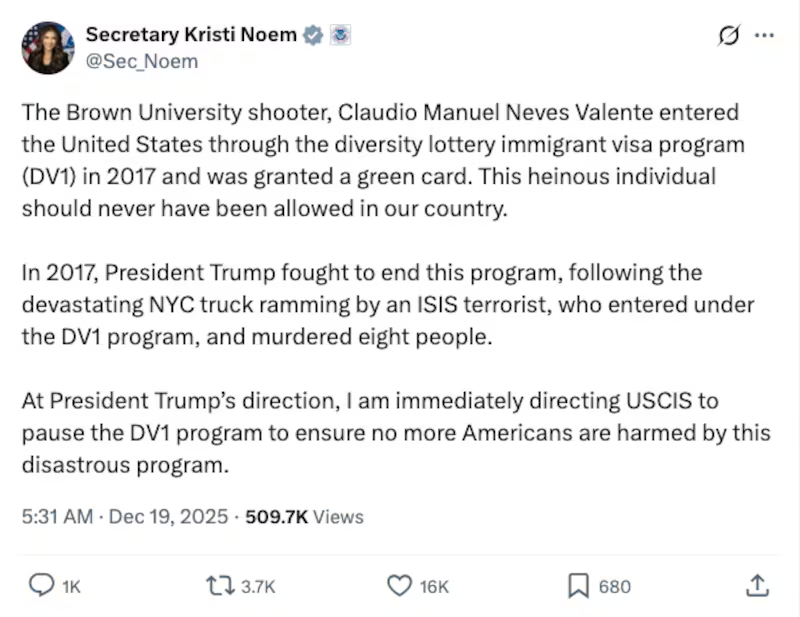
He later “entered the U.S.” in 2017 on a Diversity Visa, which is commonly referred to as the “Green Card Lottery,” and became a lawful permanent resident, Homeland Security Secretary Kristi Noem said late Thursday in a statement on X.
“This heinous individual should never have been allowed in our country,” Noem wrote. “At President Trump’s direction, I am immediately directing USCIS to pause the DV1 program to ensure no more Americans are harmed by this disastrous program.”
The DV program allows citizens of countries that have low rates of immigration to the U.S. to enter a lottery system that randomly selects about 55,000 winners to apply for green cards, with their spouses and children eligible to join them.
This year, about 131,000 people were invited to apply for green cards, including winners and their families, out of a whopping 20 million people who entered the lottery worldwide, according to the State Department.
Visa applicants are vetted for criminal and security-related issues before being allowed to enter the U.S.
Between 1994 and 2023, the most recent year for which data is available, more than 1.37 million people were admitted to the U.S. through the lottery program, according to DHS data.
Soccer star Freddy Adu’s family came to the U.S. thanks to the lottery program, as did actor David Charvet. Other winners have gone on to become doctors, attorneys, physics instructors, and even airmen in the U.S. Air Force.
The visa is often described as a “golden ticket,” with some winners applying over and over again before finally being selected.

One nurse anesthesiologist who won in 2003 told Voice of America that she began “jumping up and down” with joy when she found out she was going to the U.S.
Critics, however, have long argued that the program poses security risks, according to The New York Times.
During his first term, Trump called for the visa to be eliminated after a 29-year-old Uzbek man pledging allegiance to ISIS killed eight people by driving a truck down a New York pedestrian and cycling lane.
The suspect, who was convicted and sentenced to eight consecutive life sentences, had entered the country through the green card lottery.

At the time, the BBC reported that the Trump administration does not have the authority to unilaterally end the program, which Congress created with the Immigration Act of 1990.
The Daily Beast has reached out to the White House for comment.
Officials said the suspect in the Brown University case, Neves Valente, did not have a criminal record. He was living in Florida but flew to New Hampshire, where he fire Saturday afternoon on a lecture hall at his former university.
He is then believed to have murdered a prominent nuclear fusion professor at the Massachusetts Institute of Technology, Nuno Loureiro, who was also Portuguese, on Monday.
Police said Thursday they were still trying to determine a motive for the shocking killings.
The post ICE Barbie Uses Shooting to Shut Down Iconic Green Card Lottery Program appeared first on The Daily Beast.