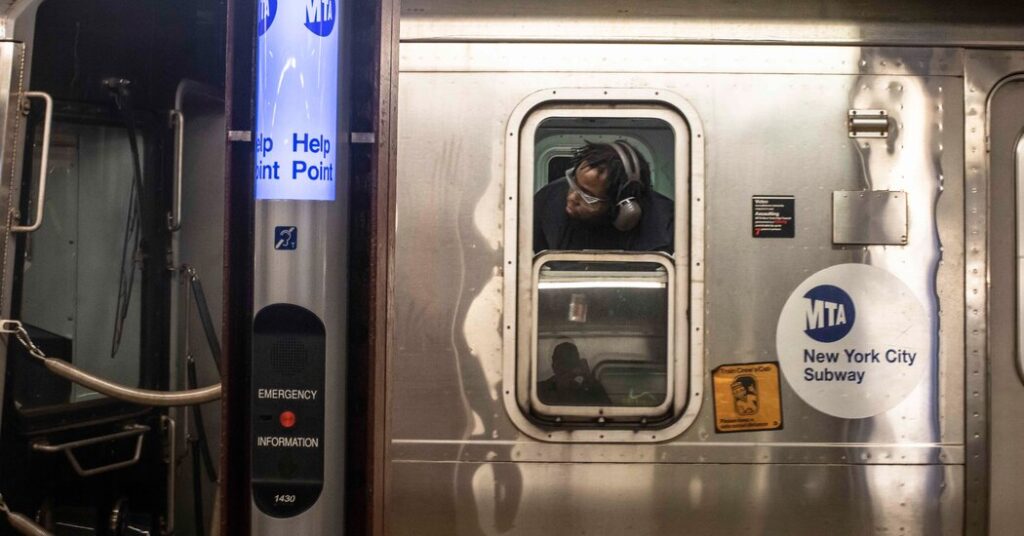
Gov. Kathy Hochul is expected to veto a bill on Friday that would require every New York City subway train to have a conductor on board in addition to a driver, according to three people familiar with her decision.
The bill, which the State Legislature passed this year to the surprise of many transit experts, would have enshrined into law the two-person crews that are currently standard on most trains while requiring the same on the few trains now operated by one person.
The issue is politically fraught for Ms. Hochul, a Democrat who is seeking re-election next year. The powerful Transport Workers’ Union, which represents subway workers and supports the bill, says the requirement would protect riders and deter crime. Critics of the legislation say two-person crews are costly, inefficient and outdated.
The subject of two-person crews is typically a sticking point in contract negotiations between the Metropolitan Transportation Authority, which operates the subway, and the union, which does not want the jobs of its roughly 3,600 conductors eliminated.
John Samuelsen, the union’s international president, said he was disappointed by the likely veto, and would rather strike than agree to removing conductors, who control train doors and make announcements, from more trains.
“They’re not going to get rid of the conductor,” he said.
Representatives of the governor’s office and the Metropolitan Transportation Authority, which operates the subway, did not immediately respond to requests for comment.
Opponents of the bill expressed relief about the expected veto, noting that the law would force the authority to immediately spend about $10 million more a year to hire second crew members for the train lines that do not already have them.
New York City’s subway system lags behind most major transit networks in adopting one-person, or even fully remote, train operation, said Eric Goldwyn, a program director at New York University’s Marron Institute of Urban Management.
In a review of more than 400 train lines in more than a dozen countries, just 6 percent still required two-person crews, according to an Marron Institute analysis. In New York, only a small number of shuttle trains and shorter lines operate without conductors.
Allowing the M.T.A. to shift some trains to single-person operation would free up money for more frequent service, especially on lines that have been improved with modern signal systems that allow trains to be controlled remotely, Mr. Goldwyn said.
“Making requirements for jobs just for the sake of having a job is not the best pathway forward,” Mr. Goldwyn said, adding that any decision on the staffing of trains would ultimately be decided between the M.T.A. and its labor unions.
The authority spends more on labor than nearly any other expense, roughly two-thirds of its annual operating budget of about $21 billion.
Ms. Hochul’s expected decision does not mean conductors will be taken off trains immediately, or at all. Some transit experts believe there are trains, especially those that travel on long, curving tracks, that can still benefit from a second pair of eyes.
But the likely veto leaves open the possibility that new train service, including the proposed Interborough Express line, could experiment with single-person or remote operation.
Mr. Samuelsen, the union leader, said the decision to veto the bill was “classist,” and will put the governor at odds with blue-collar voters during her re-election campaign next year.
“Good luck to her,” he said.
Benjamin Oreskes contributed reporting.
Stefanos Chen is a Times reporter covering New York City’s transit system.
The post Hochul Expected to Veto Bill Requiring 2-Person Crews on Subway Trains appeared first on New York Times.