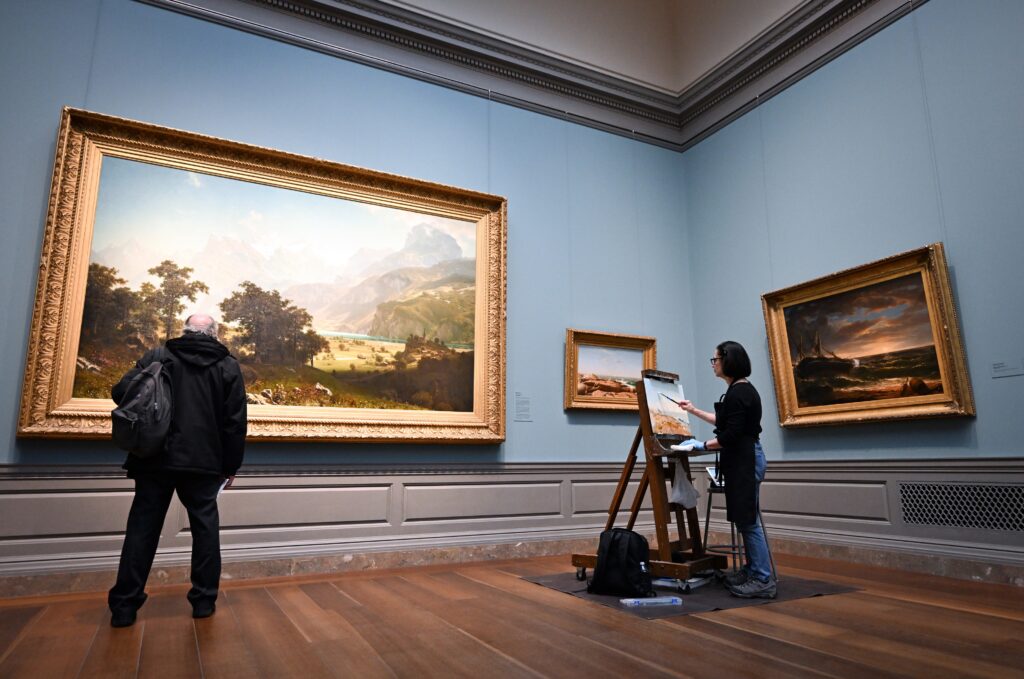
I just had a most eventful week.
I watched in horror as a terrible storm in the Mediterranean dashed a ship against a rocky coast, forcing its crew and passengers into a desperate attempt to save themselves and rescue their cargo.
I soared with the birds among snow-covered peaks in the Rockies, marveling at the many shades of white and blue.
And I joined picnickers on a serene hillside along the Hudson River, where I watched the sunlight and clouds play above a sheep pasture and a tiny village beyond it.
What’s more, I did all of this in just 90 minutes at the National Gallery of Art in Washington. I took the museum’s “Finding Awe” tour and, with the help of staff, unlocked a sense of wonder I did not know I could feel while looking at art — in this case, a 1772 shipwreck scene by Claude-Joseph Vernet, a 1946 abstraction by Georgia O’Keeffe and an 1860 landscape by Jasper Francis Cropsey.
The National Gallery, working with University of California at Berkeley psychologist Dacher Keltner, has so far hosted 36 awe tours for the 800 people lucky enough to get a slot. You can also take a self-guided awe tour using the museum’s tools, or apply the same techniques to experience wonder while looking at art anywhere.
A growing body of evidence demonstrates that the experience of awe that visual arts can trigger has mental and physical health benefits for us. They are similar to the restorative effects produced by awe-inspiring natural settings, such as a mountain vista or open sea, but we can access them more easily. The best part is you don’t need to know anything about the art you are looking at.
“In some ways I think it’s actually easier if you don’t have an understanding,” National Gallery of Art Director Kaywin Feldman told me, because “that moment of ‘oh my goodness’ is part of wonder. You have to sort of stop in your tracks, have that moment of surprise.”
This was excellent news for me, because that one semester of art history I took in college didn’t stick. Until now, the primary feeling I’ve had when visiting a museum has been drowsiness. I call it “museum head.” I race through one of the world’s best collections — the Louvre, the Uffizi, the Prado, the Met — and glimpse as many works of art as I can take in until, overstimulated and overwhelmed, I find a seat near the gift shop and wait for the others in my party to finish.
But now I know the cause of museum head: I was doing it all wrong. The way to experience awe in visual art — in fact, the way to experience awe in any setting — is to slow down. The point is not to see it all but to see a few things, or even one thing, deeply.
Feldman’s first such awe experience came in Padua, Italy, when she was 22 and, though hungry, tired and dirty from her travels, she decided to see the Giotto de Bondone frescoes in the Scrovegni Chapel. “When I walked out of that chapel, I felt like I was walking on a cloud,” she recalled. “I thought life was so beautiful, such a gift. I fell back in love with humanity and felt such optimism for the future.”
Since then, she has made it her life’s work to help others experience such moments of wonder. She told me she once kicked a pair of donors off of a Florence art tour when they declined to visit the Uffizi because they already “did it” decades earlier. “You’re there to have an experience, not to check something off the list.”
To illustrate, she took me to see a 1659 self-portrait by Rembrandt and instructed me to study his face, brightly lit while all else in the painting was in shadow. His dark eyes locked on mine even as I moved from side to side. I studied the wrinkles in his forehead, the folds under the eyes, the loose flesh in the pallid cheeks. I could see a blood vessel on his bulbous nose, the whiskers of his thin beard and the individual curls in his hair. I saw sadness and maybe worry in that face.
After I took that in, Feldman explained the sadness. Rembrandt, 53 in the portrait, had just gone bankrupt and had to move from his home and sell his possessions. He had lost his wife and several children and had a financial dispute with a partner. “He’s looking at you and connecting and asking you to acknowledge him,” she said. For her, the wonder comes from this “direct connection with somebody who is no longer alive.”
I held the great man’s gaze from across the centuries and I felt a chill. This connection to immortality made my daily vanities and worries seem small and insignificant. It reminds us, as Feldman put it, that we are “part of something bigger.”
New research out of King’s College London gauged people’s physiological responses while they viewed works by Paul Gauguin, Vincent van Gogh, Edouard Manet and Henri de Toulouse-Lautrec for 20 minutes. The study, now in preprint, foundthat participants’ levels of the stress hormone cortisol dropped by 22 percent on average, while markers of inflammation dropped even more sharply and heart rhythms indicated greater relaxation.
This is consistent with other recent research connecting immersion in visual art to human flourishing, including by reducing pain and illness, raising levels of neurotransmitters associated with well-being such as serotonin and oxytocin, and increase feelings of altruismand cooperation.
“Simply slowing down to take in the simple beauties around us is an antidote to the moral ugliness of our attention-captured, online life, and visual art and the spaces of such contemplation a gym for such training,” Keltner writes in a forthcoming book.
“It’s mind-blowing,” the Berkeley psychologist told me, “that experiencing awe standing in front of a painting makes you feel more compassionate … and it makes you more interested in being a good citizen.”
In a sense, science is catching up with philosophy. The 13th-century thinker Albertus Magnus wrote that “wonder is defined as a constriction and suspension of the heart caused by amazement at the sensible appearance of something so portentous, great, and unusual, that the heart suffers a systole.”
So how can we induce that systole, or contraction, of the heart?
For some, awe will be found in the oldest art, which allows us to meet the ancients. For others it will be in the Impressionists, because they are crowd pleasers. Some find it standing back from a piece and thinking abstractly, while others find it by studying intricate detail. In all cases, it’s better if you don’t read up on the work of art beforehand, or even read the label. Just stop at something that catches your eye — and study it for 10 minutes or longer.
Nathalie Ryan, who runs the “Finding Awe” project at the National Gallery, has been working with the Harvard Graduate School of Education to bring the concept of “slow looking” to the art world.
“The research that we’ve done for years with Harvard has shown that the longer you look at something and give it your attention and really work to make sense of it yourself and connect, the more curious you become,” Ryan said. Curiosity, in turn, leads you to states of wonder and awe.
So Ryan and colleague Cassandra Anderson start the awe workshops with breathing exercises and a 15-minute icebreaker in which participants describe to each other moments of awe they have experienced. She then turns to the session’s piece of artwork, starting with 35 minutes of quiet meditation (“linger in the pleasure of just looking … taking in all the details of this work”) followed by a group discussion about emotions and impressions and possible symbolism and metaphors. Only when that is done does Ryan take 15 minutes to provide information about the work’s history and common interpretations, which participants then reflect on for the final 15 minutes.
In terms of brain science, Keltner explained, the slow looking activates the amygdala, which processes emotions, and the periaqueductal gray matter, which regulates autonomic functions such as heart rate and breathing.
“You let those images and forms move into your feelings, and you remember things, and it calls to mind images of your childhood or a place you’ve been, and you start to transport,” he said. But once you start learning about the work’s history, the action moves to the prefrontal cortex and its organizing function — and the awe process quiets down.
The National Gallery produced a set of two dozen flashcards that allow people to take a self-guided awe tour. (Though the cards aren’t distributed to the public, with permission, I’m publishing some of them alongside this column.) The selections range from the 17th to the 21st century and each contains a series of prompts to help you find awe.
Johannes Vermeer’s “A Lady Writing” comes with a prompt to “write a letter to your future self.” John Constable’s “Cloud Study” encourages us to go outside and watch the clouds and “contemplate their transient beauty.” Archibald John Motley Jr.’s “Portrait of My Grandmother” invites us to “remember a mentor’s advice” and contemplate “how might you pass this wisdom along.”
(Explore more tips for finding awe from the National of Gallery of Art)
Some of the works inspire awe by conveying the power of nature, or the moral beauty of its subject, or by making us contemplate spirituality or themes of life and death. But in all cases, Ryan said, “it’s a way of looking more deeply at ourselves and coming to understand ourselves in relationship to this world.”
If you can’t visit the National Gallery, you can use these prompts when looking at art wherever you live. Just find something that resonates with you — and skip the audio tour.
After the Rembrandt, my awe guides took me to see a work by sculptor Dario Robleto, “Small Crafts on Sisyphean Seas.” It is an intricate collection of seashells, urchin spines and teeth, coral, tusks, claws, butterfly wings and more, all arranged with precision and symmetry. The artist intended it as his “gift for the aliens, when we meet them,” as Feldman explained it. For some, it might provoke awe-inspiring thoughts about space and extraterrestrial life and induce them, as the flashcard put it, to “meditate on the interconnectedness of all things.” But I found it a bit too abstract to transport me. We moved on, sampling other works featured in the finding-awe tours.
I felt more of a connection when we visited O’Keeffe’s “A Black Bird with Snow-covered Red Hills.” Here, I was soaring with an oddly shaped bird in a blue sky, looking down at the blue fading to white where two snow-covered hillsides formed a “V.” It was exhilarating. And puzzling. After a few minutes, Ryan gave me some context: The bird was a nod to the artist’s late husband, Alfred Stieglitz, called by the nickname “Old Crow,” who had died just before O’Keeffe painted the work. Some see loneliness and loss. O’Keeffe herself described “the snow-covered hills holding up the sky,” and the black bird “always there, always going away.”
I came still closer to finding awe in Vernet’s “The Shipwreck,” which the artist paired with a tranquil harbor scene as pendants, “Moonlight.” The latter filled me with calm: A full moon illuminated the sea, which made barely a ripple as it touched the shore, where people slept, smoked, washed or stood around a campfire.
But the tranquility only accentuated the terror in the shipwreck scene, where people clung to the crow’s nest of the submerged ship and tried to slide down a rope to safety. Huge waves crashed on the nearby rocky shore, winds splintered the bough of a tree, and a lightning bolt made a fiery patch in an otherwise dark sky.
After I took in the scenes, Ryan explained that Vernet, influenced by Edmund Burke’s “Philosophical Inquiry into the Origins of our Ideas of the Sublime and the Beautiful,” was contrasting calm beauty with the frightful sublime. A quarter millennium later, the terror still chilled me.
It was in Cropsey’s “Autumn — On the Hudson River,” however, that I found my true awe moment. The massive panorama, five feet high and nine feet across, invited me in and held me there.
I was on a shaded hillside on a warm autumn afternoon, looking down toward the village and river beyond. I heard a gurgling waterfall in the foreground and smelled the earthy decay of fallen trees and leaves. A trio of hunters enjoyed a picnic on a blanket, a bottle of wine in their basket, while their dogs rested. I moved on into the scene, past the red-winged blackbird and the paper birch, past the cattle in the stream and the sheep dotting the pasture, to the kids and dogs on a wooden bridge. Ahead of me, a man on horseback passed a log cabin and headed down the road toward the village, where wood smoke rose from chimneys. Sailing ships and steamboats plied the river, framed by low clouds on the far shore and a rocky mountainside. Streaks of sunlight streamed from behind a cloud, igniting the gold and scarlet leaves.
It brought me thoughts of my grandparents’ house in the woods, then thoughts of my grandfather, and of how his love of the land became part of my life. I wanted to linger in the now-lost woodlands and wetlands in the painted landscape. In my chest, I felt a deep yearning, almost an ache.
The National Gallery staff, in its follow-up surveys of awe tour participants, found that 95 percent of respondents sought more awe in their daily lives, and half reported that they experienced more awe. I can confirm these findings.
In the days after my visit, I found myself pausing to marvel at things I often take for granted: A Christmas fern poking through the snow, the intricate forms of lichens on a tree, a sweet birch clinging to a rocky hillside, the pink and orange in a winter sunset, the power of a house-rattling windstorm. The more you seek awe, the more you find it.
The post Feeling wonder every day improves our health. Here’s how to do it. appeared first on Washington Post.