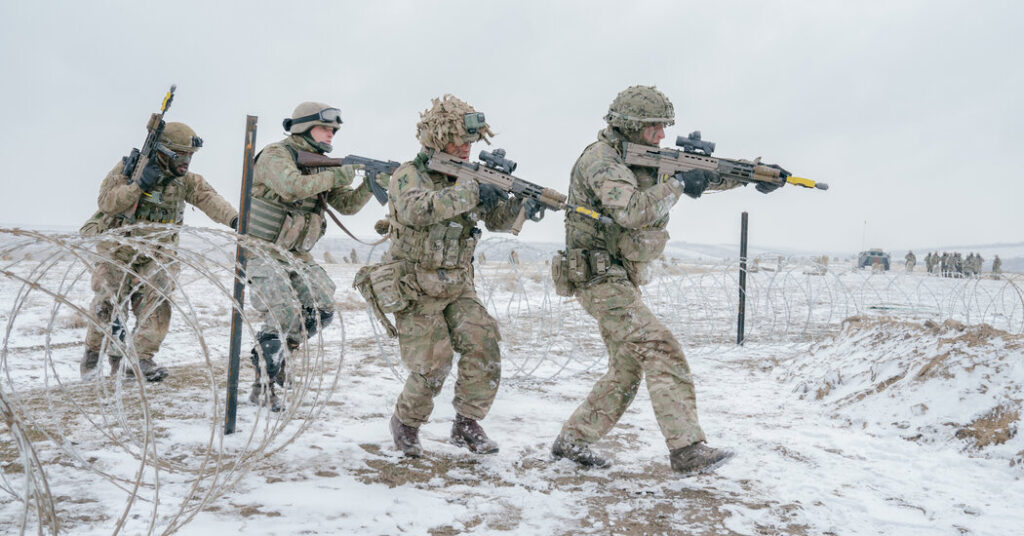
Britain’s last military force dedicated to defending the homeland was disbanded in 1992, after NATO leaders hailed a “promising era” of peace in Europe at the end of the Cold War and the government began scaling back military spending.
More than three decades later, Britain is again preparing for potential attacks on its soil.
With Secretary General Mark Rutte of NATO telling allies this month that “conflict is at our door,” Russia saying it is “ready” for war with Europe and President Trump’s increasingly vocal hostility toward European leaders, the British government is developing what it calls a “whole of society approach to deterrence and defense.”
It says that a wide-ranging home defense program will bring together the military, police and government departments to prepare for multiple scenarios. While a land invasion is not considered likely, military experts at the Royal United Services Institute, a British defense research institute, said the war in Ukraine and a spate of hybrid attacks in Europe demonstrated the possibility of assaults on critical infrastructure, through sabotage and drones.
Some military experts and lawmakers think the government is not moving fast enough.
“We are not ready — firstly in terms of resisting an armed attack, but also in terms of the wider threats,” said Tanmanjeet Singh Dhesi, a Labour Party lawmaker who chairs Parliament’s defense committee. He pointed toward the cutting of undersea cables and a steady drumbeat of Russia-backed cyberattacks.
“The home defense program is moving at a glacial pace,” he said.
Paul O’Neill, a senior research fellow at RUSI, said Britain’s defenses were “quite a long way behind” those of many Baltic and Nordic nations, like Finland, that have long run military service programs and trained civilians for conflict.
A former Royal Air Force officer, Mr. O’Neill expressed concern about training capacity and said that a sell-off of Ministry of Defense bases and housing in the 2010s could make it difficult for Britain to quickly muster a home defense force. “It will be a long slog, I think, for the U.K. to actually really turn this into something that is meaningful,” he said.
At the start of this year, Prime Minister Keir Starmer announced a landmark increase in military spending, to 2.5 percent of overall economic output by 2027, citing the “generational challenge” posed by Russia. In June, the government published a strategic defense review that said the country must move to “war-fighting readiness.”
That document called on the government to develop a new home defense force that would protect military bases and civilian infrastructure like energy and water sites.
That recommendation is being put into effect, according to a military official who was not authorized to speak publicly. But options for developing the force are still under consideration, the official said, and do not have to be presented to the defense secretary until December 2026.
Separately, Britain is working to recruit more volunteer reservists, who undergo training in the army, navy or air force. It is also increasing training and recruitment for the “strategic reserve,” which includes former military personnel who can be recalled to active service.
With Britain’s regular army having shrunk to around 70,000 full-time trained soldiers — the fewest since the start of the Napoleonic Wars — protecting the homeland is also expected to extend beyond the military.
Among the organizations taking part are the police, which have joined exercises including a simulated chemical attack in a rural Cambridgeshire village last month.
Mark Williams, the national police leader for civil contingencies, heads a working group that plans for disasters like flooding and pandemics. It has now created a dedicated role for home defense.
“We need to start to consider how we prepare society for potential conflict, either abroad or at home,” Mr. Williams said in an interview with The New York Times. He said the police were evaluating how officers would support the military “if the worst was to happen”: a new war, drone attacks, power outages.
They are also examining how the deployment of British forces overseas would affect law and order in Britain, where a significant number of armed police officers are army reservists. Mr. Williams said the discussions were “very immature, because there is a greater need for joint government work and clarity on what would be expected of us.”
During World War II, 1.7 million men who were above or below the age of conscription, or unfit for the frontline, volunteered for Britain’s “Home Guard,” which trained for a potential invasion by the Nazis. In the 1950s and 1960s, a similar group, the Civil Defense Corps, prepared for possible nuclear attacks. And the Home Service Force began in 1982, but it was disbanded after the Cold War.
The British government has released few details of the home defense program. In a statement, it said it would ensure “alignment between military and civilian effort — investing in homeland defense, increasing national resilience, and reconnecting the public with those who serve.”
It added that it would invest over a billion pounds on strengthening air and missile defense and would introduce a defense readiness bill in Parliament.
The post Britain Is Preparing for Attacks on Its Soil. Critics Say It Must Move Faster. appeared first on New York Times.