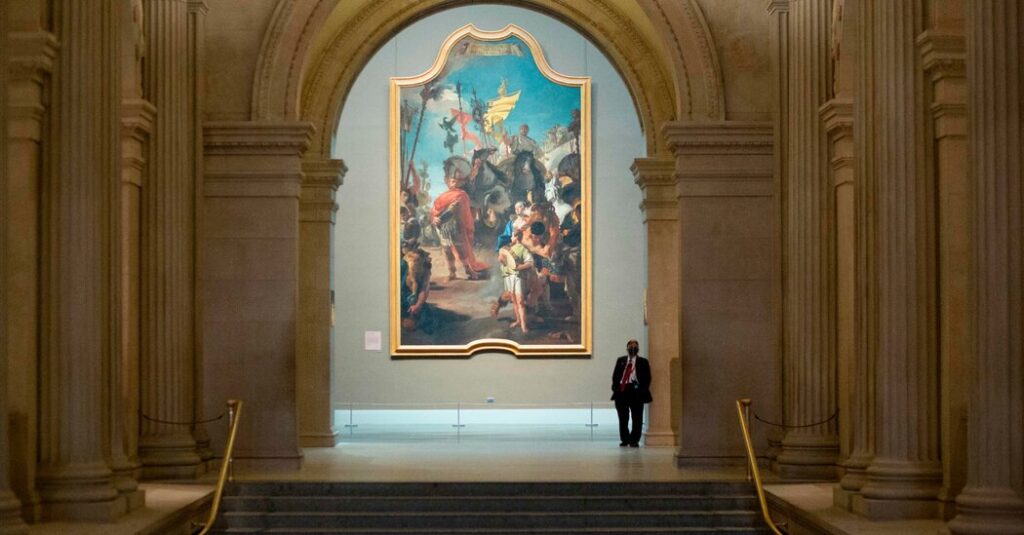
The brazen daylight heist at the Louvre has left many American museums reassessing their security measures, focusing on perimeter control, the adequacy of their security cameras and the timely availability of armed responders, security consultants and museum officials say.
Like all crimes, the Paris theft had its idiosyncratic factors, but all three of these elements played a crucial part at the Louvre, where thieves drove a stolen truck up to the museum on a quiet Sunday morning, extended an electric ladder to a second-floor window and broke in. They used disc grinders to extract jewelry valued at about 88 million euros, or $102 million, from cases in the gilded Apollo Gallery. None of the stolen material has been recovered.
“The biggest takeaway is, ‘Are your security people watching your perimeter aware of who is working at the museum?’” said Anthony Amore, director of security at the Isabella Stewart Gardner Museum in Boston. That museum lost 13 of its own works in 1990 in one of the largest art thefts in history.
Thefts of such magnitude always trigger self-reflection on the part of museum security chiefs, who are typically loath to discuss what they do or may lack as far as precautions are concerned. But private security consultants said it’s clear this heist drew their attention.
“The museums are evaluating what happened,” said James P. Wynne, a former F.B.I. art investigator who is now a partner at the ArtRisk Group.
Security experts acknowledged that their initial reaction to the Louvre heist had been one of surprise.
“The most visited museum in the world, arguably the most famous museum in the world — to see it robbed in broad daylight, that was really shocking,” said Geoffrey Kelly, a former member of the F.B.I. Art Crime Team who is now a partner with Argus Cultural Property Consultants.
Then the phone started ringing in his office and others staffed by those hired to ensure that the buildings that hold world treasures are not easy targets for thieves.
As a first priority, museum security plans typically focus on entrances, the most accessible point for thieves to enter and exit, pointed out Cathal Walsh, a security expert for Guidepost Solutions. But at the Louvre, the breach occurred upstairs at a window reached by the monte-meubles, a ladder truck commonly used in Paris to move bulky furniture into the higher floors of buildings.
At first glance, the apparatus appeared to be a maintenance vehicle and the thieves enhanced the illusion by posing as workers, wearing yellow high-visibility safety vests and setting out traffic cones.
Amore, of the Gardner Museum, said it’s important that museums ensure that officials who supervise maintenance and outside contractors are in communication with those responsible for security.
In many American museums, he said, security is notified when a contractor is scheduled to be at the museum, and those in a control center are told when those workers arrive on site. Often a guard would be assigned to accompany the workers.
It is not clear what protocols the Louvre had for the registration and tracking of contractors. It did have security personnel in control rooms with access to security cameras that monitored the museum’s exterior.
But French officials have acknowledged that the outdoor cameras were old and scarce. In a scan of the Louvre’s exterior, a New York Times reporter recently counted about 25 cameras on the museum’s perimeter, five of which were stationed on the outer walls and the rest on the walls of inner courtyards. The British Museum says it has several dozen surveying a much smaller perimeter.
Louvre officials initially said a crucial exterior camera covering the area the thieves targeted was pointed west of the balcony and so the break-in was not caught on film. But investigators last week said that, in fact, a camera near the scene of the break-in had clearly captured the thieves’ arrival at 9:30 a.m. and ascent to the second floor.
The problem, the investigators said, was that the museum’s control room does not have enough screens to show all the live feeds from the various cameras simultaneously, so guards have to toggle between them. On the day of the heist, the guards were focused on other live feeds, not the camera that was recording the thieves in real time.
This meant that two thieves were able to ascend to the balcony and begin cutting the window with power tools without being spotted in the control room, a lapse of four minutes that contributed to the delay in a police response.
In fact, the investigators said the guards did not switch to the live feed from the camera showing the balcony until the thieves had already descended and fled at about 9:38 a.m.
Since the heist, the museum has said it plans to introduce a hundred more security cameras on its perimeter, while new concrete bollards and other anti-ramming devices would hinder vehicles from getting close. It also plans to increase the police presence.
Many major U.S. museums have in recent years added systems that deploy powerful, high-resolution perimeter cameras. Some are now working to enhance that capability by using artificial intelligence, not museum staff, to examine and analyze camera feeds that alert guards to unusual behavior.
“They want to enhance their electronic security to provide a better layer of protection, an additional layer of protection,” said Steven Keller, who has advised organizations like the Smithsonian Institution and the National Gallery of Art in Washington. “Systems like that never sleep.”
Wynne, of the ArtRisk Group, said some U.S. museums are checking that they have introduced all the measures they were supposed to under their prior risk assessments.
“They need to have a command center, a 24/7 command center, and they need to have perimeter patrols,” he said.
At the Louvre, the police were ultimately alerted by a passing cyclist who thought the maintenance activity seemed odd and by the command center when an alarm went off as the second-floor window was breached. Additional alarms sounded when the display cases were cut.
The police responded in three minutes, but by that time the thieves had already sped off on high-powered motor scooters with eight items, including a tiara once worn by Empress Eugénie, wife of Napoleon III. It is set with nearly 2,000 diamonds.
“We didn’t spot the thieves’ arrival early enough,” the Louvre director, Laurence des Cars, said at a public hearing.
Four people believed to have carried out the theft have since been arrested and charged, based in part on DNA evidence found, for example, on a display case and one of the scooters the thieves used to get away.
Though guards in the Louvre gallery had confronted the thieves, they were unarmed and were threatened with the cutting tools used on the window and two display cases.
Security personnel at American museums are also typically unarmed. Most institutions have decided that the use of firearms in packed public galleries would be too risky. Instead, the museums rely, as they did in Paris, on a quick response from the local police. The gallery guards are often trained to report any trouble through their lapel microphones or radios to a central control room.
But the Met and Smithsonian Institution museums are among those that have armed personnel on-site. The Met also typically has armed police officers stationed outside the museum.
The Met declined to discuss how many of its more than 500 security staff members are armed. Officials said that, in addition to regular guards, there is a small cadre of more highly trained, but unarmed, “special officers” who have the power of arrest, as well as armed “incident response managers.” According to a recent job posting, these managers protect dignitaries, monitor interior and exterior spaces of the museum, and apply “appropriate escalation of force, up to and including armed response.”
Decades ago, the percentage of armed personnel at the Met was higher and the museum held annual contests between the day and night guards, according to Patrick Bringley, a former Met guard who has written about his time at the museum.
In 1935, a permanent shooting range was built in the basement to help train guards to become better marksmen. Still, the policy carried some risks.
“It pays to whistle when you leave your office in this place after dark,” Herbert E. Winlock, director of the museum, said at the time.
(The contests were canceled decades ago but other traditions have held firm, such as having a tailor to help with the upkeep of guards’ uniforms and providing a “hose allowance” for guards who spend so much time on their feet.)
“The safety of the Museum’s visitors, staff and collection is always our top priority, and accordingly, the Met has a well-resourced, state-of-the-art security system,” said Ann Bailis, a spokeswoman for the Met.
One protection that is inherent to visual arts museums is the difficulty thieves have in reselling well-known works, particularly at a time when online databases can be so easily checked by prospective purchasers. Museums like the Louvre, which hold precious gems and other jewelry that can be melted down or recut are more vulnerable.
Security professionals said it’s foolish to think that one magic approach can remove the threat of thefts. They said the most effective precautions are arranged as a series of layers of protection that allow for some kind of redundancy so that, if something fails, the next layer of security prevents a loss.
In the case of the Louvre, one expert said, even a second level of protection at the window, perhaps bars, that provided a bit more of an obstacle to the thieves as they worked to break in would have created precious time for the police to arrive. As it was, the museum was guarded by a window pane that, while alarmed, was quickly breached.
However, aesthetics are always a concern, especially in museums and especially when dealing with beloved historic structures like the Louvre. The Apollo Gallery is three centuries old and the cut and line of the stone and brick and glass is not something easily disregarded in favor of sensors, alarms, video cameras and other security precautions.
At some point, one museum official said, one has to recognize that not every theft is preventable and there is a cost to the extreme measures that one might take to approach that goal.
“People start looking inward and it’s typically, Can this happen here?,” said Amore of the Gardner Museum. “I tell them, ‘Yes. There is no place that’s 100 percent secure. A determined thief with the right tools and clear plan is very difficult to stop, especially if they are prepared to do violence.’”
Graham Bowley is an investigative reporter covering the world of culture for The Times.
The post After the Louvre Heist, Museums Look for Lessons to Help Stop Thieves appeared first on New York Times.