The gunman who shot up a classroom on Brown University’s campus on Saturday, killing two students and wounding nine others, has evaded capture for nearly a week. Because Americans have become culturally accustomed to police investigations that resolve at the breakneck speed of social-media-driven news cycles, this may feel to many like a distressingly long time. To some it is unacceptable, and suggests incompetence. But that is hardly the most likely explanation for the delay. Before I became a professor at Brown, I served as a police officer for 23 years, in New York City and Vermont, presiding over some challenging homicide investigations. In this most recent mass shooting, the public is getting a window into the type of grinding, unglamorous, and above all time-consuming detective work necessary when a suspect gets a lucky break.
The whodunit of a mass shooting typically reveals itself quickly, for several reasons. In many cases the attacker is personally connected to the targets, exacting some sort of perceived vengeance, and wants to make himself known. Or the attacker is suicidal, and doesn’t plan on making it out alive. Sometimes, the police arrive during the shooting, foreclosing escape, or the intended victims overwhelm the attacker in a desperate act of self-defense. If the attacker is in the midst of an acute breakdown or has a long list of targets, they might begin by killing a relative or partner; the Sandy Hook shooter killed his mother before going to the school. All it takes is one of these factors to yield a named suspect and a quickly closed case.
But in a nation with more mass shootings than all other rich countries combined, as a matter of sheer volume, there will be incidents in which an unknown shooter with an unknown motive makes an escape. It is just a matter of the odds and a little intelligent preparation on the part of the assailant. This appears to be the situation at Brown, and as much as that is unsettling, it is not evidence of police incompetence. In my own homicide cases when I was a chief of police, more often than not, an arrest required a multiday interstate hunt, one spanning the continent, and these were instances in which the perpetrator had been known to the victim or witnesses. When the investigative starting point is the complete chaos of a shooting scene, some arrests just take time, and some cases are just hard to solve.
This reality may be hard to accept given pervasive digital surveillance, which seems to have permeated every inch of our civic space. In New York City, there are hundreds of cameras per square mile, and their coverage includes its universities. Columbia University, for example, has an extensive camera system covering all of its facilities and public spaces, part of an overall network that extends well into the surrounding neighborhood. New York University does as well. The University of Chicago has not only countless cameras, but also uniformed security guards posted on foot on every block of campus as part of one the largest private-police operations in the nation.
[Xochitl Gonzalez: America is failing its children]
Brown, however, is a different animal: The campus is cloistered in an affluent part of a midsize New England city with a low-key sensibility. The college has more than 1,200 cameras, but they have notable blind spots, unfortunately including the part of the building where the shooting took place. The homes around the school are beautiful but old wooden structures that can date to colonial times, making doorbell cameras a less common retrofit. Among the allures of Brown are that it feels both urban and bucolic at once, and that it is comparatively safe for a school in a bona fide city. That allure may have been shattered, but it is one of the reasons we don’t have block-to-block footage of the killer to dissect as they moved around Providence.
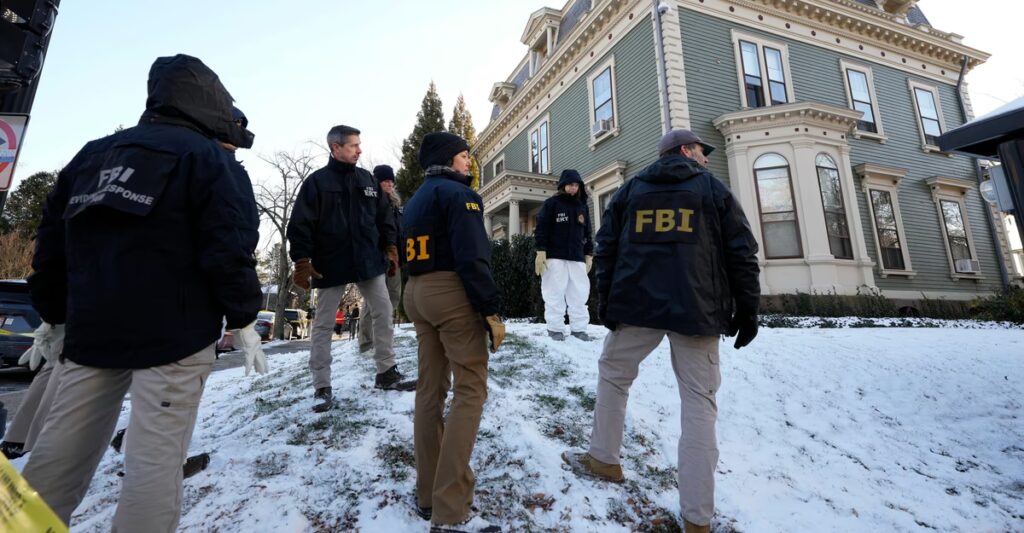
I would also hesitate to attribute the delay in this instance to disarray in the upper ranks of the FBI. Although the FBI’s leadership has been scuttled and shuffled around, and its political appointees are markedly ineffective, its special agents on the ground understand the elements of a thorough mass-shooting investigation. The agents in the FBI’s Boston field office—the one that covers this shooting—are career professionals fully capable of doing the investigative work required of what amounts to a complex homicide investigation.
A perspective that extends beyond mass-shooting incidents might be valuable. When Timothy McVeigh used a truck bomb to blow up the Alfred P. Murrah Federal Building in Oklahoma in 1995, he was coincidentally arrested by police for a traffic violation before he was identified as the suspect. Tyler Robinson, the suspect accused of assassinating Charlie Kirk in front of a crowd of thousands of people in Utah this September, made a clean escape; his surrender was negotiated by his family the next day. Luigi Mangione is alleged to have killed his victim on video on a Midtown Manhattan sidewalk a year ago, and even with extensive imagery and DNA evidence, it still took the better part of five days to arrest him at a McDonald’s in Pennsylvania.
The appearance of competence and speed, in other words, sometimes requires a good deal of luck. And in the absence of luck, competence requires hours of boring, hard work that focuses on minor details such as cellphone records, license plates, painstakingly gathered witness accounts, credit-card statements, and every manner of forensic evidence, including the marks on a bullet, bits of DNA, the make of a piece of clothing in a photo. None of this is amenable to our present news cycle, and none of it easily reassures a traumatized university and nation. But it is the essence of good detective work.
Perhaps the most tragic aspect of all of this is that the mass shooting at Brown isn’t uncommon at all in terms of its toll on human life. By one measure, 22 percent of homicide incidents in the United States involve more than one victim. Few of these deaths get national attention, and many go unsolved. But as time goes by, I have every expectation that the police, special agents, troopers, and eventually prosecutors will pore through possibly millions of bits of data, images, and statements to piece together the investigative picture of the Brown shooting. Ultimately, relentlessness is how a suspect’s luck is undone.
The post Why Manhunts Take Time appeared first on The Atlantic.