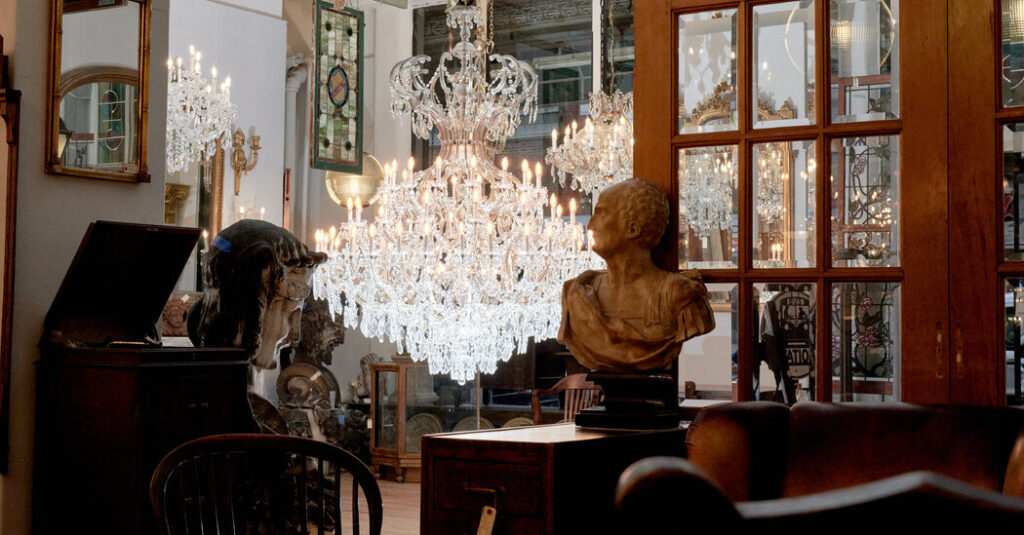
In cities like New York, where buildings are constantly reinvented, Olde Good Things makes big money from what is ripped out. Much of its quirky inventory comes from salvaging architectural treasures from businesses being demolished or renovated.
The company has worked on the Waldorf Astoria, Kennedy Airport and the Plaza Hotel. And it’s a celebrity favorite: A recent New York Times feature highlighted the writer Roxane Gay’s six-foot pink elephant that came from Olde Good Things, and years back, Taylor Swift was photographed in one of the stores.
Long known by antiques aficionados, the company has drawn a new audience, with over 450,000 followers on Instagram. Business was stagnant after the pandemic, said Jim DiGiacoma, the manager of the company’s New York store. “But definitely seeing the increase with the social media, the Instagram, the Facebook.”
While Olde Good Things has been buoyed by viral fame, its roots are with different ardent followers — devotees of a charismatic preacher with a singular view of the Bible. The company has long been enmeshed with a shadowy church that isolated its members from the world and pressured many of them to work punishing hours.
The company started in the 1990s, led by a man named Kevin Browne, though he credits someone else: “This is all because of Jesus,” he said.
Mr. Browne was not referring to a traditional religious epiphany but to the Church of Bible Understanding, or COBU, which is intertwined with Olde Good Things. According to many former members, it’s a cult.
Founded in 1971 and originally called the Forever Family, COBU has been accused of numerous misdeeds, including recruiting runaway teenagers, psychologically abusing members and running an unaccredited orphanage in Haiti where a fire in 2020 killed more than a dozen children. For decades, it was run by its founder, Stewart Traill, who died in 2018.
And while COBU’s past activity in Haiti was well documented, The Times could not find indications that it was still doing large-scale charitable work there, despite a 2024 tax document reporting more than $850,000 worth of expenses for work in the country.
The Times also found that some of the children connected with COBU in Haiti now work for Olde Good Things, which is owned by the church, in the United States. Representatives for the company did not respond to detailed questions about COBU’s work in Haiti; two descendants of Mr. Traill declined to comment.
Olde Good Things grew out of the Chelsea Flea, where Mr. Browne would sell items to make money for his church, and, over time, the antiques became shinier and grander.
At one point, the business had five stores in Manhattan, said Mr. DiGiacoma, who is listed as a COBU board member on its tax documents. Two labyrinthine warehouses in Scranton, Pa., hold most of the company’s trove, with many of its prized pieces for sale at the remaining two stores, in New York and Los Angeles. On the Olde Good Things website, you can buy a $120,000 chandelier from the Waldorf or a $340 sink from a Staten Island Ferry.
Olde Good Things built its business around the idea that objects are more valuable when there is a story behind them, quenching a thirst for authenticity in a world increasingly lacking it. Amazon sells a chandelier for $89.99. One from Janis Joplin’s high school? $22,000.
But the history of Olde Good Things itself is a back story that is harder to unpack.
The Beginning of Forever
Born in 1936, Mr. Traill grew up in Allentown, Pa., the son of a Presbyterian minister. He intended to become a physicist but dropped out of college and worked as a vacuum salesman. In the 1970s, he founded the Forever Family, preaching that the Bible was written in a code only he could decipher.
The Forever Family wore pins that read “Get Smart Get Saved” and aggressively recruited young people. Nearly a dozen Pennsylvania families accused the group of taking their teenagers.
The Times reported in 1979 that the group had rebranded as the Church of Bible Understanding and moved to New York.
Across the city, COBU became known for its carpet-cleaning business. One former member bragged that he cleaned Mick Jagger’s carpets. That the business was run by what many believed was a cult was an open secret among New Yorkers, and it was even satirized on “Seinfeld.”
James LaRue was recruited by COBU in 1980, when he was in his 20s, after a member approached him at a mall. He eventually moved into a church-owned building in Brooklyn and worked for the cleaning business.
The hours were grueling, he said, and the pay might as well have been nonexistent.
Members worked nights and were told that the income from the business was supporting COBU’s orphanages in Haiti, Mr. LaRue said. “You have this zealous labor force who believe they’re working for a good purpose.”
Church members signed their paychecks back to COBU as donations, Mr. LaRue said, calling it “social peer pressure.”
Members lived in a building in Flatbush, Brooklyn, with around four people per room. They also often slept in a COBU office in Manhattan.
When they weren’t cleaning carpets, Mr. LaRue said, COBU members would frequently spend their time looking for homeless people, whom they would invite to work and live with them, a practice they called “sweeping.”
And COBU continued to take in children. In 1985, state investigators found teenagers living in squalor in the Manhattan office.
After 14 years, Mr. LaRue said, he “escaped,” deciding that the church was a cult. He is now married and has self-published two books about COBU. What kept him in the group for so long, he said, was his isolation from the outside world. And though Mr. Traill himself was married, he didn’t allow marriages among members.
Architectural Glory
In the ’90s, COBU’s focus shifted from scrubbing to salvaging. Members made money for the church by selling coats at the Chelsea Flea. “Warhol would go through there, it was a very popular place,” Mr. Browne said. He noticed another vendor who was doing good business selling architectural remnants, and it inspired him to learn the trade, leading to Olde Good Things.
Mr. Browne, who remains an active COBU member, said he learned about the group around 1976, when he was 19 and living in Cleveland. He spent one summer “shipped out on a merchant marine” on the Great Lakes, he said. When he got back, he wasn’t sure what he was doing with his life.
That’s when he heard that COBU was starting a school in New York for “Christian training.” “That sounds like something I could use,” he thought.
Eventually, while promoting the church at a Grateful Dead concert, Mr. Browne recruited Mr. DiGiacoma. Mr. Browne still helps with salvage projects, including the former headquarters of The Times.
The salvaging often happens quickly, and having a dedicated work force, working into the night, is beneficial. At the Waldorf, one of Olde Good Things’ biggest projects, “we were there from like 8 to 8 or even later,” Mr. DiGiacoma said. The hotel is 47 stories tall and an entire city block wide. “I’d lose my tools and go around looking in all these rooms,” he said.
Bernard Epp, who joined COBU in 1979 as a 16-year-old runaway from Switzerland, worked for Olde Good Things until around 2000. He enjoyed the salvaging, but having to work seven days a week was tiring.
Mr. Epp lived in the same Brooklyn building as Mr. LaRue, but was shuffled around between New York, Pennsylvania and Haiti. COBU rotated everybody “so you can’t put down roots,” he said.
There was an overwhelming sense of control within the group. “Anybody that wanted to go to college was basically denied or very much discouraged, or anybody that wanted to develop their own human life,” Mr. Epp said.
Now 62, he hosts Zoom meetings with other former members: “My goal is to try to help anybody with the damage that COBU caused.”
The church’s neighbors in Brooklyn were suspicious of it. People rarely made eye contact, one local blogger wrote in 2011, in a post headlined “Tribeca Has NOBU … But We Got COBU.”
By the 2000s, Olde Good Things began hiring people outside the church, sometimes inviting them to join COBU. For roughly the past two decades, German Martinez has been working at one of the warehouses in Scranton, restoring furniture. “They invite me, but you know people have different … I go to church, but other church,” he said.
In one of the woodworking workshops at the warehouse, Mr. Martinez hung a “Mission: Impossible 2” poster from a salvaging haul. “I love Tom Cruise,” he said.
The Haiti Connection
Mr. DiGiacoma said that profits from Olde Good Things fund COBU’s work in Haiti, where the group has been since 1977. “We chose Haiti due to its immense need and lack of resources,” the church writes on its website, adding that the organization has “raised over 1,000 children.”
Mr. Epp worked in Haiti on six occasions, he said, adding that there were around three COBU members caring for about 200 children.
It was the most fulfilling part of being in COBU, Mr. Epp said. “I used to think, I just wish they could forget about me down here and leave us down here,” he said.
The orphanages lost accreditation after inspections starting in 2012 found unsanitary conditions and overcrowding. Then, in 2020, a fire in one of the homes killed at least 17 children. The authorities focused on a candle used during blackouts as the source.
COBU’s website and current members say that the group still has operations in Haiti. In a 2024 tax document, the church stated that it “transitioned from the orphanage into supporting children and their families in their own homes” and that it has “two Christian group homes for young adults.”
Some children who lived with the group in Haiti now work for Olde Good Things in Scranton. Mr. Browne said that some of them were helping in one of the warehouses, adding that COBU took them in “when they were this big,” gesturing with his hand to the ground.
A woman in her 20s, polishing doorknobs in the warehouse, said she grew up with the church in Haiti. (The Times is not naming her to protect her job status.) She had been in the United States for a year, she added, and lived near the warehouse with other COBU members. She liked her job, she said, and noted that she is paid for the work.
Around a decade ago, COBU’s Haiti orphanages were dilapidated, but much of the group’s real estate in the United States was valuable. In 2014, the church sold its Brooklyn building for $2.5 million, according to property records.
And though COBU members slept on floors, Mr. Traill owned planes and stayed in a 12,000-square-foot estate in Florida.
In recent months, The Times could not confirm the existence of any active COBU sites in Haiti.
Arielle Villedrouin, the director of the Institute of Social Welfare and Research in Haiti, said she thinks COBU “left for good” after the 2020 fire. Ms. Villedrouin added that she had asked the Haitian government to refuse authorization for the church to operate in the country.
In August, a reporter visited the house where the fire had burned. Its occupants said no one from COBU had returned. At the address of a second home that the church operated and listed on its tax documents, a man said it was now a private residence.
In the United States, Olde Good Things continues to thrive. People buy its antiques for the stories, said Haroldynne Rannels, another COBU member. “It’s special, especially if it comes from important buildings or an important estate,” she said. “People want something that’s part of history.”
Audio produced by Sarah Diamond.
André Paultre contributed reporting from Haiti. Alain Delaquérière, Sheelagh McNeill and Kirsten Noyes contributed research.
Anna Kodé writes about design and culture for the Real Estate section of The Times.
The post Where ‘Seinfeld,’ a $120,000 Chandelier and a Mysterious Church Converge appeared first on New York Times.