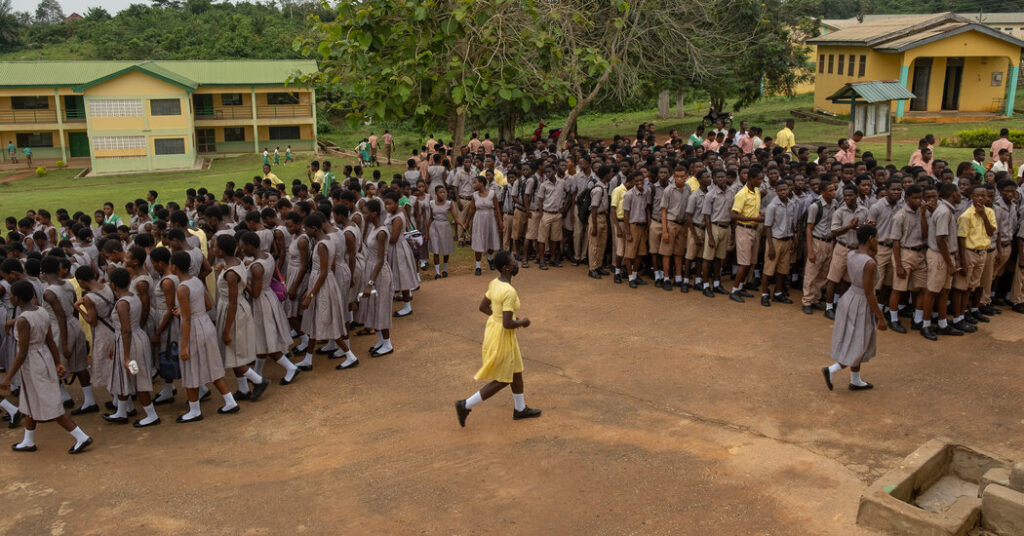
Joyce Arthur was born in rural Ghana, the eldest daughter in a family of five children. Her family slept in a single room, and their daily income, earned by catching and selling fish, wasn’t enough for everyone to eat three meals a day. Like many girls in her community, she knew that she would probably be married off early or get pregnant as a teenager or both. Education would not be an option.
Ms. Arthur knew she wanted more from her life. “I saw a future that was beyond what my community and my family were showing me,” she said. “I knew the only way out was to go to school.”
One day, while she was cooking with her mother, she shared her dream of attending school. Her mother was initially incredulous — no girl in her family had ever gone to school — but agreed to let her attend elementary school and junior high, which were free. From there, Ms. Arthur resolved, she would find a way to pay for high school, college and beyond.
Ms. Arthur understood that she would have to excel to prove the value of educating a daughter. “I was very disciplined,” she said. “Even when I was hungry, I would still go to school on an empty stomach.” In the afternoon, she would return home and help her mother sell smoked fish. She sometimes woke up at 2 a.m. to begin studying.
One of Ms. Arthur’s teachers noticed her ambition and pulled her aside one day to tell her about the Campaign for Female Education, a nonprofit that pays for girls’ education in rural Africa and supports them with mentorship. CAMFED’s help allowed her to attend high school, where she thrived, especially in her math courses. When she graduated, CAMFED sponsored her to attend college as well.
CAMFED has supported over 650,000 girls with scholarships to attend high school, which typically costs money to attend in African nations. CAMFED’s alumni network has supported an additional 1.7 million students, with each graduate paying for the school costs of three children, on average. Ms. Arthur sponsors nine, plus her three younger sisters, who she said otherwise “would never have stepped in the classroom.”
Today Ms. Arthur is continuing her own education, working toward a master’s degree in international education policy. She also runs Araba Foundation International, which provides menstrual health products, education and mentorship to girls in Ghana. Next, she said, she’ll earn a Ph.D., expand her foundation and start businesses in Ghana. “I’m still putting the plans together,” she said.
“I am a living testimony,” Ms. Arthur said, to “the possibility of when you invest in a girl.”
A $220 donation to CAMFED funds a girl’s education in rural Africa for an entire year.
You can learn more about all of the beneficiary organizations and donate at nytcommunitiesfund.org. To donate by check, please make your check payable to The New York Times Communities Fund and send it to P.O. Box 5193, New York, N.Y. 10087.
The Times is committed to publishing a diversity of letters to the editor. We’d like to hear what you think about this or any of our articles. Here are some tips. And here’s our email: [email protected].
Follow the New York Times Opinion section on Facebook, Instagram, TikTok, WhatsApp, X and Threads.
The post What Happens When You Send a Girl to School appeared first on New York Times.