The bright blue and yellow Walmart logo pops against the rugged Chugach Mountains as one of the retailer’s 53-foot trucks winds along Alaska’s curving route 1. The rig is nearing the end of Walmart’s longest, most beautiful trucking route — and its most dangerous. It takes about five days to complete the 5,000 mile round-trip drive from Washington to Alaska, with two drivers trading off shifts at the wheel around the clock.
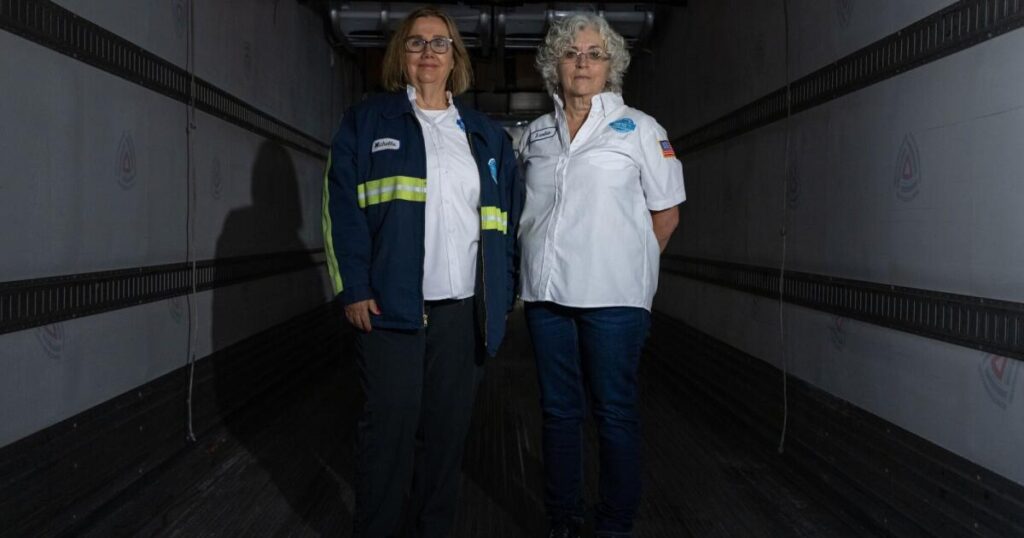
On a recent run, those drivers are Leslie Scott, 58, and Michelle Salikie, 69 — an unlikely duo in a country where fewer than one in 10 commercial truck drivers are women. People, Scott says, “are shocked when they see women up here. Especially at our age.”
They call themselves Thelma and Louise.
While competitors worry about potential worker shortages, Walmart Inc. has grown its trucking workforce by 33% in the last three years by making the job more attractive to people who might otherwise eschew the field. Scott and Salikie earn about $135,000 per year, around twice what the typical truck driver is paid. They have more predictable schedules and WiFi-equipped trucks. The retailer has also taken various steps to make the journeys safer, like pairing drivers up on the more dangerous routes.
These initiatives have helped the retailer attract an unusually large share of women to a field dominated by men. About 18% of Walmart’s truckers are women, data firm Revelio Labs estimates, nearly double the rate of the female drivers at competitors.
“Within the four walls of this company, it’s viewed as one of the best jobs,” says Ryan McDaniel, senior vice president of transportation at Walmart. “A lot of applicants are coming this way.”
The US trucking workforce is facing a demographic crisis. Drivers are aging out of the field and the industry has struggled to attract enough younger workers to replace them. The job’s long, lonely hours, dangerous conditions and low pay don’t appeal to many and are unworkable for people who have caretaking duties. Recruiting has become even more difficult in recent months, with the Trump administration cracking down on diversity initiatives and commercial truck drivers that don’t speak English.
For a company like Walmart, not having enough drivers means that trucks full of inventory sit idle or don’t get to where they need to be, which is particularly important as the retailer competes with Amazon.com Inc. and other companies for on-time delivery. Driver shortages are estimated to cost freight companies nearly $100 million every week, according to one industry analysis.
“Trucking companies will need more drivers,” says Paul Bingham, a director of transportation consulting at S&P Global Market Intelligence, “and they’ll have to attract them from the non-traditional population cohorts.”
Walmart anticipated this trucking crunch more than a decade ago when federal regulations set a cap on how long drivers could be behind the wheel. The company ramped up its recruitment and retention efforts, including raising the starting annual wage for truckers to as much as $115,000.
It also developed a 12-week training program available to its more than a million store and warehouse workers to learn to drive its trucks — a path to a six-figure salary for hourly employees earning roughly half that, at average hourly rates of more than $18.25. Walmart covers the costs associated with getting a commercial driver’s license, too. About 1,000 people have completed the program, which is now the source of about half of the company’s new drivers, McDaniel says.
“This is the first time I’ve had a job where I know if I quit today, that I would be snatched,” Scott says. “I have job security like no other that I’ve ever had.”
Scott and Salikie are far from a miracle solution to the sector’s looming trucker shortage. They’re aging out of the field and won’t be working much longer. Salikie plans on retiring shortly after she turns 70.
They also have a high tolerance for the dangers and less glamorous parts of their job.
On a late summer day in August, the landscape in Alaska is placid and picturesque. A slight chill in the air, though, is a preview of weather that will soon intensify into dense fog, heavy snow, gusty winds, blanketing ice and seemingly endless darkness.
Frozen Toilets
Alaskan winters last about seven months, with temperatures dipping as low as 50 degrees below zero Fahrenheit. Scott and Salikie have encountered bears looking for food in the dead of winter. Icy roads make it even more difficult to control a truck packed full of meat, potatoes and watermelon. But if they slow down too much, they could miss their delivery deadlines.
Truck drivers are often alone on empty roads, making them targets for robberies. They sleep on the side of the road and face the threat of flash floods, tornadoes, whiteout snowstorms and whatever else the weather throws at them. Scott and Salikie once rescued a driver stranded on the side of the road, suffering alone by himself.
For women, harassment is another constant concern. Walmart pairs up its drivers in teams of two on this Alaskan route, which the drivers say is key to keeping them safe.
On one of Scott’s earliest trips with Salikie on the Alaska route, she was driving the nearly 50,000-pound truck on a patch of ice blanketing the road. Salikie, who learned how to drive trucks from her husband Clayton, gave Scott tips on how to use gears and brakes in weather conditions she wasn’t used to. It’s something she says she wouldn’t have learned driving solo.
In addition to spending more to recruit drivers, Walmart has also made a big investment in the trucks themselves.
Scott and Salikie’s truck is built to withstand Alaska’s terrain — it’s a foot taller and longer with larger tanks and brighter headlights. The windshield wipers, which often freeze in place on the journey, are replaced after nearly every trip in the winter. The truck also has its own Starlink, which keeps them connected to the internet in remote areas.
The cab’s living quarters have a microwave, a fridge and a bed, though there’s still not much space to move around. Scott gained 70 pounds after she first started driving and had to have bariatric surgery last year. What the trucks don’t have is a bathroom. Drivers say they limit how much they drink and avoid coffee or soda partly because there aren’t many options on the road. Sometimes when Salikie and Scott do reach rest stops, toilet seats are frozen shut.
‘Lost Sometimes’
Drivers say the hardest part of the job, however, is being away from home. Traveling for days at a time makes it tough to build relationships.
“I kind of feel lost sometimes,” Scott says. “You know, I wish I was part of some club. I don’t know anybody.”
That’s, in part, why trucking is appealing to older people who don’t have families to raise. Salikie and Scott both started driving as second acts, after they both had kids and other careers.
Salikie joined Walmart in the 2000s with her husband after running their own business dropping off jet engines at airports. Scott, meanwhile, had long dreamt of living life on the road. At 49, after a career as a chef, she made the leap, in part to escape an addiction-plagued home where she feared for her safety.
The solitude is a draw, even if it means some sacrifices.
“This is the best-kept secret,” Scott says. “You know, being out here on the road.”
Kang writes for Bloomberg.
The post Walmart’s $115,000 starting pay draws women to trucking amid industry shortage appeared first on Los Angeles Times.