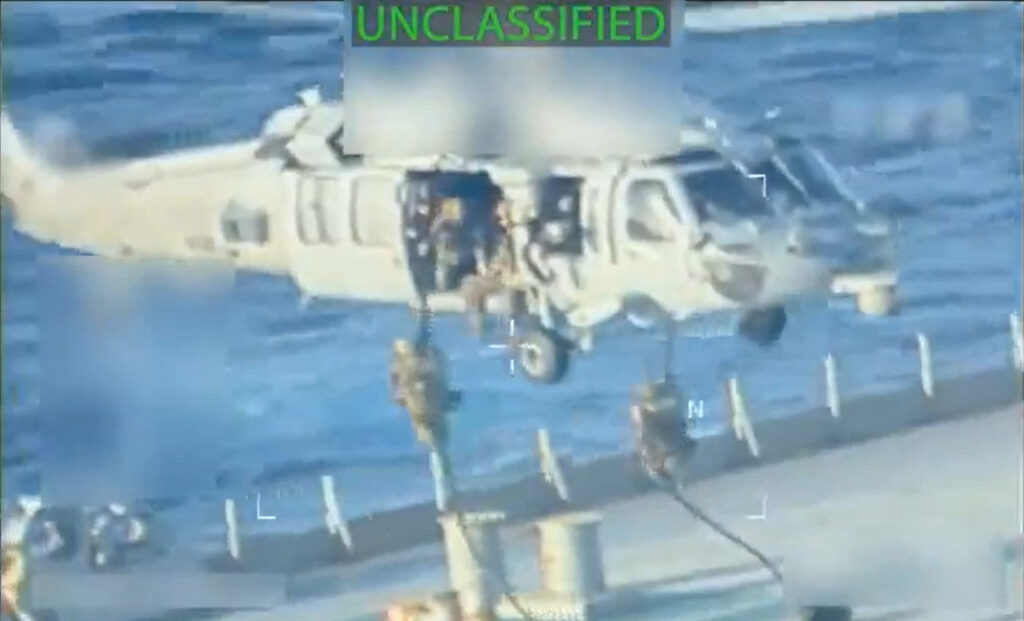
A Russian oil tanker en route to Venezuela turned around last week after the U.S. military seized another tanker, full of Caracas crude, bound for Cuba and China. That’s how deterrence is supposed to work, and it underscores why President Donald Trump has announced a full blockade of all sanctioned tankers going in and out of Venezuela. He is moving to choke off the lifeblood of Nicolás Maduro’s illegitimate regime in hopes that the socialist dictator abdicates without firing a shot.
There are three significant risks. First, a blockade risks provoking a confrontation on the high seas that could drag the U.S. into a land war in South America. Second, Venezuela’s humanitarian crisis will worsen if Trump stops the export of oil, which could trigger a fresh wave of mass migration toward America’s southern border. Third, if Maduro goes, there’s no guarantee whoever replaces him will be friendlier to U.S. interests.
Nevertheless, the oil blockade is a more coherent and legally defensible strategy to bring about regime change in Venezuela than continuing airstrikes on alleged drug smugglers, which have killed at least 95 people.
The administration frames its Venezuela policy as a drug war against “narco-terrorists,” and Trump this week issued an executive order declaring fentanyl a “weapon of mass destruction.” That added to the atmospherics, but according to the Drug Enforcement Administration’s annual reports, Venezuela plays little role in the fentanyl trade. It’s far more enmeshed with cocaine. Considering how poorly Iraq went, another president playing the WMD card gives us déjà vu.
White House Chief of Staff Susie Wiles told Vanity Fair that Trump will keep striking boats until “Maduro cries uncle.” But whatever product these speedboats are moving is nothing compared to oil for Maduro’s bottom line. If the U.S. really wants to drive a wedge between Maduro and his generals, squeezing oil exports will make it harder for the regime to meet payroll.
Oil accounts for 90 percent of exports, and Venezuela has the world’s largest known oil reserves — more than 300 billion barrels. The state-run oil company is the government’s largest source of revenue. Even under U.S. pressure — and mismanagement by Maduro — Venezuela managed to increase exports in October. This black gold is indispensable for U.S. adversaries, including Cuba and China. Because about 80 percent of Venezuela’s oil is sold on the black market, most tankers coming and going are already sanctioned. Trump can argue he’s merely stepping up enforcement.
Maduro is an outlaw. He provides safe haven for terrorist groups like Hezbollah. Iran and Russia have propped him up. Most of his population wants him gone. He stole the last election and has aggressively suppressed the healthy democratic opposition, led by Nobel laureate María Corina Machado.
Perhaps Maduro believes he can outlast Trump. That was his takeaway from the first term when Trump tried to get rid of Maduro but lost patience. His attention drifted. Could it happen again? Even an effective blockade would take time to be fully felt across the Venezuelan economy.
Trump’s one-week deadline for Maduro to leave has come and gone. The president plainly doesn’t want to commit ground troops. If this maximum pressure campaign fails, he risks entrenching Maduro and undermining U.S. credibility. If Maduro succeeds at blaming the U.S. for his people’s misery, and somehow uses worsening shortages to consolidate power, it risks emboldening strongmen elsewhere the same way President Barack Obama did by refusing to enforce his “red line” in Syria.
The best-case scenario remains Maduro retreating to some faraway country, followed by Machado somehow taking charge in Caracas. How that last part happens remains unclear. Belarus President Alexander Lukashenko extended an invitationon Monday for Maduro to take refuge in Minsk. Some call it the Paris of the Steppe. Winters aren’t ideal, but it’s beautiful in the summer, and the 63-year-old can comfortably live out the rest of his days without worrying a Hellfire missile is heading his way.
The post Trump’s blockade of Venezuelan oil tankers requires patience appeared first on Washington Post.