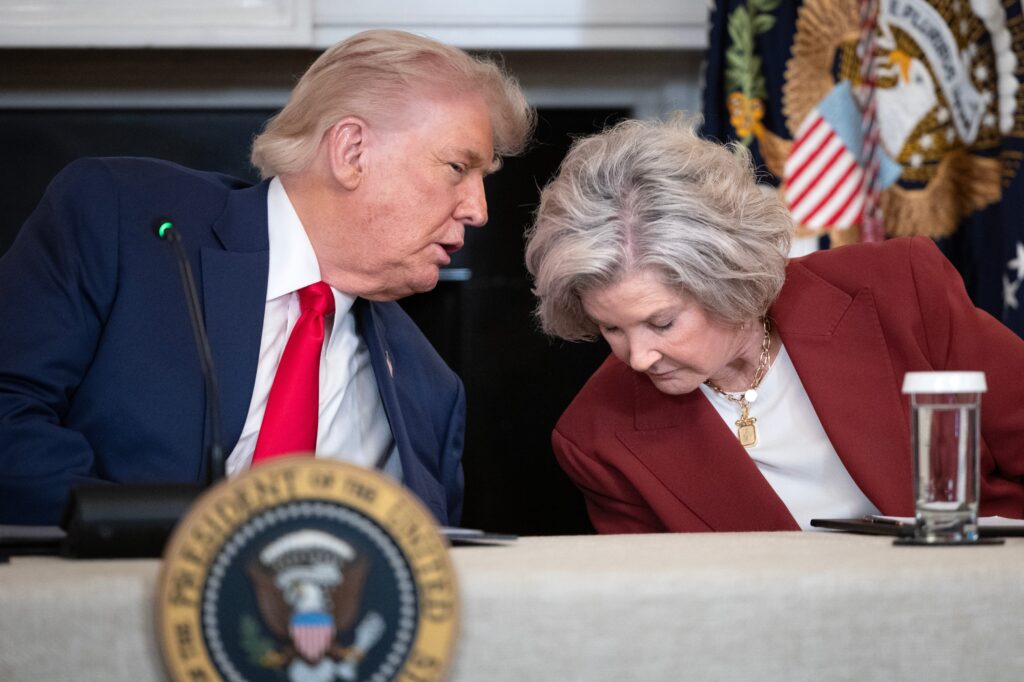
Congressional Republicans went back in time this week as social media posts from President Donald Trump and stories about West Wing staff sniping at administration allies diverted them from their agenda just before a long holiday recess.
Their responses felt straight from the early years of Trump’s first term, when the traditional White House effort at driving the party’s agenda often got swept aside by distractions.
The biggest disruption was a Vanity Fair profile of White House Chief of Staff Susie Wiles that revealed her disparaging assessments of Trump, Vice President JD Vance and others.
“Somebody sent it to me, I haven’t had a chance to read it,” Sen. John Barrasso (R-Wyoming) said Tuesday, ducking into his private office.
Sen. Bill Cassidy (R-Louisiana) was among those who acknowledged they read some of the profile — but signaled he had enough experience with these dust-ups to avoid commenting. “I’ve learned, don’t [give a] quote on excerpts till you know the context. So let me see the context,” he said.
Still, other Republicans grimaced at questions about the president’s online comments on Rob Reiner’s death, suggesting they couldn’t explain why Trump blamed the Hollywood director’s liberal political positions for his death last Sunday.
“All I can say is my view of it. I can’t speak for what the president has said. What I can tell you is I think it was a horrible tragedy, just tragic loss of life,” Senate Majority Leader John Thune (R-South Dakota) told reporters.
This year was supposed to be different for Trump and his allies on Capitol Hill, because the president and his team knew what they could achieve in a second term — especially with the disloyal folks who were part of his first term no longer around. Most importantly, Wiles, having a long career in politics that was punctuated by steering the 2024 campaign to victory, kept a lid on the type of staff sniping that dominated so much coverage on the first term.
Yet not even one year into this administration, Republicans find themselves trying to defend very similar things and complaining that their legislative achievements are not getting attention.
“I think what some people are kind of disappointed about is that there’s not a lot of writing about the good things that he’s doing — I mean, some really good things that the American people agree with, that they elected him for,” said Rep. Mike Simpson (R-Idaho), highlighting tax cuts and increased border security.
To be sure, many Republicans still think things are running more smoothly by comparison, and they give Wiles credit for overseeing a West Wing staff that has been more responsive to their needs.
“Her whole crew is really good to work with from a senator’s standpoint,” said Sen. John Hoeven (R-North Dakota), who found the staff turnover tumultuous during Trump’s first term. “He had a number of chiefs of staff, and we worked with them, and some were better than others, but clearly Susie Wiles and her team are good, and better to work with than the first Trump term, definitely.”
White House officials, ranging from Trump and Vance to other senior aides, quickly rallied behind Wiles with public statementsof support. No one contradicted the accuracy of any quotes in the magazine profile, however.
The portrait that emerged was of a senior White House staff that does little to block the president from his own instincts, even when his actions are bad for the party’s broader political outlook.
“Susie just takes the diametrically opposite viewpoint, which is that she’s a facilitator, that the American people have elected Donald Trump. And her job is to actually facilitate his vision,” Secretary of State Marco Rubio told Vanity Fair.
While Rubio meant that as praise, the flip side is what has been happening this month: a president tweeting out crude conspiracy theories about a Hollywood murder investigation and ignoring pleas from GOP lawmakers to talk about inflation in ways that could help their election chances next November.
Republicans who served in Congress during Trump’s first term acknowledge a sense of déjà vu as this year ends much like 2017 did.
Back then, the GOP majorities in the House and Senate had approved one major domestic policy law: a tax-cut package worth nearly $2 trillion, which they promised to run on during their 2018 midterm elections. But their bitter divisions on health care left them unable to come up with an alternative to the Affordable Care Act of 2010 championed by Democrats.
While they wanted to talk about those tax cuts, Trump’s social media habits so frequently caused a political stir that Fox News wrote up a “most explosive tweets of 2017” story at the end of the year.
With Congress set to adjourn this week, Republicans point to one major domestic policy piece of legislation, a massive bill that extended the 2017 tax cuts. Yet they’re again ending a year, despite a series of votes in the House and Senate, by failing to address the rising costs of health care.
“We’re always divided on health care,” Simpson lamented.
The main difference between the two first years is that the economy was starting to take off in 2017, while 2025 has been a slog.
At the start of Trump’s first term, the unemployment rate was 4.7 percent, and it would fall to 4 percent by year’s end, a drop that continued until the pandemic hit in 2020. This term began in January with unemployment at 4 percent but reached 4.6 percent in November, according to the latest data.
Job creation boomed in 2017, with six months recording more than 200,000 net new jobs.By contrast, most months this year have seen less than 100,000 jobs created.
Trump went months this year with no travels to swing statesto push up support for the big domestic policy bill — until last week, when he visited a key battleground district for the House majority in northeastern Pennsylvania. And rather than trying to allay voter anxiety over inflation, Trump called the affordability issue a “hoax” prompted by Democrats.
The Washington Post’s Natalie Allison, Kadia Goba and Hannah Knowles reported Monday that some allies have tried to intervene to get the president focused on affordability and the economy, even inviting a friendly pollster to a luncheon discussion.
“He wasn’t as interested as I would have hoped,” conservative pollster Mark Mitchell said.
By Tuesday morning, as the Vanity Fair story published, Republicans realized how much Wiles disagreed with the positions Trump has taken this year, including positions that they have had to repeatedly defend.
She did not support pardoning the rioters from the Jan. 6, 2021, Capitol attack; she wanted to delay the imposition of his widespread tariff policy; she thought the dissolving of the country’s preeminent foreign aid program was wrong; she said the process for mass deportations needed an overhaul.
Sen. Lindsey Graham (R-South Carolina) tried to defend the chief of staff by asking if she hadn’t denied uttering those quotes.
Reporters informed him that Wiles and other aides only criticized the context of the article. “I like her a lot, I’m glad she’s there, I think she’s great,” Graham said, ducking into the weekly Republican luncheon.
Afterward, Thune grew annoyed by repeated questions about Trump’s Reiner comments. “Look, I have answered that question,” he said.
He then repeated his answer — he couldn’t speak for Trump — and ended the news conference.
The post Trump tweets, White House staff disruptions trigger 2017 déjà vu appeared first on Washington Post.