President Donald Trump on Thursday ordered federal agencies to quickly ease restrictions on marijuana and make CBD more available, the latest indicator of how the once-taboo drugs have increasingly become part of America’s mainstream.
Trump framed the moves as efforts to improve medical research and stressed that he was not decriminalizing marijuana on a federal level, as many states have for recreational or medical use. Federal officials also warned Thursday about the potential addictive risks and urged adolescents not to use cannabis. But the president’s announcement — delivered from the Oval Office — represents a significant shift in how Republicans have approached the substances, four decades after President Ronald Reagan declared a “war on drugs” and many lawmakers pushed for harsh crackdowns on users.
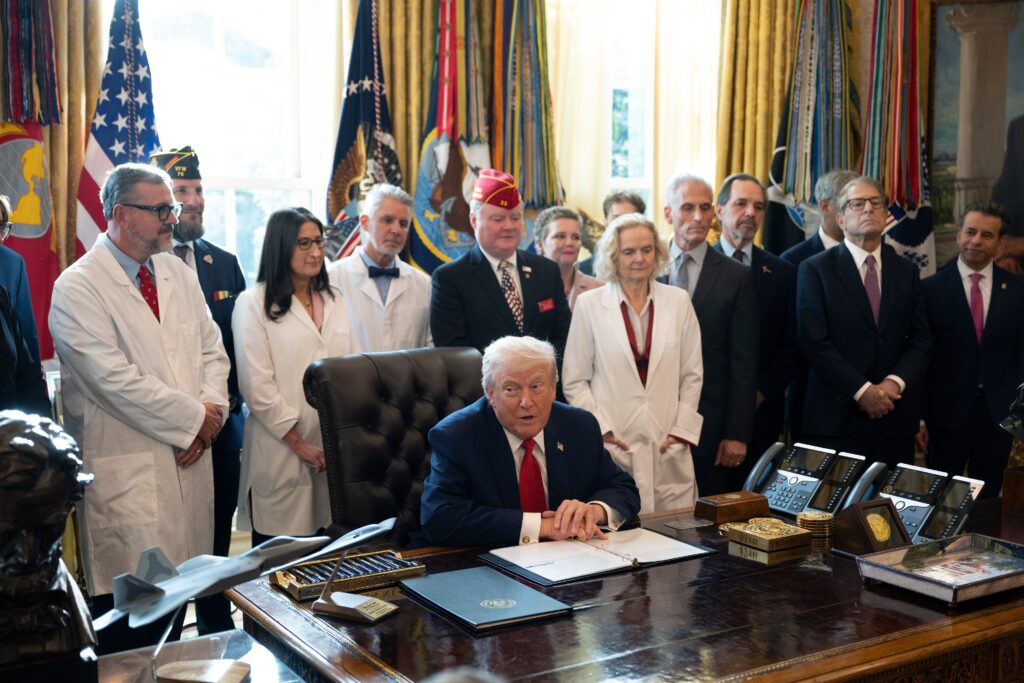
“The facts compel the federal government to recognize that marijuana can be legitimate in terms of medical applications when carefully administered,” Trump said, sitting behind the Resolute Desk and flanked by physicians in white coats.
Trump said he would direct the Justice Department to finish the process of reclassifying marijuana as a less dangerous substance, an effort that began during the Biden administration. The drug — which currently has the same Schedule I classification as heroin and LSD — would be reclassified as a Schedule III drug, making it easier for researchers to study its effects.
Trump also announced a pilot program that would allow Medicare beneficiaries to be reimbursed for some CBD treatments, beginning in April. The president separately directed White House officials to work with Congress on new regulations to ensure that some CBD products remain available after a recent law threatened a crackdown.
The moves were hailed by an array of politicians and public health experts, including scientists who say that federal restrictions on marijuana have hampered efforts to study its potential medicinal use. Others focused on the potential benefits of expanding access to CBD, saying that cannabinoid-based therapies, or CBT, can help manage pain, cancer symptoms and other conditions.
“For seniors, CBT is a game changer offering safe, evidence-based options for chronic conditions that traditional meds often fail,” Howard Kessler, a longtime Trump supporter and the founder of the Commonwealth Project, a pro-medical-cannabis group, said in a statement.
But conservative leaders bashed Trump’s plans ahead of his announcement, questioning whether he was endangering public health to capitalize on the drugs’ popularity.
House Republicans published a letter Thursday morning blasting the Biden administration for trying to “expand the use of an addictive drug for partisan gain” and urging Trump not to follow suit. They pointed to a recent Gallup survey that found sinking Republican support for legalization, and said rescheduling would boost Chinese criminal groups operating marijuana farms in the United States while boosting the use of high-potency weed by young people.
“Rescheduling tells our youth that marijuana use is acceptable and safe, a dangerous falsehood,” House members wrote.
Trump’s endorsement of loosening restrictions on marijuana marks a historic federal policy shift — and comes as more Americans than ever have access to cannabis. Forty states and D.C. have legalized medical marijuana programs, while 24 have approved recreational marijuana. A 2022 federal survey on national drug use found that about 20 percent of adults said they used CBD and 23 percent of adults said they used cannabis to manage pain and other conditions.
The cannabis industry is worth billions, and its lobbyists were among the chorus of voices urging Trump to relax federal restrictions.
Thursday’s move is poised to deliver significant tax relief to cannabis companies that have long been locked out of write-offs available to businesses that deal with legal products. That has led in recent years to a stark contraction in the industry as businesses consolidated in a desperate search for cash, said Frank A. Segall, chair of the cannabis practice at law firm Blank Rome.
Once marijuana is rescheduled, firms will be able to deduct research and development costs, payroll, and other overhead expenses from corporate profits.
“By rescheduling cannabis from Schedule I to Schedule III, President Trump finally takes the cannabis industry away from the children’s table,” said Steve Schain, a national cannabis attorney.
Cannabis remains illegal under federal law, and many public health experts and researchers have called for further study on the long-term effects of consuming marijuana and CBD products, particularly at elevated levels. CBD, while derived from the cannabis plant, is not intoxicating.
That work has long been stymied by federal restrictions on Schedule I drugs, even as millions of Americans use the drug medicinally with little or no medical supervision. A scientific review published this month by UCLA Health found that medical cannabis lacks adequate scientific evidence for conditions such as acute pain, anxiety and insomnia.
Last year, President Joe Biden’s Justice Department formally recommended the drug be reclassified as Schedule III, but the measure remains stalled amid legal disputes and a pending administrative hearing by the Drug Enforcement Administration.
Opponents of reclassification may also mount legal challenges.
If marijuana is reclassified to Schedule III, it would mark the first time a substance not approved by the FDA is placed in that category, adding pressure on the agency to enforce marketing of products, said Kevin Sabet, president of Smart Approaches to Marijuana, which advocates against legalization. He pointed out that marijuana would now be in the same tier as prescription drugs such as ketamine and Tylenol with codeine, an opioid painkiller, and that the marketing of those drugs is closely scrutinized. Meanwhile, marijuana — which has increasingly been incorporated and sold in a variety of edible products — has not come under similar scrutiny.
“You can’t have Tylenol with codeine in a gummy bear,” Sabet said. “If marijuana is a Schedule III drug, the FDA is now going to have to be fully engaged.”
Supporters of marijuana legalization have long contended that the federal government overstated the risk of cannabis as part of a broader war on drugs that disproportionately imprisoned users and low-level dealers, particularly people of color.
The reclassification may have only a limited impact on criminal justice cases involving marijuana, although supporters say the move sends a powerful message that marijuana enforcement is no longer a priority as in the past. Marijuana remains a controlled substance and subject to federal trafficking laws; local police agencies can still enforce state laws restricting trafficking of the drug.
Adam Goers, chair of the Coalition for Cannabis Scheduling Reform, said rescheduling will align federal policy with the reality that cannabis has low abuse potential and proven medical benefits.
“For over 50 years, cannabis has been misclassified as a dangerous Schedule I controlled substance,” Goers said. “This policy, once a centerpiece of our nation’s failed drug war, is finally coming to an end.”
The post Trump orders expanded access to marijuana, CBD, citing medical benefits appeared first on Washington Post.