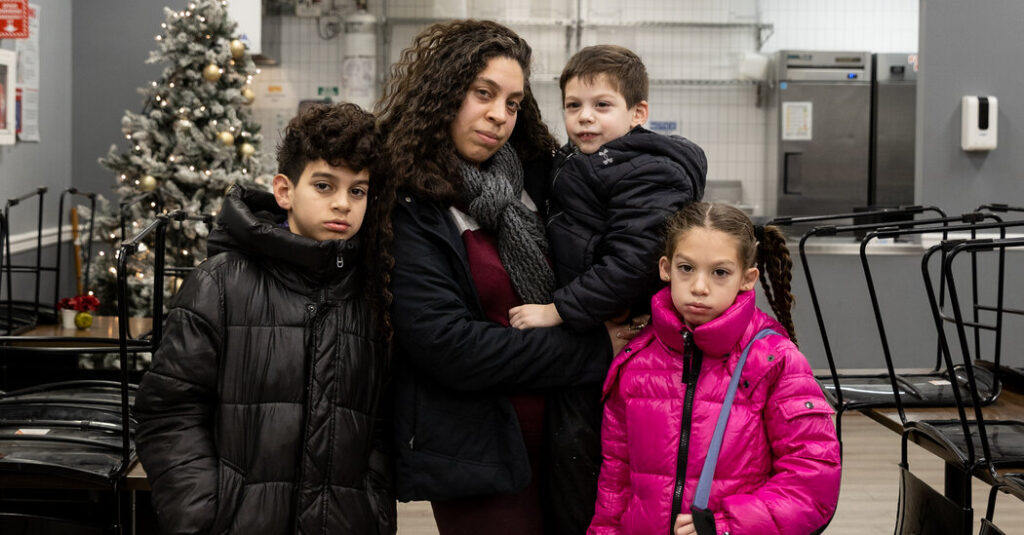
One is a mother of three from Queens, going through a divorce. Another is living on his own for the first time in the Bronx. A third is trying to hold on to an apartment in the Harlem neighborhood where she grew up.
They all work full-time jobs — some more than one. And all of them say they no longer earn enough to keep food on the table.
Blisteringly high rents and rising prices for necessities like child care, transportation and food are pushing New Yorkers to the limit, and beyond. But the pain has been felt not just by the city’s poorest, but even by people far above the federal poverty line, according to a new study by Columbia University and Robin Hood, an anti-poverty group. Last year, more than one in three New Yorkers reported needing more money for food, up from about a quarter before the coronavirus pandemic, the study found. When it came to families with children, the struggling portion was even higher, at 42 percent.
Hundreds of thousands more residents now face a shortfall in their food budgets than did before the pandemic, including an additional 440,000 adults and 70,000 families with children, the study said.
Among them are an increasing number of people who fall into what the study calls “the missing middle” — fully employed people who may make too much to be eligible for public assistance at the grocery store checkout, but not enough to make ends meet at dinnertime.
On a recent day, a 50-year-old woman from Harlem ate a free lunch of corn and rice at Community Kitchen, a food pantry on West 116th Street. She was dressed in the neat office wear she had put on that morning for her 9-to-5 job as an administrative assistant at a financial literacy nonprofit. The woman, who asked to remain anonymous to protect her privacy on a sensitive topic, said she earned $50,000 a year — more than double what a single person her age may earn while remaining eligible for food stamps, also known as the Supplemental Nutrition Assistance Program, or SNAP.
But two months ago, with the bulk of her take-home pay going toward the $2,500 monthly rent for her one-bedroom apartment, she said she felt compelled to seek out food pantries. “I came when I had to start putting stuff back on the grocery store shelves” because it was too expensive, she said.
For a single person who is eligible for SNAP, the maximum monthly benefit is $298; for a family of four, it’s $994 a month.
Food costs in the city increased by about 30 percent from 2013 to 2023, according to the Poverty Tracker from Robin Hood and Columbia University. A report by the state comptroller’s office found that grocery prices in New York City rose even more during the same time period, by 65.8 percent — far more than the national average of about 49 percent.
As the Harlem woman nibbled on a bagel, she said she felt deep guilt for taking resources she believes should be left for those needier than she is, and pain for feeling like she has somehow failed despite holding down a full-time job for years. “It’s a slap in the face,” she said.
This year, for the first time ever, she added, she is not putting up a Christmas tree. “I cannot afford to participate,” she said.
Such experiences are increasingly common, said Chymeka Olfonse, the managing director of adult and household support at Robin Hood, who pointed out that the study covers only 2024. With new tariffs and steadily increasing rents, the real number of people in this situation right now is most likely higher. “It is surprising when you see all income levels that are struggling,” she said. “It’s not just those who are perceived to be poor.”
For many people, it is also deeply demoralizing, she said. “You feel like, ‘I’ve made it,’ and then you realize: ‘I haven’t made it; I’m still struggling. What am I doing wrong?’” she said. “But their earnings are simply not keeping pace with the rising cost of food.”
And the pain points are likely to worsen as new rules introduced by President Trump’s budget bill will limit who is eligible for SNAP: About 300,000 people in New York State could lose access to the benefit.
Jessica Fuentes, 33, works seven days a week: Monday through Friday as a sales representative for a door and window company, and then the weekend shift at a Five Guys restaurant near her home. She has three children, who are 4, 9 and 11 years old, and she is raising them mostly alone, while she is separating from their father.
A full paycheck from one job, she said, goes toward rent. And still, Ms. Fuentes makes too much to qualify for SNAP, and she said she had even been turned away at food pantries, some of which require proof of income.
She has had to be resourceful and humble: After meetings of the parent-teacher association at her children’s school, she asks the janitor for bottles to recycle. She needs the extra $20 from deposits to buy milk for her 4-year-old. It’s one of the few things he will drink.
“They say, ‘If you are above this income, you don’t qualify’” for SNAP and other benefits, she said. “But it’s not fair, because they don’t see that I am a mother, and that I pay $2,250 in rent by myself,” she said. “And I do this all for my kids.”
Three-quarters of families in New York State with annual incomes below $100,000 have faced higher living costs over the past year, according to a recent study by Hunger Free America, an anti-hunger policy and direct service nonprofit that receives funding from Robin Hood. Half of those families said that affording the quality of food their household needed had become harder.
“You can’t pay less in rent or you are homeless; you can’t refuse to pay your medical bills or you don’t get treatment,” said Joel Berg, the chief executive of Hunger Free America. “If you add up all the unavoidable costs of living, there is not enough money for food.”
The implication of such food insecurity for those well above what the federal government considers poverty looms large, Mr. Berg said. “This issue is the canary in the coal mine for the collapse of the society,” he added. “If people can’t afford the basic costs of living in what were previously middle-class jobs, society is failing in fundamental ways.”
At Part of the Solution, a soup kitchen, food pantry and community center in the Bronx, 3,000 of the 10,000 households it serves each year do not receive food stamps, said Christina Hanson, the executive director. In fact, some of the nonprofit’s own staff members said they, too, had needed to use the food pantry. Ramon Sanchez, 37, who said he earns $44,000 at the center and cleans houses on the side for extra income, and receives SNAP, is one of them.
“The joy of Christmas is gone, because you can no longer afford the dinner and the gift,” Mr. Sanchez said. “It’s either-or.”
Sarah Maslin Nir is a Times reporter covering anything and everything New York … and sometimes beyond.
The post They Thought They Had ‘Made It.’ Now They Can’t Afford Food. appeared first on New York Times.