Good morning. It’s Thursday. Today we’ll find out about the one thing that’s different in a sketch that looks familiar. We’ll also get details on Gov. Kathy Hochul’s decision to sign a right-to-die bill for terminally ill people.
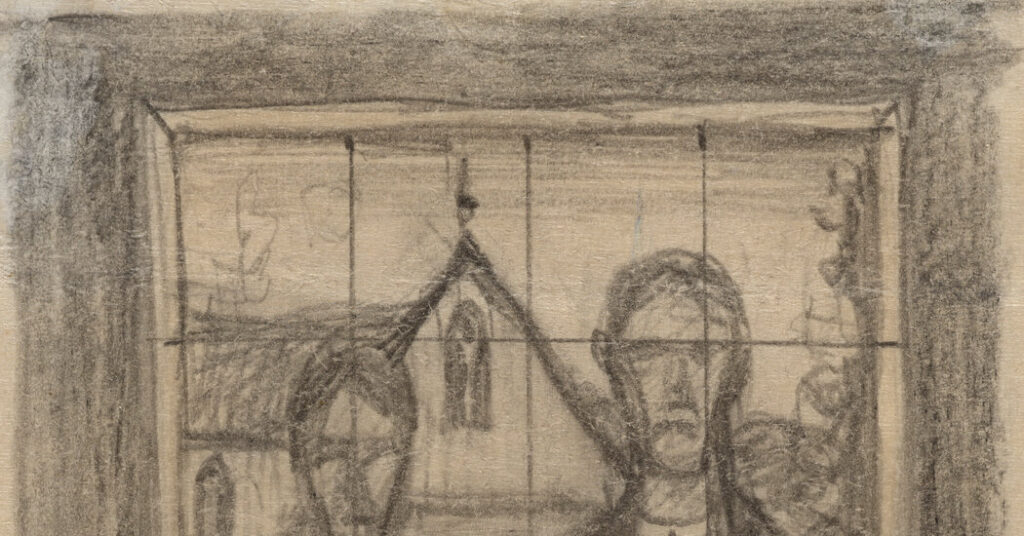
Originally, the farm tool that’s almost a character in Grant Wood’s “American Gothic” was a rake, not a pitchfork. “Gothic” is the painting that has appeared everywhere. The painting with the farmer, the woman and the pitchfork.
Except that the man wasn’t a farmer, and the woman wasn’t his wife.
We know about the rake from the only known sketch for “American Gothic.” Otherwise, the sketch looks like the painting, except that it was done in pencil and has grid lines, apparently to guide Wood as he worked on the larger final version. The artists Red Grooms and Lysiane Luong have owned the sketch since 1989. Christie’s plans to sell it next month in a sale called “We the People: America at 250.” The presale estimate is $70,000 to $100,000.
Wood had thought through everything but the pitchfork when he drew the sketch on the back of an envelope — including the title. The people almost didn’t matter: “I simply invented some American Gothic people,” he said, and painted them against a farmhouse built in the “American Gothic” or “carpenter Gothic” style, with pointed windows that hinted at Gothic architecture he had seen in Germany.
The man was a dentist. The woman was Wood’s sister Nan.
Paige Kestenman, a senior specialist in American art at Christie’s, said that Wood had persuaded his sister to straighten her usually curly hair before he painted her, and he stretched her face “to match the vision that he had.” He also ordered the apron for her and the overalls for the dentist. “They never actually posed together,” Kestenman said.
Kestenman said that as far as is known, Wood never explained why he decided to replace the rake with a pitchfork.
He entered the painting in the Art Institute of Chicago’s annual exhibition in 1930, where, as the writer Jeanine Basinger put it, “history was almost not made.” It won third prize (and $300) and “could logically have been expected to disappear.”
But Barbara Haskell, a curator at the Whitney Museum, wrote in her book “Grant Wood: ‘American Gothic’ and Other Fables,” that — thanks to a publicist Wood had hired — The Chicago Evening Post published a reproduction of “American Gothic.” It also ran a review that said Wood had provided the “biggest kick of the show” by creating something “AMERICAN.”
The third-place painting was on its way from “potential cliché to national symbol,” as Basinger put it. Kestenman said it was “the moment that he’s becoming the famous Grant Wood that we would know.” Later Wood himself would put on overalls and pose like the farmer “to sort of lean into this concept of very American art.”
People who saw it loved it or hated it. The painting “inspired a lot of talk about the mystery of who these two figures are,” Kestenman said, adding that Wood had said they were a farmer and his daughter, not a farmer and his wife, perhaps because his sister “didn’t like being associated with the dentist as her husband” because he looked so much older.
The dentist, Dr. Byron McKeeby, had agreed to pose “as long as no one would know it was him,” Kestenman said. Wood promised to exaggerate McKeeby’s features to keep him from being recognized. But that’s not how things worked out.
Weather
Today will be mostly sunny, with a high near 52. Expect rain and possible thunderstorms tonight with temperatures around 55.
ALTERNATE-SIDE PARKING
In effect until Dec. 25 (Christmas).
The latest New York news
-
Dyslexic students are still struggling: Mayor Eric Adams pledged to transform the city’s schools into a national model for providing equal education to children with dyslexia. But families and advocates say the city is falling short of the promise.
-
Adams’s farewell: Before jetting off to Mexico, the mayor held an unusual news conference, defending his one-term tenure and warning that the city would suffer under Mayor-elect Zohran Mamdani.
-
Widow of officer slain in Park Avenue attack sues the landlord and the N.F.L.: The widow of the detective who was killed when a gunman opened fire in 345 Park Avenue claims that security was lax. The detective, Didarul Islam, was off duty and was part of a paid security detail at the building, which houses N.F.L. offices.
-
Fraud charges for executives at subprime auto lender: Federal prosecutors in New York filed the charges against two executives at Tricolor Auto, a big subprime auto lender that filed for bankruptcy in September amid allegations that it had defrauded its bank lender. Two other executives have already pleaded guilty to related charges.
-
“Beaches” on Broadway: The tear-jerking 1980s novel-turned-movie will attempt an unusual strategy to deal with the difficult economics of Broadway, limiting its run to just under 24 weeks at the Majestic Theater next spring. The producers are hoping to motivate ticket buyers and generate buzz before going on tour.
-
How do you afford life in New York City? The New York Times is looking to talk to New Yorkers about how they budget, splurge and save in one of the most expensive cities in the world.
How Hochul’s experience figured in her decision to sign a right-to-die bill
Gov. Kathy Hochul’s statement was unusually personal. She said she had felt “the pain of seeing someone you love suffer and feeling powerless to stop it.”
“I watched my own mom die from A.L.S.,” she wrote in an essay published in The Times Union of Albany that explained why she had decided to sign a right-to-life bill for terminally ill people. The measure will apply to adults who have incurable, irreversible illnesses and no more than six months to live. A patient will need the sign-off of three doctors.
My colleague Grace Ashford writes that 12 states, the District of Columbia and several European countries have passed similar laws over the objections of some disability-rights advocates and religious organizations, notably the Catholic Church, which characterizes the bill as legalizing assisted suicide.
But Hochul, who is Catholic, said her faith had guided her decision to sign the bill. She said that she had struggled with the church’s position but had come to believe that the issue was not about shortening life “but rather about shortening dying.”
“I was taught that God is merciful and compassionate, and so must we be,” she added.
She said she intends to sign the bill after the State Legislature returns in January and formally adopts changes she made to address concerns that people could be pressured into life-ending decisions they would not have made on their own.
METROPOLITAN diary
Pinch walker
Dear Diary:
A new gas line had recently been installed at my house in Park Slope, and the contractor needed to check every gas jet after the service was turned back on.
Just then, my tenant came down the stoop to walk her dog.
The contractor asked if he and his crew could check her stove.
She said she was very late and had to walk her dog.
The contractor called one of his workers over and asked if it would be OK if the workman walked the dog so that he and my tenant could go up and check the stove.
Everyone was happy with the solution.
— Bill Shumaker
Illustrated by Agnes Lee. Tell us your New York story here and read more Metropolitan Diary here.
Glad we could get together here. See you tomorrow. — J.B.
P.S. Here’s today’s Mini Crossword and Spelling Bee. You can find all our puzzles here.
Davaughnia Wilson and Ed Shanahan contributed to New York Today. You can reach the team at [email protected].
Sign up here to get this newsletter in your inbox.
James Barron writes the New York Today newsletter, a morning roundup of what’s happening in the city.
The post The Sketch That Reveals the History of ‘American Gothic’ appeared first on New York Times.