DAKAR, Senegal — The president of Guinea-Bissau spent years building a political network that stretched from West Africa to Paris and beyond. This year alone, he was hosted at the White Houseand the Kremlin. All the while, according to analysts and regional and Western officials, this tiny nation of 2 million people cemented its status as a key transshipment point for cocaine destined for Europe.
Then, last month, with Umaro Sissoco Embaló, 53, projected to lose the presidential election — and his grip on power — officials and analysts say he appeared to pull off a maneuver that surprised even those who have closely followed Guinea-Bissau’s tangled politics: a coup against himself.
The country’s opposition contends that Embaló orchestrated his own removal from power, installing loyalists in his place in a bid to retain power from afar. In the weeks since he fled the country, his influence network has reasserted control. The new leaders of Guinea-Bissau are some of Embaló’s closest allies. The likely winner of the election has sought asylum in the Nigerian Embassy. The main opposition figure, whom Embaló barred from running in the election, was jailed during the coup.
The episode underscores the fragility of democracyin West Africa, which has experienced at least six coups since 2020 — though none that quite resemble Embaló’s unconventional departure from the political stage. And it has focused renewed attention on the role of Guinea-Bissau in the booming global cocaine trade.
As the Trump administration ramps up its lethal military campaign against suspected drug traffickers across the Western Hemisphere, Latin American criminal networks are expanding their reach in West Africa, experts said.
“Power and cocaine are intricately linked in Guinea-Bissau,” said Lucia Bird Ruiz-Benitez de Lugo, who has extensively studied the country’s links to drug trafficking as director of the Observatory of Illicit Economies in West Africa at the Global Initiative Against Transnational Organized Crime (GI-TOC). “Shifts in power have the potential to restructure the trade, but the fallout is still becoming clear.”
Embaló appears to have landed on his feet, first traveling to Senegal on Nov. 27 on a flight that the government in Dakar said it had chartered for him and then to Congo before winding up in Morocco. His journey illustrated the reach of his political connections, analysts say, but also his divisiveness. Senegalese Prime Minister Ousmane Sonko, breaking with his government’s official position, called what happened in Bissau “a sham.”
His skepticism was echoed by former Nigerian president Goodluck Jonathan, who traveled to Guinea-Bissau for the election as part of a West African observation group. “It was not a coup,” Jonathan said in a Nov. 29 news conference. “I would just say, for want of a better word, maybe it was a ceremonial coup.”
Embaló and João Bernardo Vieira, the country’s newly appointed foreign minister, did not respond to requests for comment.
The drug trade
Guinea-Bissau, a former Portuguese colony located between Senegal and Guinea, has been called Africa’s first narco-state, with its long coastline and dozens of islands serving as an ideal transit point for Latin American drug gangs looking to move their product to Europe.
Today, Guinea-Bissau’s cocaine market is probably more profitable than at any point in its history, according to GI-TOC. In September last year, police seized more than 2.6 tons of cocaine on a plane that had arrived from Venezuela, police said.
Top political and military leaders, as well as their families, have been implicated in the illicit commerce. The son of former president Malam Bacai Sanhá is serving an 80-month prison sentence in the United States for international drug trafficking. Bubo Na Tchuto, a former Navy chief, was arrested in a U.S. drug sting in 2013 and sentenced to four years in prison for conspiring to traffic cocaine.
Some of Embaló’s closest associates have also been linked to the drug trade, according to four current and former Western officials, speaking on the condition of anonymity to discuss sensitive matters. At the same time, they said, the president tried to position himself as a partner to Washington in its antidrug fight, including by helping with the cocaine seizure in September last year.
“In Guinea-Bissau, [Embaló’s] connections to drug dealing are known,” said Sumaila Jaló, a Portugal-based activist and analyst. “His stated support for drug seizures — which are really done by international agencies, not the military — aren’t anything more than political propaganda.”
An August report by GI-TOC and other researchers found members of Embaló’s powerful presidential guard had ties to known drug figures. Alleged kingpin and ex-general Antonio Indjai — for whom the United States put out a $5 million rewardin 2021 — stood beside Embaló during a de facto inauguration ceremonyafter his last election win in 2019. And in 2022, leaked audio recordingsappeared to show that Embaló’s interior minister and attorney general had benefited from the seizure of 600 kilograms of cocaine months earlier by police. Both men denied the allegations.
It was ironic, in the words of one former U.S. official, that Embaló played such a key role in organizing a July White House summit with five West African presidents, given Trump’s focus on international drug trafficking.
Embaló, who speaks fluent English and French, also approached Trump during a ceremony for the reopening of the Notre Dame cathedral in Paris in December last year, the former official said, and congratulated him on his election victory. About seven months later, Embaló was shaking hands with the president in Washington.
Asked for comment on the meeting, White House spokeswoman Anna Kelly said Trump is doing “more than anyone to stop the flow of illicit drugs” while treating “Africa not as a charity case but as a powerhouse partner.”
‘An institutional crime’
Elections in Guinea-Bissau follow a familiar pattern, said a longtime journalist in the country, speaking on the condition of anonymity to avoid government reprisals. People across the country head to local polls to cast their votes on paper ballots, which are then publicly counted at tables, photographed by observers and posted online in phases.
All appeared to go to plan when voters went to the polls on Sunday, Nov. 23. By that Tuesday, preliminary results showed Fernando Dias with a clear lead on Embaló. Dias had joined forces with Domingos Simões Pereira, the president’s chief political rival, whom Embaló had barred from contesting the election.
The next day, gunshots rang out near the presidential palace. Military officers soon appeared on state television, declaring they had seized power after discovering an alleged “scheme … set up by some national politicians with the participation of a well-known drug lord and domestic and foreign nationals” to “manipulate electoral results.”
On its face, it seemed like a repeat of a scene that has played out in recent years across West Africa. There were key differences, analysts said. The most glaring sign that all was not what it seemed, the journalist said, was that Embaló’s entourage of heavily armed body guards — who wear skull masks and typically guard the president’s massive motorcade — were missing in action. Had there been a serious threat to his power, the journalist said, they probably would have intervened.
In the chaos, the president was also able to call multiple news outlets to explain his side of the story. He told Jeune Afriquethat men in uniform had burst into the presidential palace to detain him and several of his associates. No one had harmed him, Embaló said.
Embaló had pressured Mpabi Kabi, the head of the national electoral commission, to cancel the elections, according to Said Larifou, a lawyer who represents both Dias and Pereira. When he refused, Larifou alleged, Embaló asked the military to apply pressure and then staged the takeover. Kabi, who local media have reported is under military surveillance, did not respond to a request for comment.
“This is not a coup d’état but an institutional crime committed by the outgoing president,” the lawyer said.
Embaló’s links to the coup leaders became evident when the new government was announced on Nov. 27. The transitional leader? A little-known major general who’d served as the chief of the general staff in Embaló’s personal guard. His allies mostly comprise the 28-member cabinet. And the new prime minister? None other than Embaló’s campaign manager.
Dias fled to the Nigerian Embassy on Nov. 26 after facing threats from military officers, Larifou said. Pereira was detained by military officers the same day, he added, and has been prevented from speaking with his family, his lawyers and his doctors.
‘They are afraid’
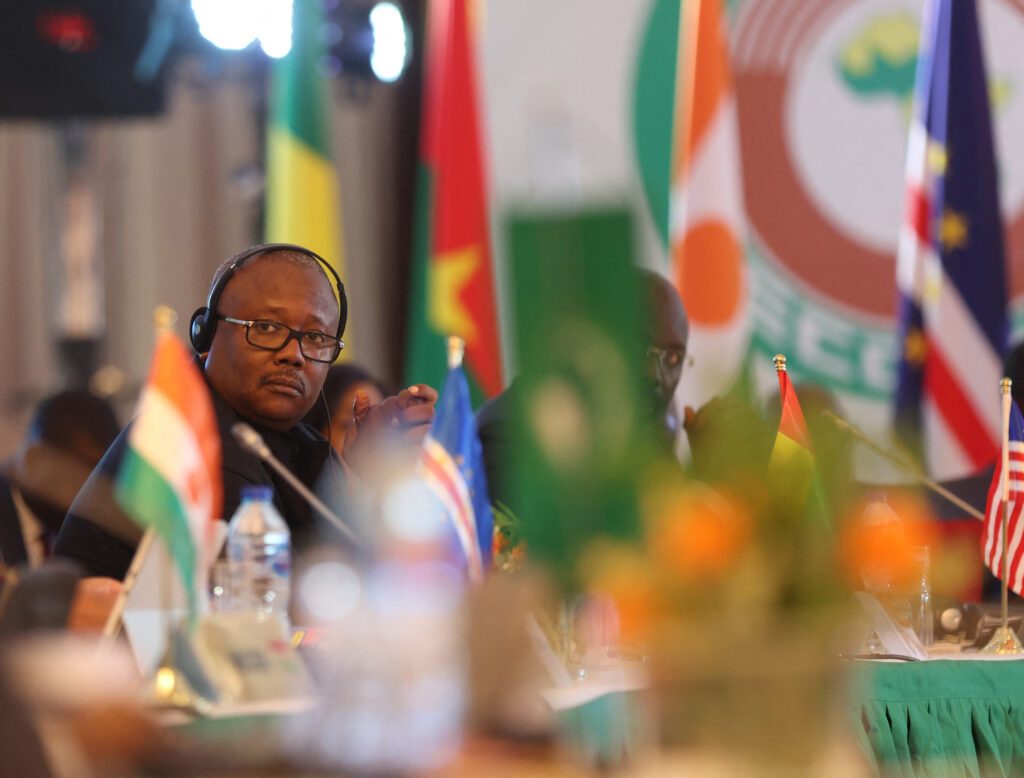
What happens next will test how much the Economic Community of West African States, a bloc known as ECOWAS, is willing to stand up for democratic norms in a region already battered by political instability, said Vincent Foucher, who focuses on Guinea-Bissau as a research fellow at France’s National Center for Scientific Research.
During a meeting on Sunday, member states condemned the coup, demanded a shorter transition period and threatened sanctions — but they did not activate their shared military force, as they had just done in the aftermath of a thwarted coup attempt in Benin.
“I’m not sure if there is the capacity — or frankly the appetite — to push back,” Foucher said, noting that Embaló’s diplomatic contacts extend “from France to Congo to Russia to Gabon.”
Embaló’s endgame remains to be seen. In Guinea-Bissau, there is immense disappointment among activists and opposition figures over the rapid democratic unraveling and the relatively mild response from ECOWAS.
One opposition figure, speaking on the condition of anonymity for fear of government reprisal, said many suspect that regional leaders are wary of crossing Embaló.
“We know they are afraid,” he said. “Because Embaló has something on them. He has something on everyone.”
The post The president said there was a coup. But was he the one behind it? appeared first on Washington Post.