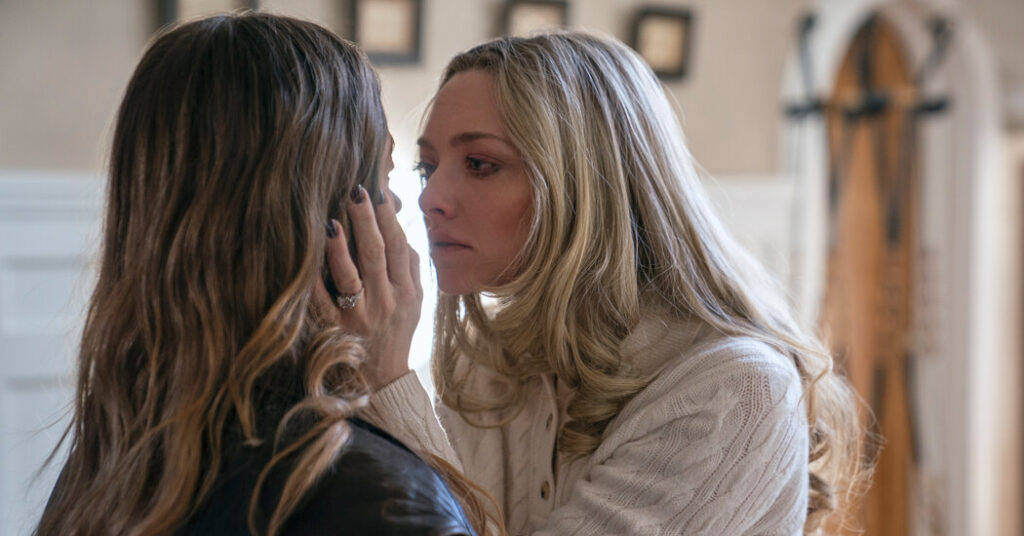
It’s clear from the start of “The Housemaid” that all is not well in the home of Nina Winchester (Amanda Seyfried), where Millie Calloway (Sydney Sweeney) is interviewing for a job. It’s one of those far-too-large homes in which no inhabitant could possibly be happy; what remains to be seen is the flavor of their unhappiness.
Millie is too preoccupied with her own misery to sniff out Nina’s, at first. After all, this rich woman has it all. Her husband, Andrew (Brandon Sklenar), is handsome and doting, and their life with their daughter, Cece (Indiana Elle), seems perfect. Millie, on the other hand, is concealing her secret: She’s trying to outrun her past, living in her car. Cleaning and cooking for the Winchesters, and hanging out with Cece occasionally, seems like a dream. Plus, it comes with a quiet little room in the attic. Which locks from the outside.
If you’re thinking run, girl, that’s the idea. Directed by Paul Feig, “The Housemaid” sits somewhere between a dark comedy and a psychological erotic thriller — it’s less kooky than Feig’s 2018 film “A Simple Favor,” but there’s a family resemblance. Both center on two beautiful women locked in mind games over a hot guy; both boast some excellent outfits (in each case, designed by Renée Ehrlich Kalfus); both prominently feature enormous martinis.
But where “A Simple Favor” is wacko and self-aware, “The Housemaid,” adapted by Rebecca Sonnenshine from Freida McFadden’s best-selling 2022 novel, is a more straight-faced nail-biter. Terrible things happen to the characters, often on-screen. It is a movie about what goes on behind fancy facades, about the weak being preyed upon. But it is also about empowerment and triumph. Borrowing on certain familiar erotic thriller tropes — let’s all point and stare at the cray-cray lady — it does some back flips and corkscrews appropriate for our time and lands with a cathartic smack.
For a movie like this to work, you’ve got to sell it with a great cast, all of whom must play characters harboring secrets. Here, some of them pull it off. Seyfried and Sweeney, about a decade apart in age, look just enough alike to let you intuit what’s probably going to happen, which also makes the impending plot curveballs more delicious. But crucially, you know the instant you meet them that there are depths to these women that will merit investigation, and that keeps the tension humming along. On the other hand, Sklenar is more nondescript: he’s generically handsome, playing a character who presents as a patient, long-suffering husband but is otherwise lacking in a personality. Yet even when his secrets start coming out, they’re a little hard to believe, because it’s such a bland performance.
Then again, the point of “The Housemaid” is not exactly realism. It’s a fantasy of terrible behavior getting its due. That’s what makes it satisfying, even fun, despite its deadly serious premise.
That’s also why it illustrates something very particular about the movies. “The Housemaid” is the kind of movie that best serves its audience in a theater. That’s where I saw it, with a full house of ordinary moviegoers who seemed to be having a blast. They chuckled, they clapped, they occasionally warned the characters to watch out. When a guy in the middle of the theater made a joke at the very end, the whole crowd burst out laughing, and we all left in a good mood. In line for the bathroom afterward, I listened as people talked about how much they enjoyed that movie. That’s the sort of experience that gets the audience to tell their friends to go see a film — which, in turn, is the kind of experience that sells tickets.
I suppose all that noise could be annoying to some people, but “The Housemaid” practically begs you to have a collective experience watching it. If I was at home by myself, I’m not sure I’d know how to react: Would I feel the permission to laugh with relief when I felt it? Would I scream a little when I jumped with fright? If there’s anything we know from horror films and comedies, it’s that humans crave permission to laugh and shriek and giggle, that we egg each other on, and that we have more fun when we do. (There’s a reason sitcoms used to, and sometimes still do, have laugh tracks.)
Of course you can watch “The Housemaid” alone and still enjoy it. It’s not a masterpiece nor a moralizing sermon. It does what it says on the box: entertains with plot twists and sexy thrills. But if it has a lesson, it’s that sometimes we need each other to get through the dark stuff of life. Sometimes watching a movie together can do that, too.
The Housemaid Rated R for all kinds of terrible stuff: bloody violence, domestic abuse, sexual assault and the like. There is also a sex scene with some nudity. Running time: 2 hours 11 minutes. In theaters.
Alissa Wilkinson is a Times movie critic. She’s been writing about movies since 2005.
The post ‘The Housemaid’ Review: Dusty Counters, Dirty Secrets appeared first on New York Times.