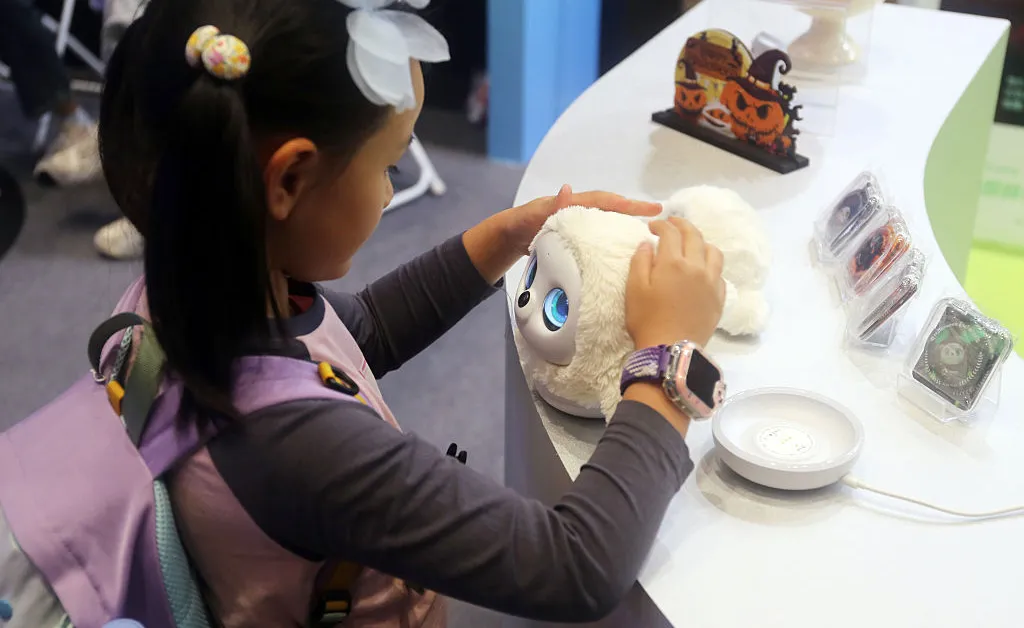
Every week brings new product announcements promising AI-driven companionship for children: Barbies who call you by name, Curio stuffies that propose adventures and imaginary games, chatbots for kids from Meta and xAI. Even Disney recently joined the AI revolution, purchasing a $1 billion stake in OpenAI to bring its beloved characters to Sora.
[time-brightcove not-tgx=”true”]
Whether they arrive as disembodied voices, avatars on a screen, or irresistibly plush toys, these products represent a fundamental break from every toy that came before: They talk, listen, and respond in ways that feel startlingly human. On the surface, these companions look benign, even sweet, or better yet, educational.
Their promise isn’t just to entertain, but to offer the kind of interaction that’s essential for building children’s brains. The Curio website features an alluring quote: “Toys designed to cut back on screen time and enhance interaction.”
Indeed, science tells us warm and responsive back-and-forth interactions fuel the creation of up to 1 million neural connections inside a baby’s brain every single second. These exchanges are directly tied to children’s language development, vocabulary acquisition, math and spatial reasoning, self-control, and more.
Up to this point, those interactions have been provided solely by humans.
Now, AI systems are designed to mimic these interactions. And unbeknownst to them, today’s parents—like the citizens of Troy facing that famous wooden horse at the city’s gates—are at risk of welcoming a would-be gift without understanding the danger that lies inside.
Afterall, we have little visibility into how these toys are built, how their algorithms operate, what default settings they arrive with, or what the short- and long-term impacts on children’s developing brains might be. But the warning signs are abundant. The consumer research organization U.S. PIRG Education Fund released a report detailing numerous, deeply troubling exchanges with AI toys made for children, including conversations where a toy discussed sexual topics in detail, or suggested where knives could be found.
As adults are forming emotional entanglements with their AI companions (even pursuing marriage to chatbots) and teens are turning to them for mental health support, it’s incumbent upon us to consider what this technology might mean for toddlers who are still wiring their brains while also learning, for the very first time, what relationships are.
Parents—and society at large—cannot afford to take a wait-and-see approach to evaluating the safety or value of these products. And the truth is, research takes time. Rigorous studies that establish causal relationships take years, and developmental impacts can take even longer to surface. But time is exactly what our youngest citizens’ developing brains don’t have.
Children’s early relationships form the architecture of development itself. Babies are drawn to contingent, responsive interaction, and the infant brain has evolved to learnfrom the emotionally rich dance of human connection. These interactions—which provide the instructional manual for a child’s brain to wire itself for language, cognition, and socioemotional development—are the exact interactions that AI systems are designed to mimic. And early evidence suggests they do a convincing job.
Infants as young as six months respond to robotic stimuli in ways that mirror their responses to humans, suggesting that in certain contexts, the social cues that drive connection may work similarly across both humans and robots. Other early studies indicate children attach feelings to social robots and responsive agents, treating them not as machines, but as companions.
While this evidence raises serious questions and profound concerns, it also underscores the reality that AI carries tremendous educational and therapeutic opportunity. When grounded in evidence and designed with intention, I believe AI can support human connection and help children flourish. As a cochlear implant surgeon, I witness firsthand how technology, when rooted in human connection, can open worlds of possibility for children with hearing loss.
So I am not anti-tech. But I am cautioning against social technology designed purely for entertainment that risks crowding out human social interaction.
To be clear, I understand the temptation to adopt such tools. Who wouldn’t welcome a stuffy that answers every “but why?” question with patience, or a robotic playmate that is always willing to engage in imaginary play? But as we enter this brave new world—where science struggles to keep pace with innovation, parents are stretched thin, and companies market to our deepest insecurities—parents must stand as guardians. Parents cannot control the flood of technologies racing toward childhood, but they can decide which ones to let inside. And they need clear, evidence-based guidance to help them make those decisions.
This is why I recommend four foundational principles for informing and guiding any potential use of AI with children:
Human connection is a biological necessity
When parents interact with their children through eye contact, shared laughter, and patient answers to questions, they activate ancient neural circuits designed for connection. These exchanges provide a form of nourishment no algorithm can match, and are the essential architecture of becoming human.
“Good enough” parenting is evolutionarily advantageous
Children don’t thrive on perfect responsiveness; they grow through mismatches and repairs. The friction created when parents misstep and then reconnect is where resilience, flexibility, and emotional regulation are forged. It’s the friction that makes us human.
Young children are wiring their brains based on their early experiences
“Brain rot” describes the erosion of cognitive skills from AI overuse. For young children, whose brains are still under construction, the more accurate risk isn’t brain rot—it’s brain stunt. Older children and adults encounter AI with already-built neural scaffolding, but young children are still wiring the very circuits that shape all future learning and relationships.
Enhancement can be a gift, but replacement is a high-stakes gamble
The question is no longer whether AI will be in our children’s lives, but how. Tools that lighten parental burdens or deepen understanding can be beneficial, but they should supplement rather than replace human interaction, and enhance rather than inhibit human connection.
In time, research will reveal what happens when we let AI interact directly with developing brains. But until then, we must guard the gates to the minds and inner lives of our children with utmost vigilance.
Just as we set guardrails for food, medicine, and safety devices that reach young children, we need guidelines and transparency standards for AI companions. Parents cannot shoulder this burden alone; policymakers and safety regulators have a responsibility to set the terms of what enters childhood.
Specifically, we need transparency about how these systems work, independent safety testing before market release, and clear labeling about developmental appropriateness. Lawmakers should be free to enact reasonable regulation in the name of child safety, not punished for doing so, as a recent executive order threatens.
The citizens of Troy didn’t pause to look inside the horse at their gate. We still have time to look inside the teddy bear at ours. It is imperative that we do, and that we protect what matters most: the irreplaceable human connections that make us who we are.
The post The Hidden Danger Inside AI Toys for Kids appeared first on TIME.