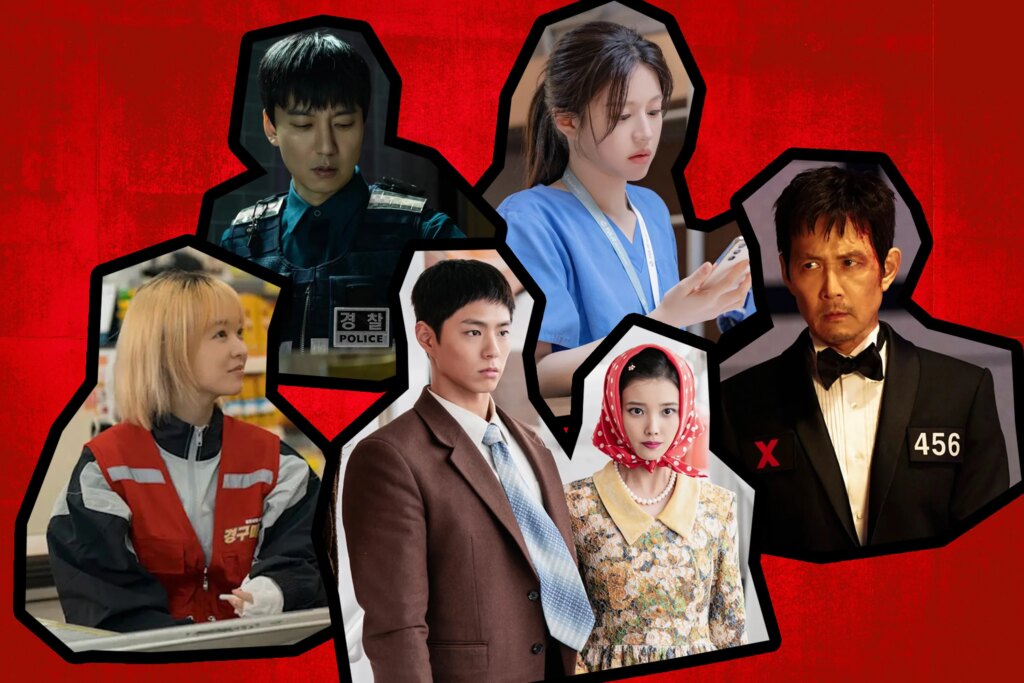
The Korean television industry continued on its trajectory of global dominance in 2025, capturing an increasing chunk of TV watchers’ interest worldwide. The export of Korean drama has a long history, but has accelerated in recent years with the investments of Netflix and other U.S.-based streamers. The shift has simultaneously made Korean dramas more accessible and weakened domestic control, impacting the shape of the stories being produced.
Netflix’s 2023 announcement that it would invest an additional $2.5 billion in Korean entertainment over the next four years has paid off, as Korean media makes up 8 to 9 percent of all Netflix watchtime since that year, the second most-watched content on the streamer after U.S.-made media. Meanwhile, Disney is doubling down on their commitment to Korean entertainment, with plans to scale Asian Pacific content into global franchises. In October, Korean media giant CJ ENM also announced a major multi-year partnership with Warner Bros. Discovery that will see the two companies co-producing Korean dramas.
[time-brightcove not-tgx=”true”]
Global growth hasn’t come without its pains. As U.S.-based streamers pump money into the Korean TV industry, domestic entertainment companies are struggling to compete. Skyrocketing production fees have led to a downturn in the number of dramas made, and an industry at a crossroads. For better in some series’ cases and worse in others, episode counts have gone down, and multi-season series have become more common. In some cases, there is a pressure to make K-dramas more attractive to foreign viewers, which could include de-prioritizing Korean-specific cultural elements or genres in favor of more “universal” ones. Amid these unprecedented shifts, Korean creatives are convening to strategize around protecting the value of their work and retain control over their IP.
In this shifting landscape, the Korean TV industry continues to make some of the world’s best TV. This year was a particularly good one for slice-of-life stories, suspense thrillers, and hospital dramas. Squid Game, one of the most-watched TV shows in modern history, released its third and final season. Korean TV explored how trust can be built, tested, and destroyed in thrillers like The Price of Confession, Nine Puzzles, and Dear X. Romance bloomed in series like Love Scout, Head Over Heels, and My Dearest Nemesis. We traveled centuries back into Korea’s past—both real and imagined—in period pieces like Bon Appetit, Your Majesty, Dear Hongrang, and The Haunted Palace. And characters settled their difference through violence in dramas like The Manipulated, Weak Hero Class 2, Mercy For None, and Trigger.
One note about selection criteria: to be in contention for this list, dramas must have completed their run in 2025. At the time of this writing, Dynamite Kiss—this year’s breakout rom-com—is ongoing. Other series still airing include Park Seo-joon romance Surely Tomorrow on Prime Video and Season 3 of popular crime drama Taxi Driver on Viki. Hyun Bin’s return to TV in period thriller Made in Korea will begin streaming on Disney+ on December 24th. All of which bodes well for a rich list this time next year. With those parameters in mind, here are the 10 best K-dramas of 2025…
10. Trigger (Netflix)
We bring ourselves to the popular culture we consume, creating distinct meaning that might not be there for other viewers watching the same thing. I imagine the experience of watching Trigger, Netflix’s K-drama about what happens when guns become easily accessible in Korea, is distinctly different for someone who lives in a country largely devoid of gun violence. In these cases, the action thriller, which follows police protagonist Lee Do (Island’s Kim Nam-gil) as he tries to keep Korean society from accepting gun violence as a norm, is more of a thought experiment than a reflection of lived reality.
As an American, however, the series takes on what is perhaps a more visceral relevance. In the way that school-set Korean zombie drama All of Us Are Dead immediately evoked images of school shootings for me, Trigger tapped into the simmering fear and anxiety that—in a country with more guns than people—any public or private space could turn into a killing field. With Trigger, writer-director Kwon Oh-seung (Midnight) has essentially made a 10-episode PSA about why gun ownership restrictions are a great idea, and Korea should continue to have them. The result is a gripping action crime drama that stays committed to its difficult theme until the very end.
9. Spirit Fingers (Viki)
Whimsical and unabashedly endearing, teen art drama Spirit Fingers blew in at the end of 2025 like glitter on the wind. The series follows Song Woo-yeon (Little Women and All of Us Are Dead’s Park Ji-hu), a timid teenager in a family of “perfect” overachievers. When Woo-yeon stumbles into the colorful world of Spirit Fingers, a sketch club that embraces passion over skill, she decides to join. Through her time with the other members, and a budding romance with self-assured heartthrob Nam Gi-jeong (Cho Jun-young), Woo-yeon slowly builds her confidence and learns to love herself.
Webtoons are a common source material for Korean dramas, but, depending on the philosophy of the adaptation, the artistic style doesn’t always remain intact in the world of the drama. Thankfully, this isn’t the case for the Spirit Fingers K-drama, which preserves much of the manhwa’s style and personality in its dynamic visual language. It also preserves the message of the source material: it’s cool to believe in yourself, even when you’re “ordinary.”
8. The Tale of Lady Ok (Kocowa)
The Glory’s Lim Ji-yeon stars in this Joseon-era drama about a female lawyer who she claims to be. Lady Ok, as we come to know her, was actually born as a slave named Goo-deok. Through a series of unexpected events, she assumes the identity of a noble named Ok Tae-yeong. After building up a career as a legal advocate who helps those in need, the secret of Lady Ok’s true identity threatens everything she has built.
One part romance-forward saeguk, one part legal drama, and one part con survival story, The Tale of Lady Ok stays gripping across 16 episodes. It is the rare historical Korean drama that doesn’t center on royalty, giving subjects like class hierarchy, gender norms, and the abuse of power more narrative room to breathe. The result is a rags-to-riches story that includes a satisfying love story but is ultimately about the resilience of one woman.
“People simply like to hear stories about poor people becoming happy,” Goo-deok tells love interest Cheon Seung-hwi (Choo Young-woo, who also starred in Trauma Code, Head Over Heels, and Mercy for None this year) in the first episode. “We imagine happy days that would never happen to us. We experience satisfaction vicariously.” It’s true, and a major reason why K-dramas have exploded in popularity around the world.
7. Study Group (Viki)
If Weak Hero Class 2—an honorable mention on this year’s list—represents the most brutal of coming-of-age action dramas, then Study Group represents the most delightful. The comedic series follows Yoon Ga-min (Alchemy of Souls’ Hwang Min-hyun), a woefully dumb high school student who happens to be good at fighting but wishes he were good at studying instead. To pursue his dream of going to college, Ga-min decides to start a study group. Unfortunately, he attends Yusung Technical High School, an institution better known for its connections to organized crime than to college.
In an action media landscape of dark, twisted dramas, Study Group refuses to take itself too seriously, cleverly subverting many of the genre’s tropes. The K-drama blends Kingsman-like fight sequences, a self-aware soundtrack, and a found family narrative for a surprisingly touching story that never loses steam for its entire 10-episode run.
6. Resident Playbook (Netflix)
While Trauma Code may have been the splashier hospital-centric K-drama in 2025, Resident Playbook was the one with the bigger heart. A spin-off of the Hospital Playlist series delayed multiple years due to a real-life medical-system crisis in Korea, Resident Playbook follows four doctors in their chaotic first year as residents in an under-staffed obstetric and gynecology department.
Alchemy of Soul’s Go Youn-jung stars as Oh Yi-young, a junior doctor who has given up on a medical career after failing to finish her first residency. She only takes the job at Yulje to pay off mounting credit card debt, and is planning to quit as soon as she is financially able. Yi-young is joined by a ragtag crew, including her high-strung high school classmate Pyo Nam-kyung (The Witch Part 2’s Shin Shi-ah), idol-turned-doctor Um Jae-il (When Life Gives You Tangerine’s Kang Yoo-seok), and socially awkward brainiac Kim Sa-bi (newcomer Han Ye-ji). Together, the four doctors navigate the ups and downs of resident life, and learn about themselves in the process.
Resident Playlist is a straightforward medical drama elevated by its execution, including its creators’ interesting choice to tie the narrative to Korea’s birthrate crisis and the expansion of its world past the series’ boundaries. Not only does the K-drama includes cameos from many beloved Hospital Playlist characters, but Jae-il’s K-pop idol past was exploited for top entertainment value when actor Kang Yoo-seok appeared on real-life Korean music show M Countdown in character with his fictional HI-BOYZ’ bandmates, TXT’s Yeon-jun and Soo-bin. Truly, an inspired choice.
5. Our Unwritten Seoul (Netflix)
“Anything you do to survive takes courage,” protagonist Mi-ji’s grandmother tells her depressed granddaughter when she struggles to leave her bed, recontextualizing her mental illness as something other than failure. This stigma-busting sentiment is at the heart of Our Unwritten Seoul’s slice-of-life story, which follows twins Mi-ji and Mi-ri—both played by Melo Movie’s Park Bo-young—as they find hope again in spite of life’s hardships.
Most stories have a catalyzing incident, and Our Unwritten Seoul’s comes when underachieving and underemployed 30-something Mi-ji discovers her identical twin sister, overachieving office worker Mi-ri, is distressed enough to try to hurt herself. Desperate to help, Mi-ji proposes a good old-fashioned twin swap. What follows is the chance for both sisters to live a life without the specific expectations of identity that have been placed on them from an early age. In a breakout performance, Park Jin-young also features as Lee Ho-su, a lawyer who has had a crush on Mi-ji since their high school years together.
Our Unwritten Seoul embeds its depiction of difficult issues—including learning to live with disability, workplace harassment, and moving past grief—into a compelling web of interpersonal relationships. The diversity of both the characters and setting, as Mi-ri and Mi-ji move between Seoul and their rural hometown, imbues a universality to these thematic depictions that is as inclusive as it is moving.
4. Tempest (Hulu)
Romance has been at the heart of the Korean dramas’ rise to global power. This year, political thriller Tempest had some of the best chemistry on screen, in a mature love story led by Jun Ji-hyun (Il Mare, My Love From the Star) and Gang Dong-won (Broker, Uprising). Jun stars as Seo Mun-ju, a former diplomat whose husband is murdered on the presidential campaign trail. When Mun-ju’s determination to get to the truth behind the assassination puts her own life in danger, mysterious bodyguard San-ho (Gang) steps in to protect her.
While Tempest sometimes gets bogged down in overly convoluted political machination, when the twists work, they really work, pulling Mun-ju, San-ho, and the viewer deeper into a shadowy, multi-national conspiracy. The series is the rare K-drama that attempts to engage with modern geopolitical tensions, painting a more critical, realistic depiction of the United States government than is usually seen in mainstream Korean storytelling. The show brings in recognizable American actors to star alongside iconic K-drama stars, includingJohn Cho, who has a key role as Deputy Secretary of State Anderson Miller.
Many of this year’s most exciting K-dramas lost the plot in their final episodes. While Tempest doesn’t quite stick the landing when it comes to its big political plot, the series never loses sight of the epic romance at its center, making it one of the year’s most enjoyable and enterprising TV watches.
3. Squid Game Season 3 (Netflix)
The end of Squid Game, or at least the conclusion of the franchise’s foundation in Seong Gi-hun’s (Lee Jung-jae) story, held no gut punches. Though the climax was partially hindered by the splitting of what really felt like one story between two seasons, Season 3 continued to deliver on creator Hwang Dong-hyuks’s original promise: to depict the desperation of life under modern capitalism.
Season 3’s Gi-hun may no longer be the everyman he was when viewers first met him in 2021, but his life is still far closer to most viewers’ than the “V.I.P.” characters’ who represent the world’s real-life billionaire class. If some of the K-dramas on this list offer a much needed escape from the brutalities of our lived dystopia, Squid Game refused to shy away from capitalism’s most despicable conclusions. That it offered us any hope in the process felt more like a gift than a guarantee.
2. Way Back Love (Viki)
Kim Min-ha, a relative newbie on the K-drama circuit, had a breakout, Blue Dragon-winning year, starring in both Way Back Love and Typhoon Family. In the former, she plays 24-year-old art student Jeong Hee-wan, who has struggled to move on with her life since the abrupt and tragic death of first love Kim Ram-woo (Love Untangled’s Gong Myung) four years prior. When Ram-woo shows up at her door as the Grim Reaper, telling Hee-wan she will die in one week, Hee-wan reluctantly agrees to seven days of bucket-list activities that Ram-woo has secretly designed to restore Hee-wan’s will to live.
Adapted from a webtoon, Way Back Love has a deceptively difficult premise to get right. There’s a danger of either shying away from the depth of Hee-wan’s grief or falling too completely into it. But, in the deft hands of It’s Okay!director Kim Hye-young (who directed alongside Choi Ha-na), the drama strikes an emotionally devastating balance. Across six episodes, we move between flashbacks of Hee-wan and Ram-woo’s lighthearted high school days to learn how their romantic friendship formed, and the present-day to understand how the trauma of losing Ram-woo has made Hee-wan reluctant to leave her apartment and suffering from panic attacks whenever she hears an ambulance.
The series is moored by the performance of Kim Min-ha, who is believable both as mischievous teen Hee-wan, and deeply depressed young adult Hee-wan. The best stories see their protagonists’ changed by the end, and Way Back Love is incredibly focused and detailed in its depiction of Hee-wan’s inch-by-inch journey from someone who has no will to live to someone who begins to believe healing is possible. This is K-drama at its cathartic, healing best.
1. When Life Gives You Tangerines (Netflix)
When director Kim Won-suk presented When Life Gives You Tangerines to journalists gathered at a pre-release press conference, he said: “This series is a tribute to past generations of our fathers and mothers, and it’s also an anthem of encouragement for the daughters and sons who will now navigate the world ahead. We were hoping that the story will help break down the invisible barriers between generations, genders, and just people in general..” Even backed by an all-star cast that included IU, Park Bo-gum, Moon So-ri, Park Hae-joon, and Yeom Hye-ran, and one of the biggest production budgets in K-drama history, these still felt like grand ambitions. Somehow, When Life Gives You Tangerines managed to pull it off.
The sweeping generational drama follows characters across four “seasons” of their lives, from the 1960s to today. Ostensibly, the series follows the life of Ae-sun (played by IU and Moon So-ri in different decades of the character’s life) as she goes from poor kid on Jeju Island to slightly less poor adult with a husband and children. But Ae-sun isn’t in it alone. First, she has her mom, a haenyeo diver who endures a hard life for the slim chance her children’s will be easier. She has her childhood friend and later husband, Gwan-sik (Park Bo-gum and Park Hae-joon), a softhearted stoic who will do anything for his family. And she has a tapestry of humanity around her made up of ordinary, diverse people who mostly care, even when they have their own suffering to endure.
In recent years, K-dramas have become more ambitious when it comes to genre. From superhero series like Moving to fate-defying romances like Lovely Runner, this had led to some of the decade’s best storytelling. However, this year’s best K-drama—and one of the year’s best TV series, full stop—told a beautiful, deeply engaging story using only the stuff real life is made of. Anyone can make the fantastical seem extraordinary. But to make the ordinary feel extraordinary without losing any of its complexity or texture? What a rare and precious feat.
***
Honorable mentions: Weak Hero Class 2, Bon Appetit, Your Majesty, Mercy For None, Love Scout, Dear Hongrang, You and Everything Else, Trauma Code: Heroes on Call, The Price of Confession, Nine Puzzles, Melo Movie, Our Movie, As You Stood By, The Manipulated, The Dream Life of Mr. Kim, The Defects, When the Phone Rings, Dear X
The post The 10 Best K-Dramas of 2025 appeared first on TIME.