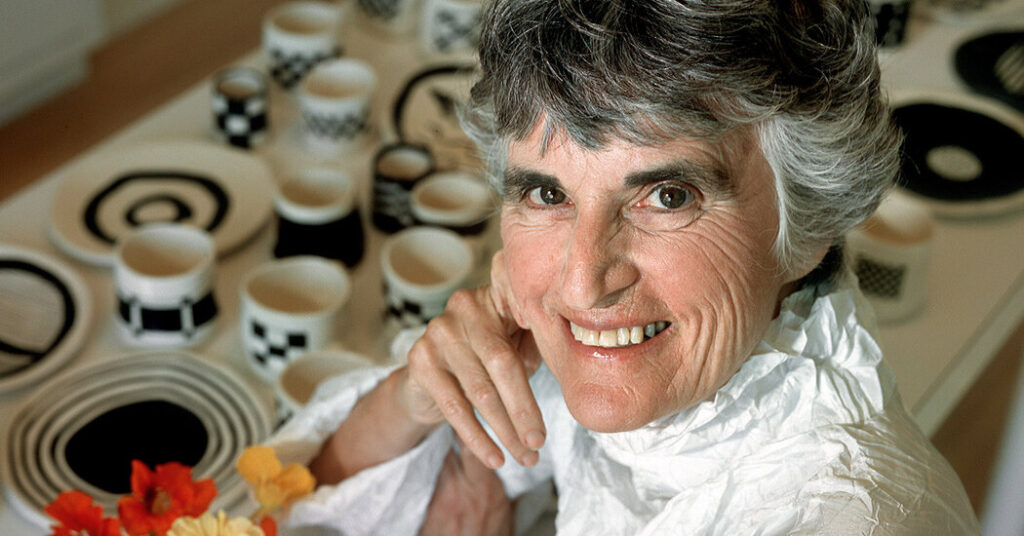
Sue Bender was juggling a hectic life in the 1980s as a family therapist, a ceramist and a wife and mother of two sons in Berkeley, Calif. She had graduate degrees from Harvard and the University of California.
“I valued accomplishments,” she wrote. “I valued being special. I valued results.”
Then, in an art gallery, she came across traditional Amish dolls without faces, and in their stripped-down, personality-effacing forms she felt a powerful challenge to her way of life.
She resolved to go and live among the Amish, and, after much effort, found farm families willing to take her in over two summers.
In Ms. Bender’s 1989 book, “Plain and Simple: A Woman’s Journey to the Amish,” she recounted how she learned from her hosts to recognize the beauty in the everyday, the peace that comes from slowing down and the dignity of ordinary work. The book became a best seller and one of the go-to texts of an anti-materialist movement of the 1990s known as voluntary simplicity.
“Satisfaction,” Ms. Bender wrote, “comes from giving up wishing I was somewhere else or doing something else.”
Ms. Bender died on Aug. 3 at an assisted living facility in Oakland, Calif. She was 91.
Her son Michael Bender said her death, which was not widely reported at the time, was caused by an acute pulmonary collapse.
Writing “Plain and Simple,” a slim book of 153 pages with airy breaks between passages, took Ms. Bender five years, and initial reviews were not all positive.
In The San Francisco Chronicle, William Rodarmor wrote, “I don’t doubt Bender’s sincerity, but her revelations are thin stuff in a thin book.”
The New York Times Book Review, however, noted that Ms. Bender “has written an account of a quest that leaves her content and, magically, has the same effect on the reader.”
Gradually, “Plain and Simple” found its audience. In 1992, three years after its initial publication, it made it onto the New York Times paperback best-seller list, alongside such titles as “Iron John” by Robert Bly, which inspired the men’s movement, and “The Road Less Traveled” by M. Scott Peck, a psychiatrist’s prescription for fulfillment through discipline and humility.
It was a decade of movements powered by middle-class Americans who sought to reduce consumption, after a recession in the early 1990s led to waves of white-collar corporate layoffs. People built tiny houses to escape mortgages; they took the “100 Thing Challenge” to pare down their possessions; and they embraced voluntary simplicity, an aspect of the American character at least as old as Henry David Thoreau’s 1840s sojourn at Walden Pond.
During Ms. Bender’s summers with the Amish, she lived with two families, in Iowa and Ohio, who were part of a sect that rejected modern conveniences. She joined a quilting bee, baked bread, canned peas and mowed the lawn.
She wrestled with the tension between being a woman who hated housework and defined herself by her artwork and professional achievements, and her desire to internalize the Amish sense of identity that came from community, godliness and manual labor.
In the immaculate kitchen of her Iowa hosts, hand-washing dishes was an exercise in mindfulness rather than a chore.
“Every step was done with care,” she wrote. “The women moved through the day unhurried. There was no rushing to finish so they could get on to the ‘important things.’ For them it was all important.”
She had hoped that living among the Amish would change her, but found it was not easy to integrate their values into her world. Back home in Berkeley, she conscripted a friend to bake bread, but the experiment in “homey pursuits” fell apart after a single day.
“Everyone was too busy,” she wrote. “I was now a misfit.”
Marjorie Sue Rosenfeld was born on Aug. 4, 1933, in the Bronx, to Murray and Sophie (Rosenzweig) Rosenfeld. Her father was a fabric cutter in a garment factory, and her mother worked as a camp counselor during summers.
After receiving her bachelor’s degree from Simmons College (now Simmons University) in Boston in the mid-1950s, she earned a master’s degree from the Harvard School of Education. She taught history at New Rochelle High School, in New Rochelle, N.Y., before her children were born.
In 1956, she married Richard Bender, a civil engineer and architect. A minimalist glass-and-wood house that he designed and built for the family in East Hampton, N.Y., was featured in 1964 in The New York Times, which noted that he kept its cost low — $11,000 — by building most of the furniture himself.
In the late 1960s, the family moved west after Mr. Bender was hired to teach at the University of California, Berkeley, where he eventually became dean of the College of Environmental Design. He died in 2022.
Ms. Bender pursued a career as a ceramic artist, showing in galleries in New York and California. She returned to school when she was 40, earned a master’s degree in social work from Berkeley and opened a private practice. With other women questioning their roles in society and their careers, she founded a discussion group called CHOICE: The Institute of the Middle Years to facilitate conversations between women about how to balance multiple identities.
She wrote two follow-ups to her first book: “Everyday Sacred” (1995), a journal of lessons from various teachers, including a cappuccino maker and a Zen monk, and “Stretching Lessons” (2001), about spiritual growth.
Besides her son Michael, she is survived by another son, David.
Ms. Bender’s early ceramics were nonfunctional; she made what she called “precious objects” intended to be shown in a gallery or displayed in a home. She thought of herself, she wrote, as “an artist with a capital A.”
But after she returned from Amish country, where women made handsome quilts and dolls but did not consider themselves artists, Ms. Bender’s work changed.
“Now, for the first time,” she wrote, “I began to make practical ceramics that our family could use every day” — dishes, bowls, plates.
It was one way she found to bring what she had learned from the Amish into the life she had hoped in vain to shed.
Trip Gabriel is a Times reporter on the Obituaries desk.
The post Sue Bender, Who Wrote About Living With the Amish, Dies at 91 appeared first on New York Times.