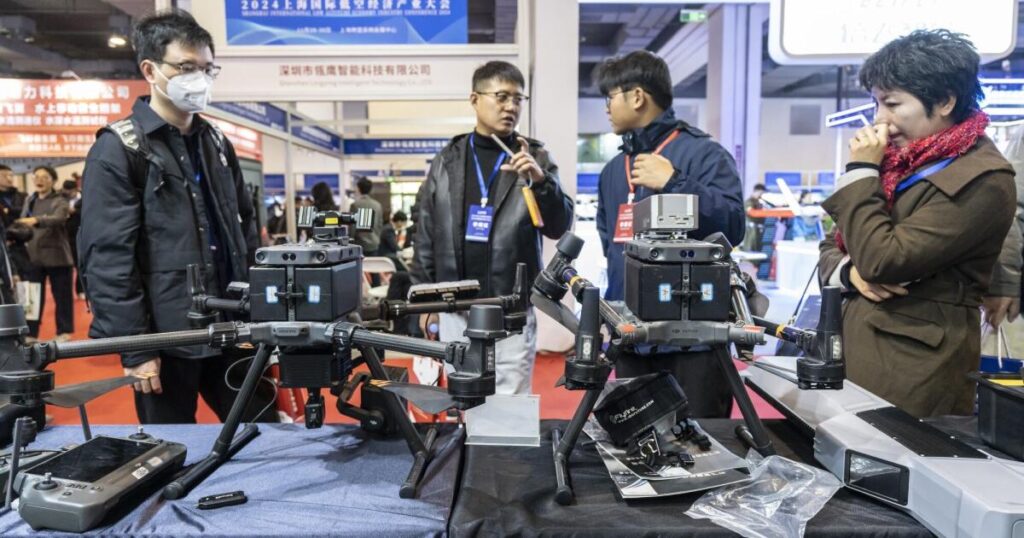
President Donald Trump’s administration faces a Tuesday deadline for declaring whether Chinese drone maker DJI Technologies poses a national security threat, a decision with the potential to ground thousands of machines deployed by police and fire departments across the U.S.
The president already signed an executive order in June targeting “foreign control or exploitation” of America’s drone supply chain. That came after Congress mandated a review to determine whether DJI deserves inclusion in a federal register of companies believed to endanger national security.
If DJI doesn’t get a clean bill of health for Christmas, it could join Huawei Technologies Co. Ltd. and ZTE Corp. on that Federal Communications Commission list. The designation would give the Trump administration authority to prevent new domestic sales or even impose a flight ban, affecting public agencies from New York to North Dakota to Nevada.
“People do not realize the security issue with these drones, the amount of information that’s being funneled back to China on a daily basis,” said Mike Nathe, a North Dakota Republican state representative at the forefront of a nationwide campaign sounding alarms about the Made-in-China aircraft.
The fight over the security of America’s airspace pits cash-strapped police departments against a growing number of state and federal lawmakers vying to disrupt what they say is Beijing’s deep reach into the US, a debate that includes fears about the theft of technology and the dominance of space. The White House’s Tuesday deadline is speeding into view as Republican politicians ratchet up anti-China rhetoric during Trump’s campaign to reset global trade.
Nathe, a retired mortician, sponsored legislation this year to enable North Dakota state agencies to replace more than 300 DJI drones — used to surveil oil fields, nuclear-weapons facilities and the border with Canada — with aircraft made in the U.S. or allied nations.
“More states need to do this,” he said.
In addition to complicating Trump’s trade negotiations with China, a national ban would strain local police and fire departments that fly DJI drones.
The fleet used by public safety agencies nationwide exceeds about 25,000 aircraft, said Chris Fink, founder of Unmanned Vehicle Technologies LLC, a Fayetteville, Arkansas-based firm that advises law-enforcement clients.
The overwhelming majority of those drones — called uncrewed aerial vehicles, or UAVs, in industry parlance — comes from China, said Jon Beal, president of the Law Enforcement Drone Association, a training and advocacy group that counts DJI and some U.S. competitors as corporate sponsors.
Big cities across the country operate DJI’s products. The New York Police Department had 40 DJI drones, about 40% of its fleet, according to a 2024 city report.
DJI accounts for nearly half of Kansas City, Missouri’s 18-drone police fleet, a spokesperson said. The city of El Paso, Texas, has about two dozen of DJI’s automated hangars for its drones, and officials from the police department and other public-safety agencies participated in a promotional video for the company.
Operators favor Shenzhen-based DJI’s advanced technology, user-friendly design and low prices. The sheriff’s department in North Dakota’s Burleigh County, home to Bismarck, has five DJI drones to use at traffic accidents and in search-and-rescue operations, said Jim Hulm, the major in charge of the team.
“The DJI stuff has treated us very well,” he said. “It’s been quality for us.”
DJI doesn’t share US-collected data with the Chinese government, the company said, and in October it appealed a federal district court ruling upholding its designation as a Chinese military company.
“DJI was extremely disappointed that state lawmakers passed harmful bills that will irreparably undermine public safety and hurt small businesses, farmers, and researchers, while wasting millions in tax dollars with no added security benefits,” Adam Welsh, head of global policy, said in an emailed statement.
The company wants an extension on the security review, saying Tuesday is too soon to make a conclusion.
Currently, at least half a dozen states have targeted DJI and other Chinese-manufactured drones, including restrictions in Arkansas, Mississippi and Tennessee. A Nevada law prohibiting public agencies from using Chinese drones took effect in January.
Florida allocated $25 million in 2023 to help replace Chinese vehicles.
Legislators also took up the cause in Connecticut, which passed a law this year preventing public offices from using Chinese drones. Supporters said they’re worried about these eyes in the skies being used for spying.
“We’re kind of sitting ducks,” said Bob Duff, the Democratic majority leader in the state senate who promoted the legislation. “They are designed to infiltrate systems even when the users don’t think that they will.”
The backlash is creating opportunities for existing U.S. drone makers such as Silicon Valley-based Skydio Inc. and Brinc Drones Inc. from Seattle. Newcomers are also poised to benefit from greater investor interest, said Dawn Zoldi, chief executive officer of P3 Tech Consulting LLC, which advises on UAVs and other emerging technologies.
“They know this is a market,” she said.
For now, though, public safety officials say it’s difficult to find domestic alternatives that match DJI in price and performance.
Mark Gentile, deputy fire chief in the small Connecticut town of Rocky Hill, depends on five DJI drones to survey burning buildings and help his crews determine a course of action.
“I can use a DJI drone to stand off almost a quarter-mile away and still see what I need to see,” Gentile said. U.S.-made drones still lag behind DJI’s camera technology, he said.
“They’re really useless to us when it comes to actually firefighting,” he said.
In North Dakota, Hulm is thinking about downsizing, given the chances that the Trump administration acts this month or state lawmakers decide to enact broader restrictions in the future.
However, domestically made drones are “at least double and triple the price out of the gate,” and that may force the county to reduce its fleet to just a pair. Even so, drone operators will have to accept the short-term challenges and adapt, North Dakota lawmaker Nathe said.
“The sacrifice is a small price to pay to make sure that we’re not hurting our security within the state and within the country,” he said.
Einhorn and Versprille write for Bloomberg.
The post Security concerns mount as police departments face potential ban on Chinese-made drones appeared first on Los Angeles Times.