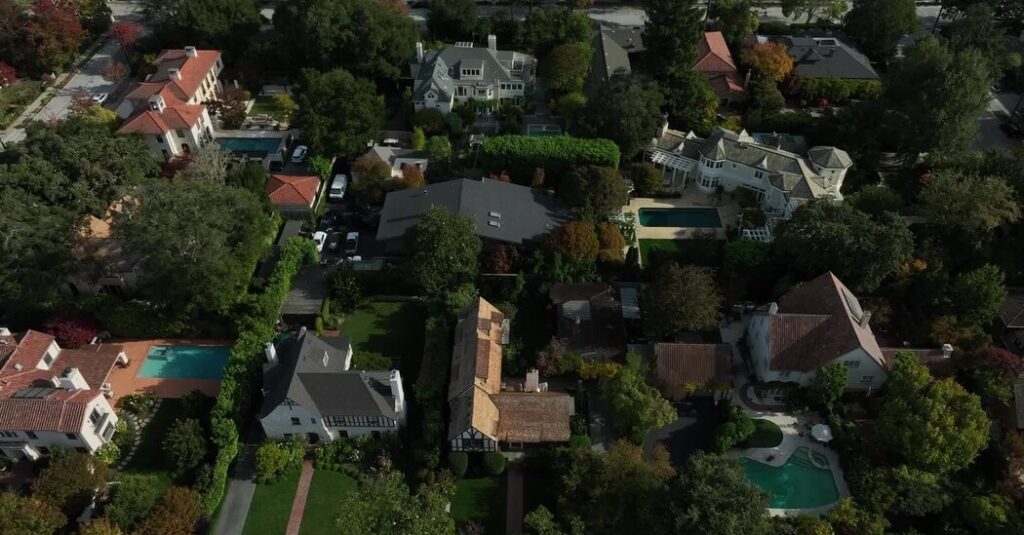
Life might soon become a little more difficult for billionaires in Palo Alto.
Known as the birthplace of Silicon Valley, the town used to house just your average well-to-do people. Doctors, lawyers, executives and Stanford University professors lived in comfortable bungalows on tree-lined streets, and one house per family was considered enough.
Then the tech boom created tremendous wealth, and the billionaires moved in. Some bought several homes on adjacent plots and left a few empty, or turned them into office spaces for their employees. Some hired security guards to shoo people away from public sidewalks. Construction work seemed endless.
Greer Stone, a Palo Alto councilman, has had enough.
He plans to introduce legislation on Thursday that would restrict the way the town’s wealthiest homeowners can operate. To Mr. Stone, a high school teacher, it is as much about protecting residents from neighborhood chaos as it is about addressing the wealth disparity that has forced middle-class residents out of his city.
Mr. Stone says his legislation would aim to stop billionaires from taking over the streets with construction equipment and delivery trucks. Demolition, rebuilding and remodeling cannot continue in perpetuity. No more leaving spare homes permanently empty, and no more unmarked security vehicles.
“To see other people take housing out of the housing stock in such a flippant way is frustrating,” Mr. Stone said in an interview. “The growing discrepancy between the top 1 percent and the rest of us has never been more clear.”
Mr. Stone had heard neighborhood complaints for years, but he sought to address the situation in earnest after The New York Times in August published two articles on the ruckus caused by Mark Zuckerberg’s Palo Alto compound. Mr. Zuckerberg, the Facebook founder, is worth an estimated $226 billion, and has spent more than $110 million on 11 homes in the city’s Crescent Park neighborhood, offering double or triple what the homes were worth to buy out his neighbors.
High rows of hedges encircle his compound, hiding lush gardens, a pool that can be covered by a movable floor and his guest homes. Mr. Zuckerberg also operated a private school for his children and their wealthy friends that was not allowed under city code, but the program relocated after the report by The Times.
Brian Baker, a spokesman for Mr. Zuckerberg and his wife, Priscilla Chan, said, “Their home improvements have been thoroughly reviewed and approved by the appropriate city agencies, including the Palo Alto Building and Planning Departments, and they will continue to follow applicable laws.”
Palo Alto’s Compound Fracture
Other tech billionaires have similarly bought up numerous homes within the same neighborhood, some using them for office space and personal use, others to build compounds.
Laurene Powell Jobs, the philanthropist and businesswoman, who is worth around $12 billion, still owns the home in Old Palo Alto that she shared with her husband, Steve Jobs, the Apple co-founder who died of pancreatic cancer in 2011. She also has other homes on adjacent blocks.
On a recent afternoon, two men barreled out of one of the homes moments after a reporter and photographer appeared on the sidewalk outside her main residence. One of the men declined to give his name and wore no identification. He said that people who appear to be paparazzi were not wanted and were irritating to residents.
A spokeswoman for Ms. Powell Jobs declined to comment on the interaction or the proposed legislation.
About two blocks away, Larry Page, the co-founder of Google who is estimated to be worth $246 billion, is associated with limited liability companies that own several homes. He and his wife, Lucinda Southworth, live there, but are rarely seen, neighbors said.
In 2021, an electrical fire tore through one of the homes associated with Mr. Page. Inspectors found multiple washing machines in the garage, all of which had cloths used for cleaning inside, and a dozen more laundry machines stacked in the back, according to a city report.
Neighbors saw maids, nannies and other workers filing in and out of the house daily, and security staffing was a constant presence outside, Palo Alto Online wrote at the time. Two new homes are being built where the burned one stood, according to the city permitting system.
Requests for comment from Mr. Page, sent to Google officials and the head of his family office, were not acknowledged.
Marissa Mayer, the former chief executive of Yahoo! who is worth an estimated $1.3 billion, purchased and demolished three town homes in Palo Alto and built a swimming pool and accessory dwelling unit in their place. She is seeking to knock down a fourth town home in order to build a 4,600 square foot home with a “grand hall,” elevator and large basement, according to plans filed with the city.
In 2013, she purchased a mortuary just down the street for $11.2 million, and sought to turn it into a private women’s club. The plan did not advance after neighbors fought the proposal.
The exterior of part of the mortuary features honey bears painted by the San Francisco street artist fnnch. “The city is aware of occasional events hosted there, which is permitted with a special events permit,” Meghan Horrigan-Taylor, a spokeswoman for the city of Palo Alto, wrote in an email.
Ms. Mayer did not respond to a request for comment.
Local housing crisis
Mr. Stone said the mortuary is just one example of property owned by wealthy people that could be put to better use in a region with a severe housing shortage and affordability crisis, calling it “perfect for multifamily housing.”
Unlike Bay Area hillside communities, where compounds have been the norm, Palo Alto has long had denser neighborhoods with single-family homes, condos and a walkable downtown. Replacing several homes with compounds has changed the character of the city and reduced the number of units available for those working nearby.
Homes in Palo Alto have become incredibly expensive, with the median sales price hovering between $3.5 and $4 million and homes often purchased in cash, well beyond the reach of even the upper-middle-class. While the ultrarich have swelled the city coffers over time, they have also forced more and more workers out of the area.
Mr. Stone said that he and his wife, who is also a high school teacher, struggled to afford the $2,600 monthly rent on their aging, one-bedroom apartment. Keith Reckdahl, a councilman cosponsoring the legislation with Mr. Stone, said he stretched to buy a home 30 years ago, as an engineer with Lockheed Martin. He said, with a laugh, that he thought at the time he was buying at the top of the market.
Kirsten Flynn, an interior designer, said she missed the days when Palo Alto was a true college town, featuring thrift shops, artists, musicians playing in the lobby of independent movie houses and a raft of cool bookstores, dive bars and cheap restaurants.
“All the ‘groovies’ are fleeing Palo Alto. If they do something groovy, they’re gone,” she said. “It’s heartbreaking. This is my hometown, and it will not be the hometown for any future generations of my family.”
The proposed legislation would apply to people who buy three or more homes within a radius of 500 feet, roughly the length of a city block. Any construction project expected to last more than 180 days would need a detailed daily schedule of construction work to prove it can be conducted without double-parking vehicles or blocking driveways or bike lanes.
After finishing one construction project, homeowners would need to wait three years to begin another unless a major emergency occurred. Homes could not be vacant for more than six months in any given year.
The proposal relies on neighbors for enforcement, leaving it up to another homeowner or tenant living within 500 feet to file a lawsuit.
The proposal would place new restrictions on private security guards across Palo Alto, not just those serving wealthy homeowners. All security vehicles would have to be marked and permitted by the city. Security guards would have to identify themselves to the public when asked. They would be prohibited from harassing or intimidating passers-by on public property.
Christopher Elmendorf, a law professor at the University of California, Davis, who specializes in property law, said the proposals are “really unusual” for a city to take up.
“But the problem of having many people worth more than $10 billion in your city is also unusual, right?” he said.
He said he thinks that all of the components would pass legal muster, with the possible exception of the requirement that vacant homes be inhabited. An “empty homes tax,” approved by San Francisco voters in 2022, was struck down by a Superior Court judge, but is being appealed by the city.
The full Palo Alto City Council is likely to take up Mr. Stone’s proposal in January or February. Mr. Stone said he is confident that a majority of the seven-member council, which has taken a keen interest in housing affordability, would support the general framework but could send it to a committee or city staff member for refinement. It could take six months or longer to reach a final vote, he said.
Michael Kieschnick, whose home is bound on three sides by Mr. Zuckerberg’s properties, supports some of the restrictions, particularly those on private security. But he said it was unrealistic to put enforcement in the hands of neighbors.
“It’s the city’s obligation to enforce the law, and it shouldn’t try and pass it off to neighbors,” he said. “Who would sue Mark Zuckerberg?”
Mr. Stone said that he wanted to make sure he heard from wealthy residents as well as from their neighbors. On Sept. 5, he and Priscilla Chan sat for an hour outside Blue Bottle Coffee in downtown Palo Alto. She understood why her neighbors were frustrated and was open to his ideas, he said.
Ms. Chan owns at least 11 homes in Palo Alto. Mr. Stone said he never expected to be in a position to purchase one.
“We win the lottery, great,” he said. “But short of that, I see no chance.”
Georgia Gee and Kirsten Noyes contributed research.
Heather Knight is a reporter in San Francisco, leading The Times’s coverage of the Bay Area and Northern California.
The post Palo Alto Confronts Billionaires Over Their Housing Compounds appeared first on New York Times.