Congressional Republicans won big election victories in 2010 riding the Tea Party revolt against President Barack Obama’s Affordable Care Act. But the health care issue has inflicted considerable political pain on them ever since, and is threatening to do so again in 2026 with their control of the House and Senate on the line.
Deep Republican struggles on national health policy were starkly evident on Capitol Hill in recent days as a handful of Republicans in both chambers broke with their party to join Democratic efforts to extend pandemic-era health insurance subsidies set to expire at the end of the year.
Their defections were not enough to save the subsidies, which Republican majorities in both chambers refused to preserve. But they did reflect major divisions in the G.O.P., which has repeatedly failed to produce a realistic and workable alternative to the A.C.A., also known as Obamacare. And they pushed the fight over health care costs into the midterm election year, putting Republicans under intense pressure to deliver in a difficult political environment on a subject that has proved among their greatest vulnerabilities.
“Other than world peace, honest to God, health care is the toughest issue ever,” said Representative Jeff Van Drew, Republican of New Jersey. “It is really hard, but I think it behooves us to come up with something.”
That something has proved extremely elusive after the backlash to the new law and promises of repeal put Republicans in control of the House in 2010 while cutting substantially into what had been a commanding Democratic majority in the Senate.
Since Senator John McCain, the Arizona Republican, famously turned his thumb down in the early morning of July 28, 2017, on his party’s plan to repeal the health law, the G.O.P. has been on the defensive over what their party’s answer is for health care if not the A.C.A.
The situation has created a frustrating predicament for Republicans, who note that many members of both parties agree that the federal health care system has become unwieldy and unaffordable since the passage of Obamacare — which broadened access to health coverage and required insurers to cover preexisting conditions — yet have been unable to agree on how to fix it.
“We worked on repealing and replacing Obamacare back in 2017,” Speaker Mike Johnson told reporters in October. “I still have P.T.S.D. from the experience.”
After Mr. McCain scuttled Republicans’ bid to scrap the health law, Democrats stormed back to the House majority in 2018 as they focused on the threat to the A.C.A. and the possibility that people with pre-existing medical conditions could lose coverage under the G.O.P.
“Health care was on the ballot, and health care won,” Representative Nancy Pelosi, returning to the speakership, declared in summing up the Democratic victory.
Then in 2020, deep anxiety over the pandemic and the handling of it by President Trump, combined with voter unease about Republicans and health care, helped put Joseph R. Biden Jr. in the White House and produced a Senate Democratic majority, handing the party unified government control.
Trump Administration: Live Updates
Updated
- Trump and his loyalists move to name the Kennedy Center for him.
- Trump signs an executive order that eases restrictions on marijuana.
- Democratic lawmakers are asking an inspector general to review Howard Lutnick’s possible conflicts.
The constant refrain from Mr. Trump that a Republican alternative to the health law was just around the corner became a punchline as one never materialized. That was the case again in recent months, when the president repeatedly said he would come up with something better than Obamacare. He then contemplated endorsing an extension of the subsidies, but ultimately declined to weigh in with any proposal, leaving Republicans in Congress rudderless.
“The truth is, Republicans have always said they have a plan, but they never had a plan,” Representative Jim McGovern of Massachusetts, the senior Democrat on the Rules Committee, said on Wednesday.
As Democrats pounded them on the health care subsidies in recent days and they toiled to come up with something their members could vote for, House and Senate Republicans did produce proposals. Both featured recycled G.O.P. ideas on health savings accounts and cutting red tape around prescriptions among other elements. The Senate plan hit a stalemate while the House bill passed narrowly on a party-line vote, with no immediate path forward. Neither did anything about the expiring subsidies.
Republicans assail the A.C.A. as fraud-ridden and fiscally unsustainable — labeling it the “Unaffordable Care Act” as illustrated by the fact that Americans need costly subsidies just to be able to purchase coverage on the government exchanges. They constantly note that no Republican ever backed the A.C.A., which was muscled through exclusively with Democratic votes, and that Democrats themselves scheduled the subsidies to expire, creating the current crisis.
“Republicans hate Obamacare like the devil hates holy water,” Senator Richard J. Durbin of Illinois, the No. 2 Senate Democrat, observed in summing up the Republican view of the health law.
While saying they favor more market-based solutions, Republicans also concede that they have had a very difficult time coming together on a health care plan.
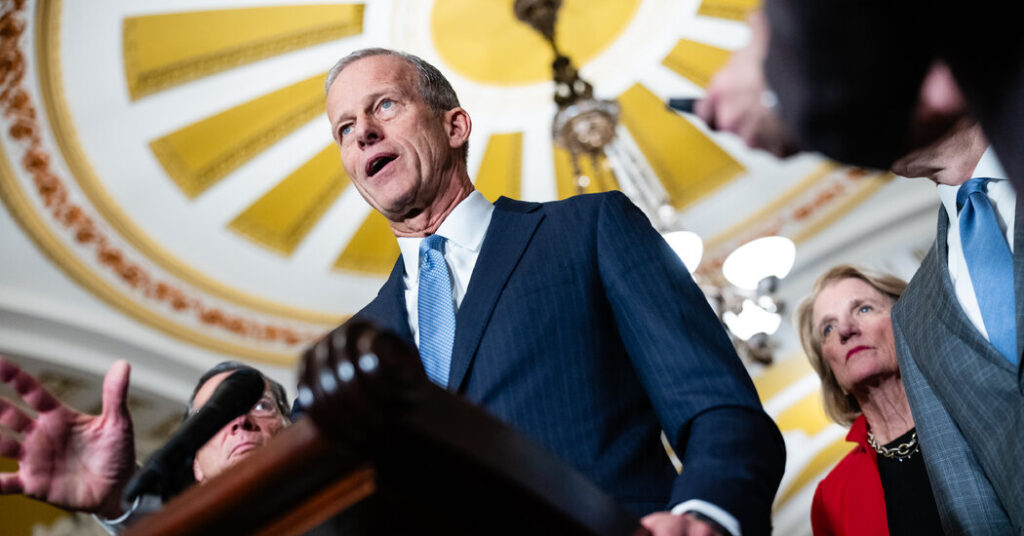
“It’s a complicated issue, no doubt about it, a lot of moving parts and we have very different visions about what health care ought to look like,” Senator John Thune, Republican of South Dakota and the majority leader, said this week.
It was the longstanding political weakness of Republicans on health care that motivated the Democratic leaders Representative Hakeem Jeffries and Senator Chuck Schumer, both of New York, to make the expiring tax subsidies the issue at the center of the government shutdown. Democrats believe the Republican flailing of recent days showed that their risky approach was the right one, positioning the G.O.P. to get the blame for spiking premium costs.
“When it comes to health care, the damage has been done,” Mr. Schumer said. “Americans will know when health care dies, it was the Republicans who did it.”
In the Senate, a large bipartisan group of senators that met this week to try to find some common ground on health care policy and a way forward in January emerged with some optimism.
“At the end of the day, what the American people need to understand, despite maybe some of the headlines, is that there are people working in here with good intentions to actually solve problems,” Senator Bernie Moreno, Republican of Ohio and one of the organizers of the bipartisan group, said.
The decision on Wednesday by four House Republicans to cross party lines and clinch a Democratic discharge petition to force a vote on a three-year extension of the health care subsidies means the issue will confront Congress early next year.
Mr. Johnson has promised extensive debate on Republican health care alternatives, a potentially dangerous move in an election year given his party’s political exposure on the issue.
“Republicans are the ones who will fix health care,” Mr. Johnson said in an interview on CNBC as he accused Democrats of mainly trying to gin up a campaign issue.
“They don’t want a solution to this,” he said.
Carl Hulse is the chief Washington correspondent for The Times, primarily writing about Congress and national political races and issues. He has nearly four decades of experience reporting in the nation’s capital.
The post Once Again, Health Care Proves to Be a Bitter Political Pill for G.O.P. appeared first on New York Times.