The Nigerian government has begun cataloging the health and environmental damage caused by factories that shipped recycled lead to the United States for use in car batteries.
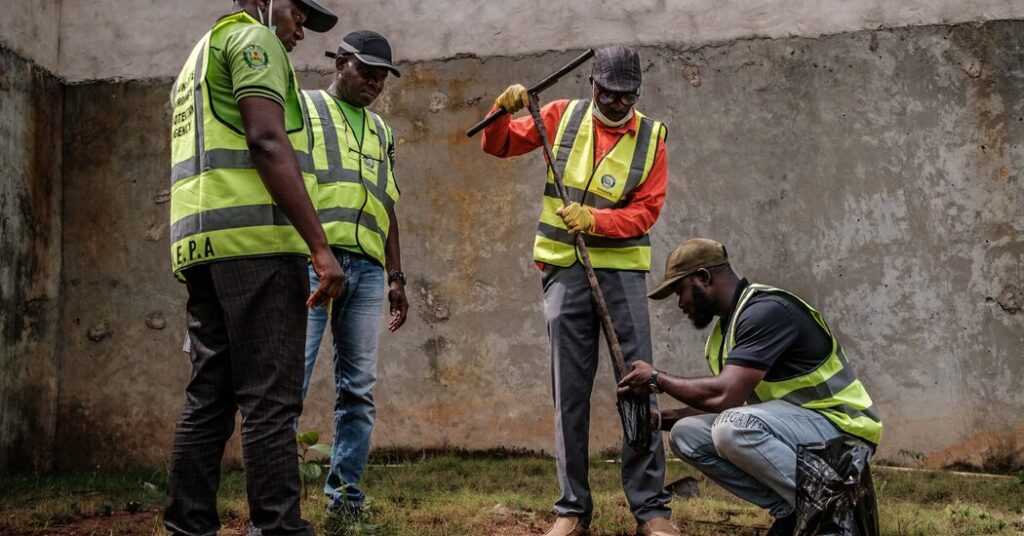
A team of scientists arrived Tuesday in the industrial town of Ogijo, Nigeria, outside Lagos, to test the soil and air for lead. Officials have shut down recycling factories in the area and are making plans to conduct blood tests on about 500 people who live nearby.
Public health experts in Nigeria described the response as one of the most aggressive campaigns to alleviate lead poisoning in the country’s history.
The government action followed the publication of an investigation by The New York Times and The Examination, which revealed a public health catastrophe linked to batteries made for the world’s largest automakers.
Lead is an essential element in car batteries, and most of it now comes from recycling old batteries. The auto industry has portrayed this as an infinitely sustainable, green process. But as the United States tightened regulations to protect Americans from lead poisoning, companies began looking for new suppliers abroad.
That led them to towns like Ogijo, which has become the heartland of lead recycling in Africa. Blood tests commissioned by The Times and The Examination found that about 70 percent of volunteers had lead poisoning. Half the children had lead in their bodies at levels associated with permanent brain damage.
While the extent of the pollution and the ecological damage remain unknown, local officials are already talking in broad terms about compensating people who live nearby. Some families say that they’ve been encouraged to move but cannot afford to do so.
“There must be consequences for action or inactions,” said Ola Oresanya, the regional environmental commissioner, who is leading the local response
The auto industry has known for decades that international lead recycling factories were spewing toxic smoke into the air. A major battery manufacturer blocked an effort to address the problem, while car companies repeatedly declined to sign onto inspection and certification programs.
The shutdown of Ogijo’s recycling plants could prove so costly for those companies that they finally invest in cleaner technology and better working conditions, said Andreas Manhart, a senior researcher at the Oeko-Institut, a research institution in Germany that promotes safe recycling practices.
“The pressure will increase standards over time,” Mr. Manhart said. “The Nigerian market is just too attractive to abandon.”
Representatives of two factories in Ogijo have denied wrongdoing. Others have not responded to requests for comment.
In announcing the shutdown of the plants, the Nigerian authorities cited a widely shared New York Times video that profiled an 11-year-old boy named Freeman Ominyi, who had more than five times as much lead in his blood as the World Health Organization’s threshold for lead poisoning. His father said Freeman suffers from headaches, stomach aches and body pains, which are common symptoms of lead poisoning.
The video and articles sparked debate across local radio and television and on social media. The Nigerian Senate voted to request that the country’s emergency management agency help pay for people near the factories to move away. Lawmakers proposed creating a task force to trace lead exports and coordinate the cleanup and medical responses.
“Children are dying slowly,” said Senator Mukhail Adetokunbo Abiru. “Families have lived for years under poisonous smoke and dust.”
In response to the Times and The Examination’s findings, East Penn Manufacturing, one of the world’s largest battery makers, said it stopped buying lead from Nigeria. But experts say that without industry standards or regulations, metal buyers will continue to pivot from one unsafe recycler to the next.
One solution is for the auto industry to support an independent certification program for lead suppliers, said Mikey Jarrell, a researcher at the University of California, San Diego who studies the recycling industry.
“Make the definitive list: ‘Here are the good ones,’” Mr. Jarrell said. “And if you are not on the list, you are bad, you’re poisoning children, and nobody should buy from you.”
The auto industry has resisted programs like that for decades. Most carmakers declined to comment on the findings, the cleanup in Nigeria or their views on a certification program. Most carmakers said they rely on their suppliers to abide by the law and sustainable sourcing policies, though lead isn’t generally among the metals and minerals that get special attention.
Ford is “in touch with all suppliers who use lead to ensure compliance” with its social and environmental standards, according to a statement from a spokeswoman, Ursula Muller.
The Nigerian government has made — and broken — promises before to clean up the battery recycling industry. Still, some residents of Ogijo said the government’s response left them optimistic. Residents watched on Tuesday as scientists in reflective jackets used augers to extract soil samples.
“It gives me hope that real change is possible,” said David Owulo, who worked at True Metals, one of the largest of the shuttered plants. “The fact that they keep coming back tells me that something will change.”
Modinat Balogun, who lives near True Metals, said she hoped that the authorities will follow through. “We hope the government will match their words with action.”
Others said that, after being profiled in the article, they have been shunned by their neighbors, who blame them for closing one of the few steady sources of income in the community.
Nigeria produces so much lead that the industry cannot easily shift production to other countries, Mr. Manhart said. But records show that new suppliers of recycled lead are entering the supply chain.
Ivory Coast, another West African nation, began exporting lead this year to the Port of Baltimore, the leading hub for lead shipments arriving on the East Coast, U.S. trade data shows.
Koutoua Thomas d’Aquin Gnamessou, an official at the Ivorian environment ministry, said he worried that the industry will move from Nigeria to Ivory Coast. To prevent that, he said he wants to ban lead exports.
“Many people are unaware of the true nature of lead,” Mr. Gnamessou said. “They don’t understand the danger.”
Tunde Eludini contributed reporting from Ogijo, Nigeria.
Peter S. Goodman is a reporter who covers the global economy. He writes about the intersection of economics and geopolitics, with particular emphasis on the consequences for people and their lives and livelihoods.
The post Nigeria Closes Factories Linked to U.S. Auto Industry Amid Poisoning Inquiry appeared first on New York Times.