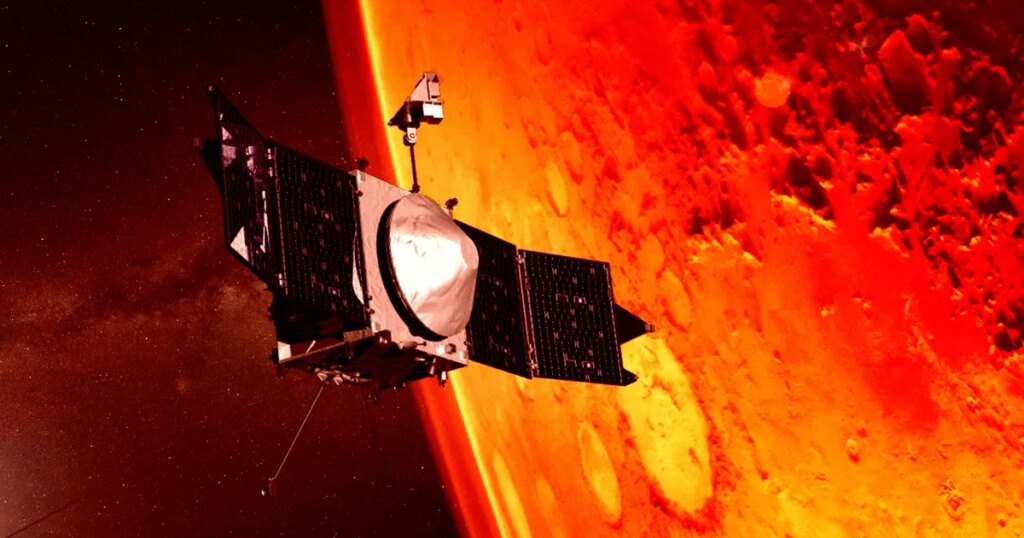
Last week, NASA revealed that it had lost the signal from its MAVEN (Mars Atmosphere and Volatile EvolutioN) spacecraft, one of just seven Earthly probes currently orbiting Mars.
The agency failed to reestablish contact with the spacecraft and hasn’t received any signs of life since December 4, according to its latest update. Worse yet, MAVEN appeared to be “rotating in an unexpected manner when it emerged from behind Mars,” which could make future attempts to regain control far more difficult.
“The team continues to analyze tracking data to understand the most likely scenarios leading to the loss of signal,” NASA wrote. “Efforts to reestablish contact with MAVEN also continue.”
It’s an unfortunate development for a probe that has allowed NASA to keep in touch with its rovers currently tracking across the Martian landscape. It has also provided invaluable data about the Red Planet’s upper atmosphere and how Sun particles interact with it, key research that could shed light on how the planet became the hostile, barren wasteland it is today.
Technically, MAVEN is “still alive and transmitting on the low-gain antenna!” as Germany’s arm of the amateur radio operators organization AMSAT wrote in a Wednesday update on X. “Signal is weak on our 20-meter dish Sternwarte Bochum, but MAVEN is currently in command lock with [Deep Space Network] in Madrid.”
“Fingers crossed that they will be able to fully recover the spacecraft,” the organization added.
Now that its signal has been lost, the NASA is “working to mitigate the effect of the MAVEN anomaly on surface operations for NASA’s Perseverance and Curiosity rovers.”
Fortunately, there’s backup. MAVEN is one of four orbiters that can relay communications to support the agency’s operations on the planet’s surface.
“NASA’s Mars Reconnaissance Orbiter, Mars Odyssey, and ESA’s (European Space Agency’s) ExoMars Trace Gas Orbiter all remain operational,” the agency’s update reads.
As a result of MAVEN going dark, the agency has arranged to receive “additional passes from the remaining orbiters,” and the rover teams have “adjusted their daily planning activities to continue their science missions.”
It’s not the first time MAVEN has gone dark. In 2022, scientists were forced to put the spacecraft into safe mode after key orientation sensors “began exhibiting anomalous behavior,” per NASA — but that time, they were able to recover the spacecraft after just under three months.
More on MAVEN: A NASA Spacecraft Orbiting Mars Just Mysteriously Went Offline
The post NASA’s Mars Spacecraft Spinning Helplessly After Signal Lost appeared first on Futurism.