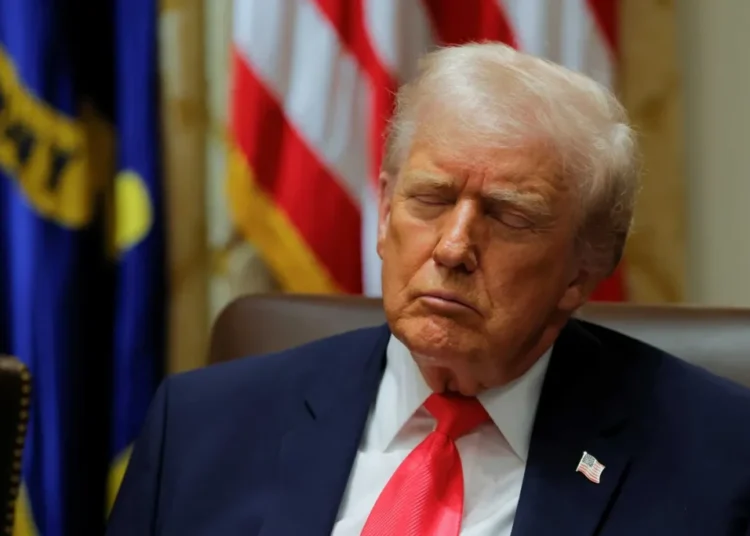
Since President Trump returned to office, White House officials have disparaged the New York City subway as crime-ridden and lawless — grounds, they said, for withholding federal funding from state transportation projects.
On Thursday, Gov. Kathy Hochul of New York gave a pointed rebuttal: The year 2025, she said, has been one of the safest years on the subway so far this century.
Excluding two years during the peak of the pandemic when ridership cratered, major crime on the subway is at its lowest level since 2009, and the system is on pace to have its second lowest crime rate since the 1990s, according to the governor’s office. Major crimes include rape, murder, robbery and felony assault.
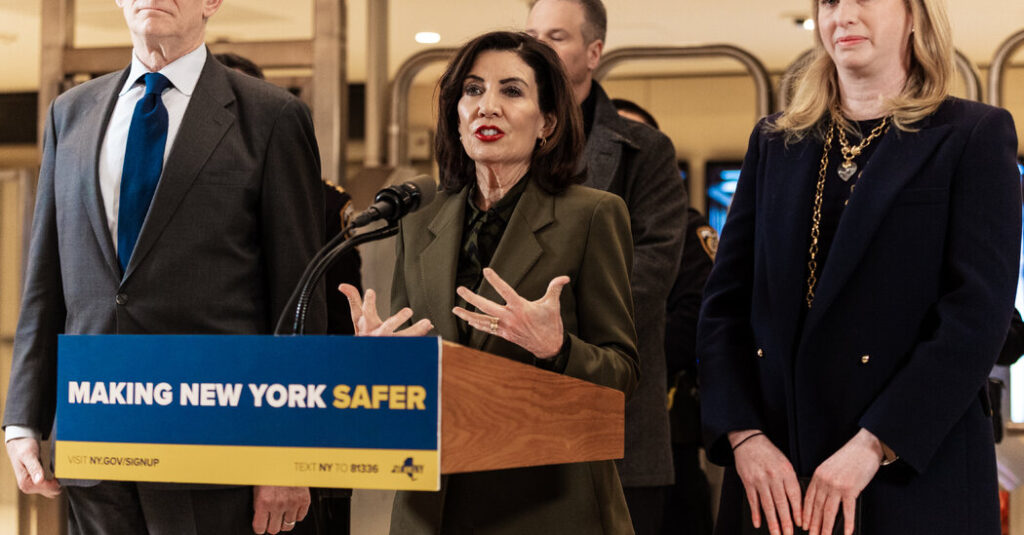
“They were wrong then, and they are wrong now,” Ms. Hochul said of her critics in Washington during a news conference. She added, “We’d appreciate if the administration would just deal in reality.”
Ms. Hochul credited a range of efforts for the decline in crime, including state funding for additional police officers on subway platforms and trains. The governor delivered her remarks in Grand Central Terminal, flanked by Police Commissioner Jessica Tisch and Janno Lieber, the head of the Metropolitan Transportation Authority, the state agency that operates the subway.
To keep crime down and put riders at ease, Ms. Hochul announced that the state would provide $77 million for more police officers on subway platforms and trains. That is in addition to the $77 million she committed at the start of the year to augment policing.
Other moves have included the installation of brighter LED lights in every station — a project expected to be completed by the end of the year — and the addition of thousands of surveillance cameras across the system and of teams of clinicians who seek out people with mental health issues.
The M.T.A. has also installed platform edge barriers at 115 of the system’s 472 stations to help prevent riders from falling or being pushed onto the tracks.
The governor acknowledged that while serious crimes on the subway are rare, reports of assaults remain higher than before the pandemic, and several alarming attacks have put many New Yorkers on edge.
Earlier this month, a 45-year-old man was stabbed in the back at the Union Square station after a dispute with another rider. Last December, Debrina Kawam, who was sleeping on a Brooklyn train, was set on fire by a stranger and died from her injuries.
Such incidents, violent and seemingly random, have come to define a shift that started in 2023, when felony assaults in the subway outnumbered robberies for the first time in nearly two decades.
Vital City, a civic think tank that analyzes police data, projects that there could be 576 reported felony assaults in the subway by the end of the year, an increase of more than 50 percent over 2019, before the pandemic. Felony assaults this year were expected to be slightly lower than in 2024, when 581 were reported.
“This is a very serious crime that destabilizes and worries people a lot,” Josh Greenman, the managing editor of the organization, said about the surge.
Part of the rise reflects a growing number of attacks on police officers in the subway, which are categorized as felonies, the M.T.A. has said.
Still, the risk for passengers remains low. There were 1.65 major crimes reported per million riders in 2025, a decrease of roughly 30 percent from 2021, according to the governor’s office. Compared with 2019, major crime in the transit system is down 14.4 percent, the office said. About 2 percent of all crime in New York City occurs in the subway.
The reduction in crime comes as ridership is climbing. More than 4.65 million passengers took the subway on Thursday, Dec. 11, the most in a day since the pandemic. Last week, ridership was less than 10 percent below the same period in 2019, according to the M.T.A.
For months, Sean Duffy, the U.S. transportation secretary, has derided the subway as dangerous. In March, he suggested that the White House would withhold federal funding if crime rates did not improve.
When asked for comment on the latest figures, Nathaniel Sizemore, a spokesman for the Transportation Department, said crime, especially assault, remained a major problem in the subway.
“Secretary Duffy shouldn’t have to threaten to withhold tens of millions of dollars from New York State to get Kathy Hochul to care about the safety of commuters,” he said in a statement.
Ms. Hochul, a Democrat, must now prepare to work with the incoming mayor, Zohran Mamdani, on a strategy for subway safety that could differ from the current administration’s.
On Thursday, the City Council was expected to introduce a bill to create a new civilian-led agency that would deploy mental health teams instead of police officers to respond to some 911 calls, an idea Mr. Mamdani has pushed for.
Asked about the legislation, Ms. Hochul praised the work of Commissioner Tisch, who will also serve under the new mayor, but declined to give an assessment of Mr. Mamdani’s proposal.
“We’re having conversations,” she said.
Maia Coleman contributed reporting.
Stefanos Chen is a Times reporter covering New York City’s transit system.
The post N.Y.C. Subway Crime Is Down, Hochul Says, Rebutting Trump Officials appeared first on New York Times.