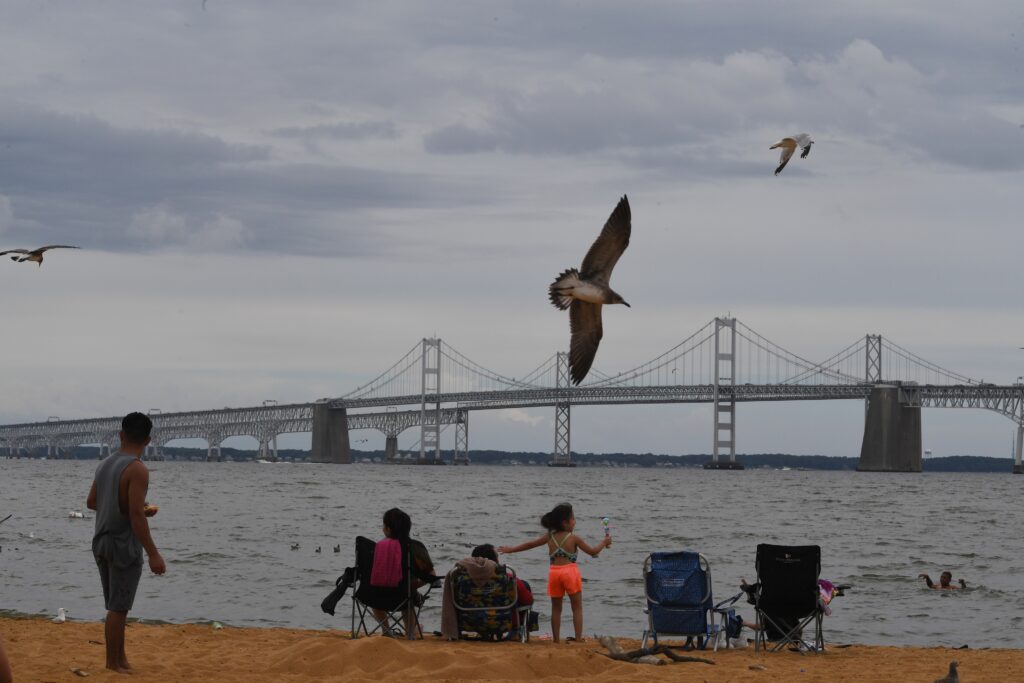
Plans to knock down the 73-year-old Chesapeake Bay Bridge and replace it with one that has close to twice as many lanes won state approval on Thursday, putting a project in the works since 2016 closer to reality but at double the initially estimated cost.
The Maryland Transportation Authority Board, which includes state officials and citizen members, voted unanimously for the proposal Thursday morning.
The bigger bridge would be “a smoother travel experience for those who drive over the bridge and the Marylanders who live by it,” Samantha J. Biddle, the acting director of the Maryland Department of Transportation, said in a statement. The Bay Bridge famously has no shoulders; some people are so scared of crossing it that they pay other drivers to take them. The new one would have shoulders, along with four lanes of traffic in each direction instead of two plus a reversible lane.
It will also be high enough to accommodate the biggest cargo ships, in line with plans for the new Francis Scott Key Bridge. After the Key Bridge was destroyed by a container ship collision, the National Highway Traffic Safety Administration identified the Bay Bridge as needing an assessment of its vulnerability to a similar disaster.
The Transportation Authority (MDTA) previously estimated a cost of about $7.3 billion to $8.4 billion; now it is projecting the cost would be $14.8 billion to $16.4 billion. MDTA planning director Melissa Williams said in an interview that the original estimates were “extremely early numbers” used mostly to compare options. The decision to raise the height of the bridge was a significant factor driving up the cost, she said.
The cost estimate for the Key Bridge rebuild has also doubled since last year; Gov. Wes Moore (D) said “national economic conditions have deteriorated and material costs have increased” since the state’s initial estimates.
The updated Bay Bridge estimate is also very preliminary, Williams noted; design of the new bridge has yet to begin. Construction is not likely to start before 2032.
Roads that feed into the bridge would be widened to six lanes. The plan includes the possibility of running buses on the road shoulder and improving nearby park-and-ride facilities. Officials said they would also consider adding a bicycle and pedestrian path on the bridge, which would add a little over $1 billion to the cost.
Williams said the option chosen was the least expensive and had the lowest environmental impact of the bridge replacement proposals, because it hews closely to the existing bridge. Construction would be done in segments to minimize the impact.
Current tolls on the bridge start at $1.40 for commuters; Williams said officials said considered a congestion pricing or higher tolled express lanes but is currently planning to keep the same structures.
“It’s a very busy roadway,” Williams said. “In order to get people to shift and drive at different times of the day, tolls would need to be quite, quite high. And that’s not what we’re looking to do. We’re looking keep the state of Maryland moving and keep vehicles moving.”
The bridge carries roughly 80,000 vehicles a day and more in the summer, as people travel to beaches on the Delmarva Peninsula.
Movement toward expanding the crossing that connects the Eastern Shore to the rest of the state has been in the works since Republican Larry Hogan became governor a decade ago. Although federal law required studying alternatives, including a new bridge farther away or a “no-build” plan focused on transit, Hogan said from the start that adding to the existing bridge was “the only serious way forward.”
The Federal Highway Administration still has to approve the proposal, and it must go through an environmental review process that includes public feedback. The Chesapeake Bay Foundation said in a letter to public officials that this proposal is better than some other options studied that would have cut through undeveloped marshland. But, the foundation said, any widening of the bridge “will result in indirect impacts to the environment, from increased nutrient loading in Eastern Shore streams due to growing wastewater volumes to increased greenhouse gas emissions from commuter vehicles.”
The post Maryland set to nearly double the size of the Chesapeake Bay Bridge appeared first on Washington Post.